

Fighting escalates along Lebanese border as Hezbollah threatens to strike anywhere in Israel

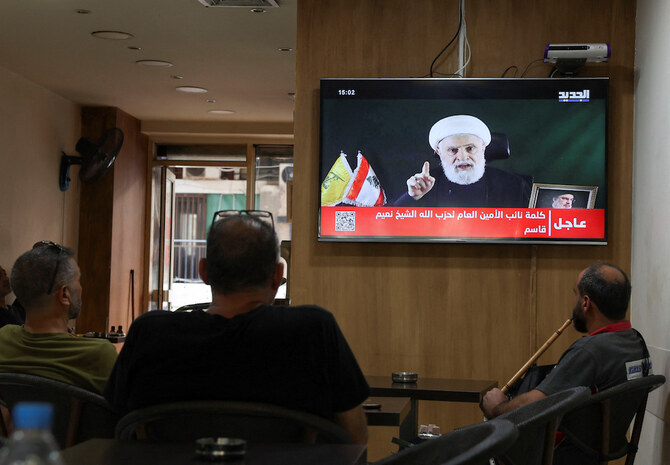
Above, people watch Hezbollah deputy leader Sheikh Naim Qassem delivering a televised address as they sit in a cafe in Beirut on Oct. 15, 2024. (Reuters)
Short Url
Updated 15 October 2024
Follow

Fighting escalates along Lebanese border as Hezbollah threatens to strike anywhere in Israel

  • As tensions continued to escalate, calls by Lebanese politicians for a ceasefire grew
  • Israel stepped up airstrikes on numerous towns in southern Lebanon, the Bekaa Valley

BEIRUT: Clashes between the Israeli army and Hezbollah intensified on Tuesday as an Israeli infantry unit advanced on the outskirts of the border town of Rab El-Thalathine.

At the same time, Israel stepped up its airstrikes on numerous towns in southern Lebanon and the Bekaa Valley, resulting in mass casualties.

As tensions continued to escalate, calls by Lebanese politicians for a ceasefire grew and they urged the government to deploy army forces in the border region.

In a televised speech, however, Hezbollah’s deputy secretary-general, Sheikh Naim Qassem said “the party (Hezbollah) is strong and united.” Pictured alongside a Lebanese flag and the Hezbollah banner, he warned that “since the enemy has targeted all of Lebanon, we have the right, from a defensive standpoint, to target any point within the Israeli entity.”

He added: “The solution lies in a ceasefire. Following the ceasefire … the settlers will return to the north. However, as long as the conflict persists, the number of uninhabited settlements will increase, placing hundreds of thousands, potentially more than 2 million, at risk.”

Fouad Siniora, a former prime minister of Lebanon, called for “an immediate cessation of hostilities to halt the bloodshed … as well as a complete adherence to the constitution.”

The Kataeb Party called upon “the speaker of the parliament and the prime minister to urgently seek a definitive and unambiguous position from Hezbollah concerning the immediate acceptance of a ceasefire.”

Meanwhile, fighting continues. Hezbollah said its members “engaged in combat with the Israeli forces that infiltrated into the area of Rab El-Thalathine using automatic weapons and missiles, and the clashes are ongoing.”

Fighting also resumed in the border town of Aita Al-Shaab. The Israeli army has tried to cross the Blue Line and enter Lebanese territory in several places. The extent to which incursions have been successful remains unclear, other than video footage released by the Israeli army.

Meanwhile, more than 20 people were killed or injured when an airstrike hit a residential building in the town of Riyaq in Bekaa. Elsewhere, Mohammed Hassan Mashourab, an employee of internet provider Ogero, his wife Ghida Farhat and their children, Raine and Ali, were killed when an airstrike hit their house in the town of Jarjou, in Iqlim Al-Tuffah region.

Israel also targeted Qilya in Western Bekaa with a series of airstrikes, killing three paramedics from Hezbollah’s Islamic Health Organization. Similar attacks targeted Hosh Al-Sayyid Ali in Hermel, and the border area of Jarmash, near the border with Syria.

Parts of Baalbek in the vicinity of its Roman castle were also hit by airstrikes at dawn, described by residents as “the most violent of all times.” Neighboring Al-Murtada Hospital was severely damaged and forced to close.

Israeli forces said they “eliminated Khader Al-Abed, who was in charge of the area north of the Litani River with Hezbollah’s aerial unit.” Hezbollah did not immediately confirm this.

Israeli reconnaissance planes entered Lebanese airspace over Beirut and its suburbs and thermal balloons were deployed over the capital.

Army forces targeted a residential building in Ayto, a town in the Zgharta district of northern Lebanon and the death toll among civilians there rose to 23 on Tuesday, including women, children and the elderly, some of whom were reportedly “blown to pieces.”

Avichai Adraee, a spokesperson for the Israeli military, again warned residents of southern Lebanon on Tuesday “not to return to their villages in the south or to their olive groves.”

In a joint statement, the World Food Programme and UNICEF said “the humanitarian needs of displaced people in Lebanon are increasing. We need to mobilize efforts to provide additional funding to enable a scaled-up response.” A ceasefire is urgently required, they added.

According to the latest daily report issued by the Lebanese government, 200 Israeli airstrikes were recorded in the past 48 hours, bringing the total number of attacks on Lebanon since the start of hostilities just over a year ago to 9,866. The reported death toll stands at 2,309, with 10,782 people injured and 188,146 displaced and living in more than 1,000 shelters, the majority of them in Beirut and Mount Lebanon.

Lebanese citizens have received calls from Israeli authorities ordering them to evacuate their homes and other buildings in specific streets in many Lebanese regions because Hezbollah militants are sheltering in them, which has caused panic among residents.

Some of these calls, described as “psychological warfare,” were reported in Christian areas, including Sin El-Fil, Ballouneh and Hadath, causing chaos among residents and displaced people who thought they were in safe areas.


What do the leaked Assad videos tell us about the deposed Syrian regime?

Updated 10 December 2025
Follow

What do the leaked Assad videos tell us about the deposed Syrian regime?

  • Videos obtained by Al-Arabiya and Al-Hadath channels expose former president Bashar Assad’s inner circle, revealing toxic culture
  • Regional media coverage regard leaks as confirmation of critiques of Assad’s contempt for Syrians, cynicism toward allies

LONDON: The recent leak by Al-Arabiya of a series of videos allegedly showing Bashar Assad in candid, closed-door conversations has reopened longstanding questions about how his former regime functioned — and perhaps why Syria descended into such a devastating conflict.

Assad is shown in the Al-Arabiya leaks, prior to his Dec. 8, 2024, ouster, making contemptuous remarks about Syrians, Syria itself, Eastern Ghouta and even Russian President Vladimir Putin, while speaking privately with his late adviser Luna Al-Shibl.

While the new Syrian government of Ahmad Al-Sharaa has not verified the footage, analysts say the material is consistent with the behavior patterns of Assad’s inner circle: personalized decision-making, narrative obsession and a deep-rooted siege mentality.

Assad is shown in the Al-Arabiya leaks, prior to his Dec. 8, 2024, ouster, making contemptuous remarks about Syrians and Syria itself. (AFP)

“These videos don’t actually tell Syrians anything new — they merely reveal, with complete clarity, what people have known and lived through for decades,” Ibrahim Hamidi, editor-in-chief of Al-Majalla, who is himself from Syria, told Arab News.

“What stands out to me is the indifference and contempt he shows toward everything: his people, his cities, his allies, and the sense that power is an inheritance, not a responsibility.”

In one clip, when Al-Shibl asks him what he feels about the state of Syria, Assad says he does not only feel ashamed but “disgusted,” adding that this is “our country,” conveying revulsion rather than responsibility.

In another segment he says that when Syrians look him in the face he “loves them” yet is also “disgusted by them,” exposing a deeply cynical view of his own population.

He is also shown mocking ordinary Syrians for their spending priorities, saying they spend money on mosques even though they “cannot afford food.”

Several clips are from a tour of Eastern Ghouta and its surroundings, during or after the area’s reconquest in 2018. Assad is heard cursing Ghouta, directed at an area that had endured years of siege and bombardment.

“It showed that Assad is a weak dictator,” said Ghassan Ibrahim, a Syria expert and founder of the Global Arab Network. “He tried to present himself as a strong personality, but all these videos showed how easy it was to be manipulated by his assistant, his media officer.”

In another clip, Assad appears to mock the Russian president’s appearance, despite Moscow having been his main war-time ally.

When Al-Shibl draws his attention to how “puffy” Putin looks, Assad responds that it is “all procedures” or “all surgeries,” suggesting extensive cosmetic work.

The tone in these exchanges is casual and derisive, portraying Assad as privately belittling Putin’s looks while publicly thanking him. (AFP/File)

The tone in these exchanges is casual and derisive, portraying Assad as privately belittling Putin’s looks while publicly thanking him.

“Such remarks reflect Assad’s deep-rooted duplicity,” said Egyptian writer and political expert Hani Nasira. “The same man who publicly deferred to Putin — whose military intervention preserved Assad’s rule and offered him refuge — privately mocked him.

“These comments will likely erode whatever sympathy Putin may still have for the former Syrian leader and underscore Assad’s penchant for betrayal, even toward those who offered him sanctuary.”

Hamidi concurs: “The question now is: How will Putin respond? Especially since Bashar lives in Moscow — and Putin does not easily forgive any insult.”

The videos also capture Assad and Al-Shibl speaking dismissively about Hezbollah and pro-regime commanders.

Regional media coverage framed the Assad leaks as confirmation of long-held critiques of his contempt for Syrians and cynicism toward allies, with tone varying by outlet but broadly harsh.

Pan-Arab platforms like The New Arab and Asharq Al-Awsat foregrounded Assad’s insults toward Ghouta, Syrians and the army, highlighting his disgust at Syria, and mockery of soldiers as emblematic of an entrenched disdain for his own population.

Gulf-based media stressed his ridicule of loyalist figures and allies, using the leaks to underline his perceived disloyalty to those who fought for him and to question his past narratives of steadfastness and resistance.

Several clips are from a tour of Eastern Ghouta and its surroundings, during or after the area’s reconquest in 2018. Assad is heard cursing Ghouta, directed at an area that had endured years of siege and bombardment. (Supplied)

Syrian opposition-aligned and exile media amplified the footage as further evidence of his moral and political bankruptcy rather than a revelation, stressing that the content matched years of lived experience under his rule.

A recurring feature in the leaked clips is Assad’s habit of issuing direct orders to intelligence chiefs, senior officers and advisers, bypassing ministries and formal structures.

The informal tone — part off-the-record briefing, part reprimand — underscores the extent to which the Syrian state under Assad revolved around personal allegiance.

Assad postured publicly as a defender of the Syrian state but has since been unmasked as someone who harbors deep disdain for all around him.

In private, he mocks his loyal fighters, sneers at those who kiss his hand, and speaks of them with derision — as if unable to feel genuine empathy for their sacrifices.

“This is a man who views Syria through the lens of masters and servants, rulers and ruled,” said Nasira.

“To Assad, those who fought for him — in Syria and abroad — are nothing more than an annoyance. Speaking casually and comfortably to Al-Shibl, he reveals a condescending view of the nation, his people, and even his inner circle.”

The leaked videos stripped away the official image and exposed the toxic culture of a ruling circle that never viewed Syrians as citizens with rights but “as subjects expected to endure anything,” Hamidi said.

Assad postured publicly as a defender of the Syrian state but has since been unmasked as someone who harbors deep disdain for all around him. (AFP)

“For years, they endured hardships believing Assad was steady, serious, and above chaos. What hurts them now is seeing a completely different personality: careless, mocking, and seemingly dismissive of people’s suffering.

“This shakes the narrative they built in their minds to justify their loyalty. And when that narrative cracks, everything else becomes harder to defend.”

The footage also shows Assad fixating on media coverage, urging officials to safeguard the regime’s messaging and chastising those who, in his view, allowed “contradictory signals” to emerge.

His language mirrors longstanding regime strategy: project strength, deny missteps and attribute all instability to external interference.

Another pattern evident throughout the clips is Assad’s repeated framing of Syria’s crises as part of a coordinated foreign plot. Whether discussing political dissent, economic collapse or battlefield challenges, the theme of encirclement dominates.

The leaked comments reveal that “for Bashar Assad, there was never a true cause or message — just a regime to preserve, and a throne to protect,” Nasira said.

Despite the performative confidence, the videos reveal moments of frustration, especially when Assad chastises advisers for mismanaging situations or warns of rivalries within the security services.

The timing of the leaks is notable. Regional governments have reopened channels with Damascus, diplomatic rehabilitation is creeping forward, and the question of Syria’s postwar reconstruction looms large.

Assad is also shown mocking ordinary Syrians for their spending priorities. (AFP)

“Released on the anniversary of what pro-regime media called “Liberation Day” — marking the collapse of Assad’s rule — the timing could not have been more symbolic,” said Nasira.

For Syrians, the footage is less revelation than validation — an affirmation of what many lived through: a state defined not by institutions but by coercion, suspicion and the whims of an inner circle.

“Most Syrians no longer care about Bashar himself; they care about Syria’s future. They want to look forward, not backward,” said Hamidi.

For international observers, the videos offer one of the clearest windows yet into the operating logic of a regime that has survived sanctions, war, isolation and internal collapse.