

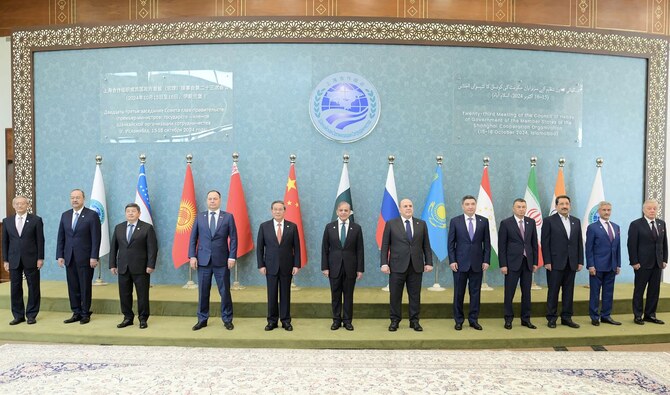

ISLAMABAD: A China-led 10-state regional group criticized what it called protectionist trade measures on Wednesday, part of an intensifying standoff between Beijing and Western countries over tariffs on Chinese products.
The Shanghai Cooperation Organization (SCO), a Eurasian security and political group, also hit out at “unilateral sanctions” as member states Iran and Russia face curbs on trade.
The criticism came in a joint statement, following a heads of government meeting of the SCO in Islamabad, signed by 10 countries, including China, Russia, Iran, India and host Pakistan.
The statement said that the 10 member states, represented by seven prime ministers, “consider it important to continue joint efforts to counter protectionist trade measures that are contrary to WTO rules.”
The United States and Canada have increased tariffs on Chinese products such as electric vehicles, aluminum and steel, and the European Union is set to follow suit. Beijing has termed the moves discriminatory, and responded with similar actions as the standoff intensifies.
The SCO also said that “unilateral application of sanctions” is against international law and has an impact on third countries.
Russia and Iran, both members of the SCO, face sanctions from the West. Both possess some of the world’s largest energy resources.
Sanctions have meant that smaller countries have shied away from trade with the two, even as larger more influential economies, such as China and India, continue to purchase energy from them.
Energy-starved Pakistan does not import gas or fuel from neighboring Iran despite its cost-effectiveness, and a gas pipeline between the two has stalled due to Islamabad fearing US sanctions.
’EXPAND BRI’
Earlier at the meeting, Pakistan’s Prime Minister Shehbaz Sharif called for the expansion of China’s Belt and Road Initiative (BRI).
“Flagship projects like the Belt and Road Initiative of President Xi Jinping ... should be expanded focusing on developing road, rail and digital infrastructure that enhances integration and cooperation across our region,” Sharif said in his speech as the chair of the meeting.
The BRI is a $1 trillion plan for global infrastructure and energy networks that China launched a decade ago to connect Asia with Africa and Europe through land and maritime routes.
More than 150 countries, including Russia, have signed up to participate in it.
Beijing’s rivals see the BRI as a tool for China to spread its geopolitical and economic influence.
Western countries, under the G7 platform, last year announced a $600 billion rival connectivity infrastructure development plan.
The China-Pakistan Economic Corridor (CPEC) is a part of the BRI and has seen Beijing pump in billions of dollars into the South Asian country for road networks, a strategic port and an airport.


