In veiled dig at West, China-led SCO calls for countering protectionist policies, sanctions

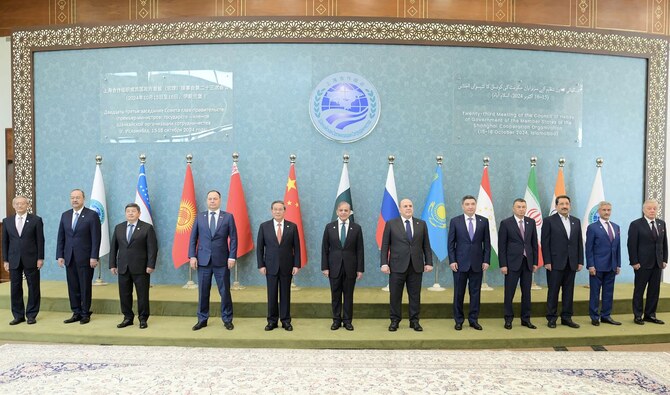
This handout photograph taken on October 16, 2024 and released by Pakistan's Press Information Department (PID) shows Pakistan's Prime Minister Shehbaz Sharif (C front) posing for a group picture with the heads of the delegate members during the Shanghai Cooperation Organisation (SCO) summit, in Islamabad. The SCO comprises China, India, Russia, Pakistan, Iran, Kazakhstan, Kyrgyzstan, Tajikistan, Uzbekistan and Belarus -- with 16 more countries affiliated as observers or "dialogue partners". (AFP)
Short Url
Updated 16 October 2024
Follow

In veiled dig at West, China-led SCO calls for countering protectionist policies, sanctions

  • China and West have been at loggerheads over tariffs imposed on Chinese products
  • Shanghai Cooperation Organization says protectionist trade measures contrary to WTO rules

ISLAMABAD: A China-led 10-state regional group criticized what it called protectionist trade measures on Wednesday, part of an intensifying standoff between Beijing and Western countries over tariffs on Chinese products.

The Shanghai Cooperation Organization (SCO), a Eurasian security and political group, also hit out at “unilateral sanctions” as member states Iran and Russia face curbs on trade.

The criticism came in a joint statement, following a heads of government meeting of the SCO in Islamabad, signed by 10 countries, including China, Russia, Iran, India and host Pakistan.

The statement said that the 10 member states, represented by seven prime ministers, “consider it important to continue joint efforts to counter protectionist trade measures that are contrary to WTO rules.”

The United States and Canada have increased tariffs on Chinese products such as electric vehicles, aluminum and steel, and the European Union is set to follow suit. Beijing has termed the moves discriminatory, and responded with similar actions as the standoff intensifies.

The SCO also said that “unilateral application of sanctions” is against international law and has an impact on third countries.

Russia and Iran, both members of the SCO, face sanctions from the West. Both possess some of the world’s largest energy resources.

Sanctions have meant that smaller countries have shied away from trade with the two, even as larger more influential economies, such as China and India, continue to purchase energy from them.

Energy-starved Pakistan does not import gas or fuel from neighboring Iran despite its cost-effectiveness, and a gas pipeline between the two has stalled due to Islamabad fearing US sanctions.

’EXPAND BRI’

Earlier at the meeting, Pakistan’s Prime Minister Shehbaz Sharif called for the expansion of China’s Belt and Road Initiative (BRI).

“Flagship projects like the Belt and Road Initiative of President Xi Jinping ... should be expanded focusing on developing road, rail and digital infrastructure that enhances integration and cooperation across our region,” Sharif said in his speech as the chair of the meeting.

The BRI is a $1 trillion plan for global infrastructure and energy networks that China launched a decade ago to connect Asia with Africa and Europe through land and maritime routes.

More than 150 countries, including Russia, have signed up to participate in it.

Beijing’s rivals see the BRI as a tool for China to spread its geopolitical and economic influence.

Western countries, under the G7 platform, last year announced a $600 billion rival connectivity infrastructure development plan.

The China-Pakistan Economic Corridor (CPEC) is a part of the BRI and has seen Beijing pump in billions of dollars into the South Asian country for road networks, a strategic port and an airport. 


Pakistan, global crypto exchange discuss modernizing digital payments, creating job prospects 

Updated 8 sec ago
Follow

Pakistan, global crypto exchange discuss modernizing digital payments, creating job prospects 

  • Pakistani officials, Binance team discuss coordination between Islamabad, local banks and global exchanges
  • Pakistan has attempted to tap into growing crypto market to curb illicit transactions, improve oversight

ISLAMABAD: Pakistan’s finance officials and the team of a global cryptocurrency exchange on Friday held discussions aimed at modernizing the country’s digital payments system and building local talent pipelines to meet rising demand for blockchain and Web3 skills, the finance ministry said.

The development took place during a high-level meeting between Finance Minister Muhammad Aurangzeb, Pakistan Virtual Assets Regulatory Authority (PVARA) Chairman Bilal bin Saqib, domestic bank presidents and a Binance team led by Global CEO Richard Teng. The meeting was held to advance work on Pakistan’s National Digital Asset Framework, a regulatory setup to govern Pakistan’s digital assets.

Pakistan has been moving to regulate its fast-growing crypto and digital assets market by bringing virtual asset service providers (VASPs) under a formal licensing regime. Officials say the push is aimed at curbing illicit transactions, improving oversight, and encouraging innovation in blockchain-based financial services.

“Participants reviewed opportunities to modernize Pakistan’s digital payments landscape, noting that blockchain-based systems could significantly reduce costs from the country’s $38 billion annual remittance flows,” the finance ministry said in a statement. 

“Discussions also emphasized building local talent pipelines to meet rising global demand for blockchain and Web3 skills, creating high-value employment prospects for Pakistani youth.”

Blockchain is a type of digital database that is shared, transparent and tamper-resistant. Instead of being stored on one computer, the data is kept on a distributed network of computers, making it very hard to alter or hack.

Web3 refers to the next generation of the Internet built using blockchain, focusing on giving users more control over their data, identity and digital assets rather than big tech companies controlling it.

Participants of the meeting also discussed sovereign debt tokenization, which is the process of converting a country’s debt such as government bonds, into digital tokens on a blockchain, the ministry said. 

Aurangzeb called for close coordination between the government, domestic banks and global exchanges to modernize Pakistan’s payment landscape.

Participants of the meeting also discussed considering a “time-bound amnesty” to encourage users to move assets onto regulated platforms, stressing the need for stronger verifications and a risk-mitigation system.

Pakistan has attempted in recent months to tap into the country’s growing crypto market, crack down on money laundering and terror financing, and promote responsible innovation — a move analysts say could bring an estimated $25 billion in virtual assets into the tax net.

In September, Islamabad invited international crypto exchanges and other VASPs to apply for licenses to operate in the country, a step aimed at formalizing and regulating its fast-growing digital market.