

Pakistan’s Sindh approaches high court for judicial inquiry into killing of blasphemy suspect

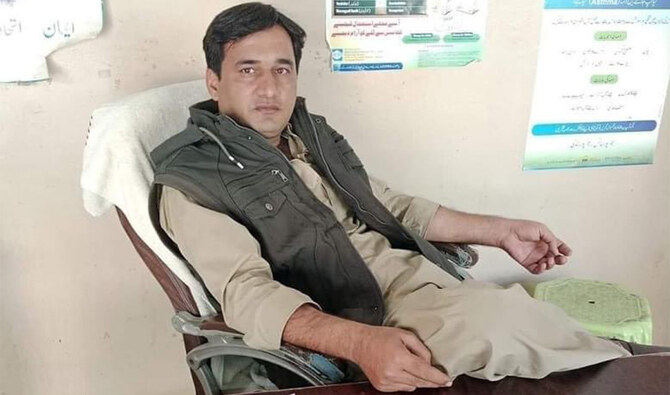
The undated picture shows Dr. Shahnawaz Kanbhar, a blasphemy suspect who was allegedly killed in police custody. (Social media)
Short Url
Updated 16 October 2024
Follow

Pakistan’s Sindh approaches high court for judicial inquiry into killing of blasphemy suspect

  • Dr. Shahnawaz Kanbhar’s family alleges he was killed in police custody last month after being blasphemy allegations
  • An inquiry committee constituted by Sindh’s inspector general determined doctor was killed in “fake encounter” 

KARACHI: Pakistan’s Sindh government on Wednesday approached a high court for a judicial inquiry into the alleged police killing of a doctor after he was accused of committing blasphemy. 

Dr. Shahnawaz Kanbhar, accused of sharing blasphemous content online, was arrested last month in Sindh’s Umerkot district and killed hours later by police in a purported shootout. According to media reports, police said Dr. Kanbhar was killed unintentionally when cops asked two men on a motorcycle to stop but one of them opened fire, prompting police to shoot back. Police said it was only after the shooting that they learned the slain man was the doctor being sought by them for alleged blasphemy. 

His family disputes the police account, claiming he was murdered in custody. A subsequent inquiry committee constituted by Sindh’s inspector general of police determined that the encounter was a “fake” one.

The incident has sparked widespread condemnation from Pakistani rights activists, who have demanded a transparent investigation into the incident. One person was killed and dozens arrested last week in Karachi after opposing protests by rights activists and an ultraconservative party in Pakistan over the issue triggered clashes with police. 

“It has now become imperative that Judicial Inquiry may be conducted into the subject matter incident in order to ascertain the real facts and fix responsibility on the delinquent police officers/officials and individuals in the interest of justice,” a copy of a letter sent by Sindh’s Home Department to the Sindh High Court’s registrar said. 

“Foregoing in view, it is requested that Judicial Inquiry may be ordered to be conducted in the subject matter by a serving Judge of High Court under intimation to this department.”

Blasphemy accusations are common in Pakistan and under the country’s blasphemy laws, anyone found guilty of insulting Islam or Islamic religious figures can be sentenced to death. While no one has been executed on such charges, often just an accusation can cause riots and incite mobs to violence, lynching and killings.

In August 2023, thousands of people set churches and homes of Christians on fire in Jaranwala, a district in Punjab province, over blasphemy allegations in what was one of the worst incidents of violence against Christians in Pakistan. 

Human rights groups and civil society organizations have urged the Pakistani government to repeal the country’s blasphemy laws, which they argue contribute to discrimination and violence. They have also called for a comprehensive review of law enforcers’ response to blasphemy accusations.


Opposition protests over Imran Khan’s eye treatment as government offers specialist care

Updated 36 min 38 sec ago
Follow

Opposition protests over Imran Khan’s eye treatment as government offers specialist care

  • Opposition alliance says protest in front of parliament to continue until Khan is admitted to Shifa Hospital
  • Government says the ex-premier’s medical report will be compiled again amid judicial oversight of the case

ISLAMABAD: Pakistan’s opposition alliance staged a sit-in outside Parliament House on Friday demanding that jailed former prime minister Imran Khan be shifted to a private hospital for treatment of his worsening eye condition, as the government promised the best possible treatment and said the case was under judicial oversight.

Police locked the gates of parliament and cordoned off surrounding roads, preventing protesters from gathering in front of the building, witnesses and opposition leaders said. Security was also tightened around Khyber Pakhtunkhwa (KP) House, where officials and lawmakers from Khyber Pakhtunkhwa were stopped from approaching parliament.

The province is governed by Khan’s Pakistan Tehreek-e-Insaf (PTI) party which is in the opposition at the center.

“We have staged a sit-in for the earliest medical check-up of Imran Khan, which would take just ten minutes,” Mehmood Khan Achakzai, Leader of the Opposition in the National Assembly and head of the opposition Tehreek-e-Tahafuz-e-Ayeen-e-Pakistan alliance, told reporters at Parliament House.

“If it is conducted, we will end our protest,” he added.

In a post on X, the alliance said its leadership would continue the sit-in “until Imran Khan is admitted to Al-Shifa Hospital.”

A group of protesters, led by Khyber Pakhtunkhwa Chief Minister Sohail Afridi, also camped outside the KP House in the federal capital after an initial scuffle with police.

During the clash KP government spokesperson Shafi Jan was arrested but later released as more protesters gathered outside the facility.

Jan warned that if PTI activists were prevented from joining the main protest, they “will give a call for a countrywide strike.”

“We want to proceed toward Parliament to join the protest,” he added. “We want the Supreme Court’s verdict to be implemented that Imran Khan be shifted to Shifa Hospital, treated there and then brought back.”

The protest follows a rare prison visit earlier this month by Barrister Salman Safdar, appointed as amicus curiae by the Supreme Court to assess Khan’s health and living conditions at Rawalpindi’s Adiala jail. Safdar submitted a detailed report that was made public on Thursday.

The report said that in view of the seriousness of Khan’s ocular condition, “it is imperative that the seriousness of the condition be independently ascertained without delay.”

Safdar also recommended that the court consider involving Khan’s personal physicians or other specialists of his choice, warning that “any further delay poses a serious risk to the Petitioner’s well-being.”

According to a Feb. 6 medical report from the Pakistan Institute of Medical Sciences (PIMS) cited in Safdar’s filing, Khan was diagnosed with “right central retinal vein occlusion” after reporting reduced vision in his right eye. He underwent an intravitreal injection at PIMS and was discharged with follow-up advice.

In his interaction with Safdar, Khan said he had suffered “rapid and substantial loss of vision over the preceding three months” and claimed his complaints had not been addressed promptly in custody. He further said he had been left with “only 15 percent vision in his right eye.”

Safdar’s report noted that the 73-year-old former premier appeared “visibly perturbed and deeply distressed” over the loss of vision, though it also recorded that he expressed satisfaction with his safety, basic amenities and food provisions in prison.

Responding to the controversy, Parliamentary Affairs Minister Tariq Fazal Chaudhry rejected PTI’s claims that Khan had been suffering from an eye issue since October last year.

Speaking to reporters in Islamabad, he said Khan was visited by his sister on Dec. 2 but she did not mention the medical issue.

“Medical report will be compiled again, the chief justice of the Supreme Court is himself monitoring this case,” he said. “Wherever it will be requested, Imran Khan’s eye will be examined at.”

Chaudhry vowed there would be no negligence.

Information Minister Attaullah Tarar earlier rejected claims of mistreatment, saying the “narrative being propagated to international media” by Khan’s family had “fallen flat on its face,” and that prison records showed he enjoyed facilities “more than any other prisoner.”

Khan has been in custody since August 2023 in connection with multiple cases that he and his party describe as politically motivated. The government denies the allegation.

Concerns over his health resurfaced after authorities confirmed he had briefly been taken from prison to a hospital in Islamabad for an eye procedure. While the government said his condition was stable, Khan’s family and PTI leaders alleged they were not informed in advance and that he was being denied timely and independent medical access.