


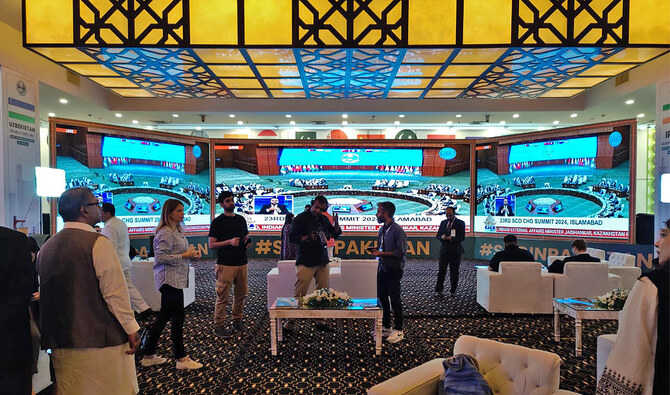

ISLAMABAD: The two-day Shanghai Cooperation Organization (SCO) Summit concluded in Islamabad on Wednesday, with member states adopting a joint communiqué calling for enhanced multilateral trade, economic cooperation and electronic commerce within the bloc.
The SCO is a key Eurasian political, economic and security alliance founded in 2001 by China, Russia and several Central Asian nations. Over the years, it has expanded to include countries like India and Pakistan, making it a significant regional bloc.
The 23rd meeting of the SCO Council of Heads of Government formally began with Prime Minister Shehbaz Sharif’s keynote address, with representatives from China, Russia, India, Iran, Kyrgyzstan, Tajikistan, Kazakhstan, Uzbekistan and Belarus in attendance.
“The heads of delegations, noting the presence of significant potential and opportunities for further building up trade and economic ties, stressed the importance of implementing the Concept of Cooperation in the Development of the ‘New Economic Dialogue’ between the SCO member states,” the communiqué said.
“The heads of delegations believe it is necessary to effectively utilize the digital economy and scientific and technological innovations in order to give a new impetus to economic development and progress in the SCO space, as well as to enhance the competitiveness of the region’s economy and potential,” it continued, emphasizing the importance of holding regular meetings of the Special Working Group on electronic commerce.
Earlier, Sharif urged member states to expand regional connectivity and economic integration without viewing such initiatives through a narrow political lens.
“While supporting all SCO connectivity initiatives, Pakistan underscores the importance of establishing a robust SCO connectivity framework,” he said in his opening statement. “This framework should not simply boost regional trade but should also advance a vision of connected Eurasia.”

Participants of Shanghai Cooperation Organization (SCO) Summit pose for a group picture in Islamabad, Pakistan on October 16, 2024. (@DrSJaishankar/X)
“Flagship projects, like the Belt and Road Initiative of President Xi Jinping, the China-Pakistan Economic Corridor, which is in its second phase, and the International North-South Transport Corridor should be expanded, focusing on developing road, rail, and digital infrastructure that enhances integration and cooperation across the region,” he continued. “Let’s not look at such projects through a narrow political prism and invest in our collective connectivity capacities, which are crucial to advancing shared visions of an economically integrated region.”
Sharif pointed out that a stable Afghanistan was crucial for achieving this objective.
“While the international community must extend the needed assistance to help the Afghan Interim Government stave off the humanitarian crisis and prevent an economic meltdown, it must also demand from the Afghan Interim Government to take concrete measures to promote political inclusivity, as well as to ensure that its soil is not used for terrorism against its neighbors by any entity,” he continued.
The Pakistani premier maintained that such initiatives were necessary to ensure poverty alleviation across the neighborhood and the prosperity of its people.
He said regional integration and collaboration could also help address the climate crisis and secure a safer future for upcoming generations.
He also called for a ceasefire in Gaza while speaking at the forum and reaffirmed Pakistan’s support for an independent Palestinian state.
The SCO summit was significant as it marked the first visit by an Indian minister to Pakistan since 2015, with External Affairs Minister Subramanyam Jaishankar attending the summit and highlighting what he described as a lack of trust and good neighborliness, which he said was impeding regional cooperation.
Pakistan’s information minister Attaullah Tarar described Jaishankar’s visit as an “ice breaker” on the sidelines of the event amid the bitter relations between the two nuclear-armed neighbors, though there was no bilateral meeting between both countries.
“Neither us nor them requested for a bilateral meeting... but I believe his arrival here is an ice breaker,” Tarar said.
“Yesterday, when all the leaders were being welcomed and there were handshakes, I think positive images were sent out globally,” he continued, referring to the Indian minister’s brief interaction with the Pakistani prime minister.
At the end of the session, Pakistan handed over the chairmanship of the Council of Heads of Government to Russia, which will host the next summit in 2025.


