

War-torn Gaza a ‘constant peak emergency’: UN official

1 / 5
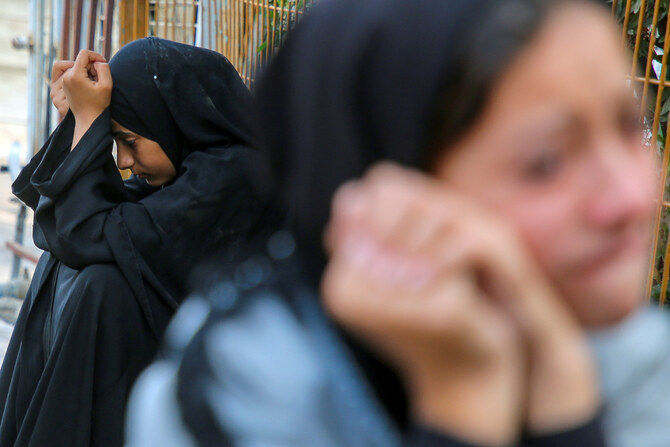
Relatives of Palestinians from Abu Taima family, who were killed in an Israeli strike, grieve during their funeral, amid the ongoing Israel-Hamas conflict, at Nasser hospital in Khan Younis, in the southern Gaza Strip, October 15, 2024. (REUTERS)
2 / 5
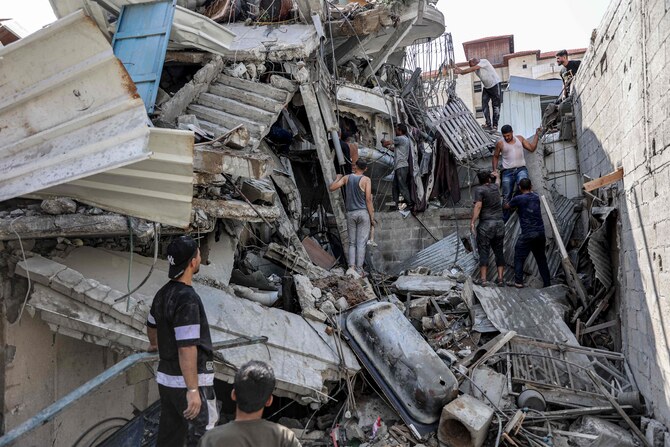
People gather outside a collapsed building as they attempt to extricate a man from underneath the rubble following Israeli bombardment in the Saftawi district in Jabalia in the northern Gaza Strip on October 15, 2024 amid the ongoing war in the Palestinian territory between Israel and Hamas. (AFP)
3 / 5
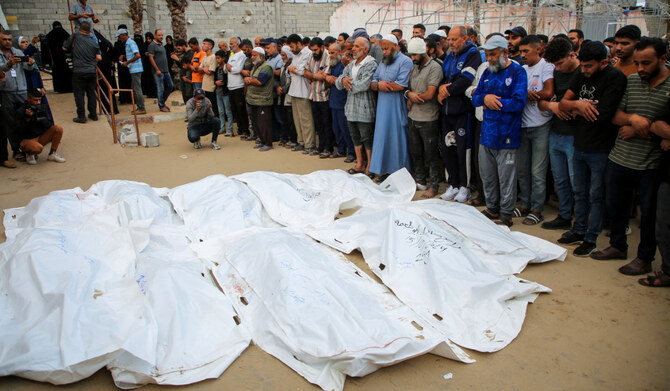
People offer funeral prayers next to the bodies of Palestinians including members of Abu Taima family, who were killed in an Israeli strike, amid the ongoing Israel-Hamas conflict, at Nasser hospital in Khan Younis, in the southern Gaza Strip, October 15, 2024. (REUTERS)
4 / 5
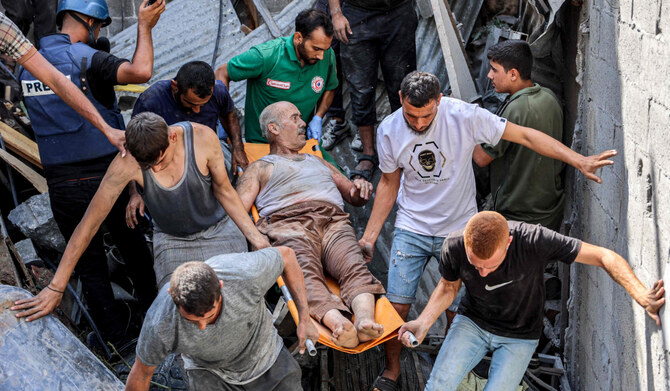
People carry on a gurney a man extricated from the rubble of a collapsed building following Israeli bombardment after his rescue in the Saftawi district in Jabalia in the northern Gaza Strip on October 15, 2024 amid the ongoing war in the Palestinian territory between Israel and Hamas. (AFP)
5 / 5
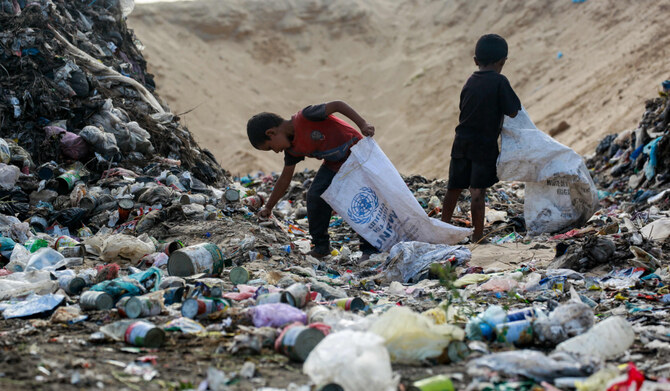
Children sift through waste at a landfill in Khan Yunis in the southern Gaza Strip on October 15, 2024, amid the ongoing war between Israel and the Palestinian militant group Hamas in the besieged Palestinian territory. (AFP)
Short Url
Updated 15 October 2024
Follow

War-torn Gaza a ‘constant peak emergency’: UN official

  • They practically have no access to fresh food — just staples provided by UNRWA and WFP,” Renard said, referring to the UN agency for Palestinian refugees

JERUSALEM: The Gaza Strip remains in a state of “constant peak emergency,” a UN official said, as aid groups continue to face severe challenges in delivering assistance after more than a year of war.
“Every day is a struggle to make sure that we can provide our assistance,” Antoine Renard, head of the World Food Programme (WFP) in the occupied Palestinian territories, told AFP shortly after a visit to war-torn Gaza.
Vast areas of Gaza have been devastated by Israel’s retaliatory assault on the territory after the October 7 Hamas attack last year sparked the war.
Israel has been intensifying operations in the north of the besieged Palestinian territory, where the UN has warned hundreds of thousands of people are trapped.
“People in the north of Gaza are relying solely on assistance. They practically have no access to fresh food — just staples provided by UNRWA and WFP,” Renard said, referring to the UN agency for Palestinian refugees.
He said that most residents have survived so far on tinned food, a situation he describes as “unsustainable.”
“It’s unique to actually have one year into a war where people are just depending on processed food that is coming from cans,” he said.
“We face issues with crossings. We face issues in having our assistance not being under bombs,” he added, noting that looting of the goods once in the territory was also a problem.
Despite a desperate need to increase the amount of aid going in, he said no WFP food aid has managed to reach northern Gaza since October 1, requesting that “crossings be reopened.”
The Israeli military said it was facilitating the transfer of humanitarian aid into northern Gaza, including fuel for hospitals and allowing the transfer of patients from one hospital to another.

According to the military, some 30 trucks carrying flour and food from the WFP entered northern Gaza through the Erez West crossing on Monday.
James Elder, spokesman for the UN children’s agency UNICEF, on Tuesday said Gaza appeared to be facing the worst restrictions on aid yet.
“August was the lowest amount of humanitarian aid that came into the Gaza Strip of any full month since the war broke out,” he said.
Renard said access to fresh food in southern Gaza is slightly better, with some vegetables and fruits available, but most people in the area still lack access to dairy, meat or fish.
Most goods, however, remained out of reach for many residents with shortages causing prices to skyrocket.
“The price of a can has just doubled now again on the market in the south of Gaza,” he said.
Bread remains one of the few fresh staples available to Gazans, he said, with WFP-assisted bakeries providing a loaf of bread to 2.1 million people daily.
“For many in Gaza, this is the only fresh food they have,” Renard added, calling them a “lifeline for the entire population.”
The war in Gaza was sparked by Hamas’s attack on October 7 last year, which resulted in the deaths of 1,206 people in Israel, mostly civilians, according to an AFP tally based on official Israeli figures which includes hostages killed in captivity.
Israel’s retaliatory military offensive has killed 42,344 people in Gaza, most of them civilians, according to figures from the health ministry in Hamas-run Gaza that the United Nations has described as reliable.


Over 2,200 Daesh detainees transferred to Iraq from Syria: Iraqi official

Updated 08 February 2026
Follow

Over 2,200 Daesh detainees transferred to Iraq from Syria: Iraqi official

  • Iraq is still recovering from the severe abuses committed by the terrorists

BAGHDAD: Iraq has so far received 2,225 Daesh group detainees, whom the US military began transferring from Syria last month, an Iraqi official told AFP on Saturday.
They are among up to 7,000 Daesh detainees whose transfer from Syria to Iraq the US Central Command (CENTCOM) announced last month, in a move it said was aimed at “ensuring that the terrorists remain in secure detention facilities.”
Previously, they had been held in prisons and camps administered by the Kurdish-led Syrian Democratic Forces (SDF) in northeast Syria.
The announcement of the transfer plan last month came after US envoy to Syria Tom Barrack declared that the SDF’s role in confronting Daesh had come to an end.
Saad Maan, head of the security information cell attached to the Iraqi prime minister’s office, told AFP on Saturday that “Iraq has received 2,225 terrorists from the Syrian side by land and air, in coordination with the international coalition,” which Washington has led since 2014 to fight Daesh.
He said they are being held in “strict, regular detention centers.”
A Kurdish military source confirmed to AFP the “continued transfer of Daesh detainees from Syria to Iraq under the protection of the international coalition,” using another name for Daesh.
On Saturday, an AFP photographer near the Kurdish-majority city of Qamishli in northeastern Syria saw a US military convoy and 11 buses with tinted windows.

- Iraq calls for repatriation -

Daesh seized swathes of northern and western Iraq starting in 2014, until Iraqi forces, backed by the international coalition, managed to defeat it in 2017.
Iraq is still recovering from the severe abuses committed by the terrorists.
In recent years, Iraqi courts have issued death and life sentences against those convicted of terrorism offenses.
Thousands of Iraqis and foreign nationals convicted of membership in the group are incarcerated in Iraqi prisons.
On Monday, the Iraqi judiciary announced it had begun investigative procedures involving 1,387 detainees it received as part of the US military’s operation.
In a statement to the Iraqi News Agency on Saturday, Maan said “the established principle is to try all those involved in crimes against Iraqis and those belonging to the terrorist Daesh organization before the competent Iraqi courts.”
Among the detainees being transferred to Iraq are Syrians, Iraqis, Europeans and holders of other nationalities, according to Iraqi security sources.
Iraq is calling on the concerned countries to repatriate their citizens and ensure their prosecution.
Maan noted that “the process of handing over the terrorists to their countries will begin once the legal requirements are completed.”