

Fighting escalates along Lebanese border as Hezbollah threatens to strike anywhere in Israel

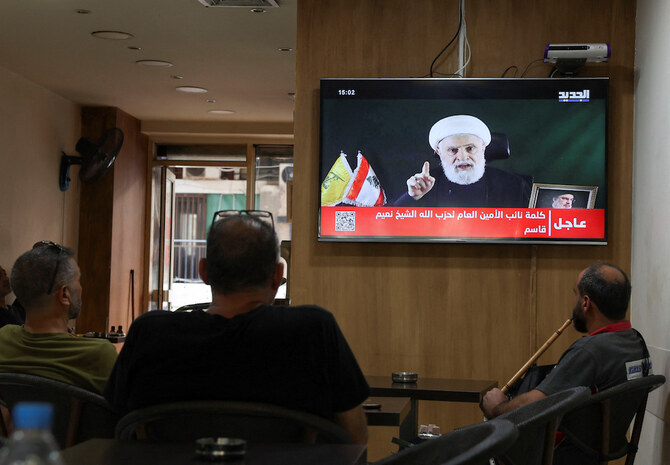
Above, people watch Hezbollah deputy leader Sheikh Naim Qassem delivering a televised address as they sit in a cafe in Beirut on Oct. 15, 2024. (Reuters)
Short Url
Updated 15 October 2024
Follow

Fighting escalates along Lebanese border as Hezbollah threatens to strike anywhere in Israel

  • As tensions continued to escalate, calls by Lebanese politicians for a ceasefire grew
  • Israel stepped up airstrikes on numerous towns in southern Lebanon, the Bekaa Valley

BEIRUT: Clashes between the Israeli army and Hezbollah intensified on Tuesday as an Israeli infantry unit advanced on the outskirts of the border town of Rab El-Thalathine.

At the same time, Israel stepped up its airstrikes on numerous towns in southern Lebanon and the Bekaa Valley, resulting in mass casualties.

As tensions continued to escalate, calls by Lebanese politicians for a ceasefire grew and they urged the government to deploy army forces in the border region.

In a televised speech, however, Hezbollah’s deputy secretary-general, Sheikh Naim Qassem said “the party (Hezbollah) is strong and united.” Pictured alongside a Lebanese flag and the Hezbollah banner, he warned that “since the enemy has targeted all of Lebanon, we have the right, from a defensive standpoint, to target any point within the Israeli entity.”

He added: “The solution lies in a ceasefire. Following the ceasefire … the settlers will return to the north. However, as long as the conflict persists, the number of uninhabited settlements will increase, placing hundreds of thousands, potentially more than 2 million, at risk.”

Fouad Siniora, a former prime minister of Lebanon, called for “an immediate cessation of hostilities to halt the bloodshed … as well as a complete adherence to the constitution.”

The Kataeb Party called upon “the speaker of the parliament and the prime minister to urgently seek a definitive and unambiguous position from Hezbollah concerning the immediate acceptance of a ceasefire.”

Meanwhile, fighting continues. Hezbollah said its members “engaged in combat with the Israeli forces that infiltrated into the area of Rab El-Thalathine using automatic weapons and missiles, and the clashes are ongoing.”

Fighting also resumed in the border town of Aita Al-Shaab. The Israeli army has tried to cross the Blue Line and enter Lebanese territory in several places. The extent to which incursions have been successful remains unclear, other than video footage released by the Israeli army.

Meanwhile, more than 20 people were killed or injured when an airstrike hit a residential building in the town of Riyaq in Bekaa. Elsewhere, Mohammed Hassan Mashourab, an employee of internet provider Ogero, his wife Ghida Farhat and their children, Raine and Ali, were killed when an airstrike hit their house in the town of Jarjou, in Iqlim Al-Tuffah region.

Israel also targeted Qilya in Western Bekaa with a series of airstrikes, killing three paramedics from Hezbollah’s Islamic Health Organization. Similar attacks targeted Hosh Al-Sayyid Ali in Hermel, and the border area of Jarmash, near the border with Syria.

Parts of Baalbek in the vicinity of its Roman castle were also hit by airstrikes at dawn, described by residents as “the most violent of all times.” Neighboring Al-Murtada Hospital was severely damaged and forced to close.

Israeli forces said they “eliminated Khader Al-Abed, who was in charge of the area north of the Litani River with Hezbollah’s aerial unit.” Hezbollah did not immediately confirm this.

Israeli reconnaissance planes entered Lebanese airspace over Beirut and its suburbs and thermal balloons were deployed over the capital.

Army forces targeted a residential building in Ayto, a town in the Zgharta district of northern Lebanon and the death toll among civilians there rose to 23 on Tuesday, including women, children and the elderly, some of whom were reportedly “blown to pieces.”

Avichai Adraee, a spokesperson for the Israeli military, again warned residents of southern Lebanon on Tuesday “not to return to their villages in the south or to their olive groves.”

In a joint statement, the World Food Programme and UNICEF said “the humanitarian needs of displaced people in Lebanon are increasing. We need to mobilize efforts to provide additional funding to enable a scaled-up response.” A ceasefire is urgently required, they added.

According to the latest daily report issued by the Lebanese government, 200 Israeli airstrikes were recorded in the past 48 hours, bringing the total number of attacks on Lebanon since the start of hostilities just over a year ago to 9,866. The reported death toll stands at 2,309, with 10,782 people injured and 188,146 displaced and living in more than 1,000 shelters, the majority of them in Beirut and Mount Lebanon.

Lebanese citizens have received calls from Israeli authorities ordering them to evacuate their homes and other buildings in specific streets in many Lebanese regions because Hezbollah militants are sheltering in them, which has caused panic among residents.

Some of these calls, described as “psychological warfare,” were reported in Christian areas, including Sin El-Fil, Ballouneh and Hadath, causing chaos among residents and displaced people who thought they were in safe areas.


STC announces dissolution

Updated 29 min 43 sec ago
Follow

STC announces dissolution

The Yemeni separatist group Southern Transitional Council (STC) has announced it will dissolve following talks in Saudi Arabia. Several STC members are in Riyadh for discussions on ending unrest in southern Yemen. The group praised Saudi Arabia’s efforts, while former STC leader Aidarous al-Zubaidi, now wanted by the Presidential Council for high treason, has fled Yemen and has not participated in the talks. 

A Yemeni source told Arab News: “this announcement and ease shown in the televised video statement shows that in fact Al Zubaidi was the obstacle, and that most southerners are open to resolving their matter via dialogue and discussion”

The members of the Southern Transitional Council (STC) in Yemen spoke during the Riyadh Southern Dialogue Conference on Friday.

During the meeting, the Council said military operations in Hadramout and Mahra harmed the Southern cause in Yemen. 

The Council said they did not participate in the decision for the military operations in Hadramout and Mahra. 

"We hope to reach a vision and concept for resolving the Southern issue at the Riyadh Conference,” said the Council.

The Council thanked Saudi Arabia for hosting the dialogue conference in Riyadh.

  • Below is a full translation of the STC announcement as reported by the Arabic language Yemeni news agency (SABA):  

Announcement of the Dissolution of the Southern Transitional Council

The Presidency of the Southern Transitional Council, the Supreme Executive Leadership, the General Secretariat, and the other affiliated bodies convened a meeting to assess the recent unfortunate events in the governorates of Hadramout and Al-Mahrah, and the subsequent rejection of all efforts toward de-escalation and resolution. These developments have led to serious and painful consequences. Referring to the statement issued by the Ministry of Foreign Affairs of the Kingdom of Saudi Arabia regarding its sponsorship of a southern dialogue to resolve the southern issue—and in order to safeguard the future of the southern cause and the right of the southern people to restore their state according to their will and aspirations, and to preserve peace and social security in the South and the broader region—we make the following declaration:

The Southern Transitional Council was established to carry the cause of the southern people, represent them, and lead them toward achieving their aspirations and restoring their state. We founded it with the belief that the goal was to achieve this mission—not to cling to it as a means of gaining power, monopolizing decision-making, or excluding others.

Since we were not involved in the decision to launch the military operation in Hadramout and Al-Mahrah—an operation that harmed southern unity and damaged relations with the coalition led by the Kingdom of Saudi Arabia, which has made and continues to make great sacrifices and provide ongoing political, economic, and military support—the continued existence of the Council no longer serves the purpose for which it was created. In light of this and our historical responsibility toward the southern cause, we hereby announce the dissolution of the Southern Transitional Council, the disbanding of all its main and subsidiary bodies, and the closure of all its offices inside and outside the country. We will instead work to achieve our just southern goal by preparing for and participating in the comprehensive southern conference under the Kingdom’s sponsorship.

We commend the Kingdom of Saudi Arabia for its clear and explicit commitments and the sincere concern it has shown for our cause in seeking solutions that meet the aspirations and will of the southern people.

We call on all active southern figures and leaders to engage in the path of the comprehensive southern dialogue conference, hoping that the participants will reach a vision and framework to resolve the southern issue and fulfill the people’s aspirations through their free will, and to establish an inclusive southern framework.

From this platform, we call on the people of the South, our colleagues in the capital Aden, and all the governorates of our beloved South to recognize the gravity of this moment, the sensitivity of the current phase, and the importance of uniting efforts to preserve our gains and protect the South from chaos or instability.

We reaffirm our continued commitment to serving the just and legitimate cause of the southern people and achieving their aspirations according to their will. We also extend our gratitude to the leadership and people of the Kingdom of Saudi Arabia for hosting the comprehensive southern dialogue conference and for their support of the South, its cause, and its people across all fields and stages.