

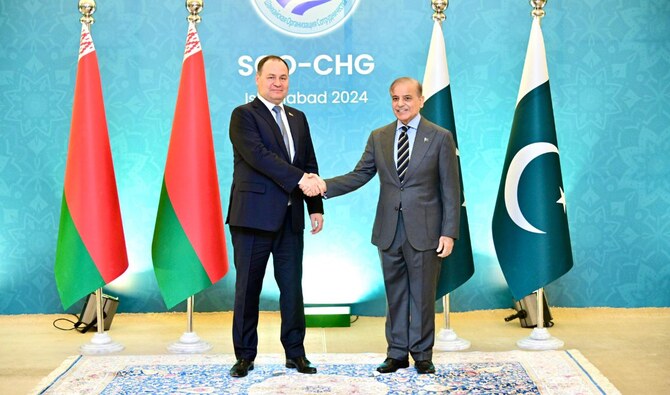

ISLAMABAD: Prime Minister Shehbaz Sharif on Tuesday met with Central Asian leaders and discussed trade, investment and regional connectivity on the sidelines of a two-day Shanghai Cooperation Organization (SCO) summit in Islamabad, Sharif’s office said.
The prime ministers of China, Kyrgyzstan, Tajikistan, Russia, Belarus, Kazakhstan and Uzbekistan as well as Iran’s first vice president and the Indian external affairs minister are in Islamabad to attend the summit on October 15-16.
The Pakistani government has declared a three-day holiday in the federal capital of Islamabad since Monday, with schools and businesses closed to ensure security of foreign leaders attending the high-profile regional summit.
In a meeting with Kazakhstan PM Olzhas Bektenov on Tuesday, Sharif reaffirmed Pakistan’s commitment to work with all member states in advancing the SCO’s principles and purposes, according to the Pakistan PM’s office.
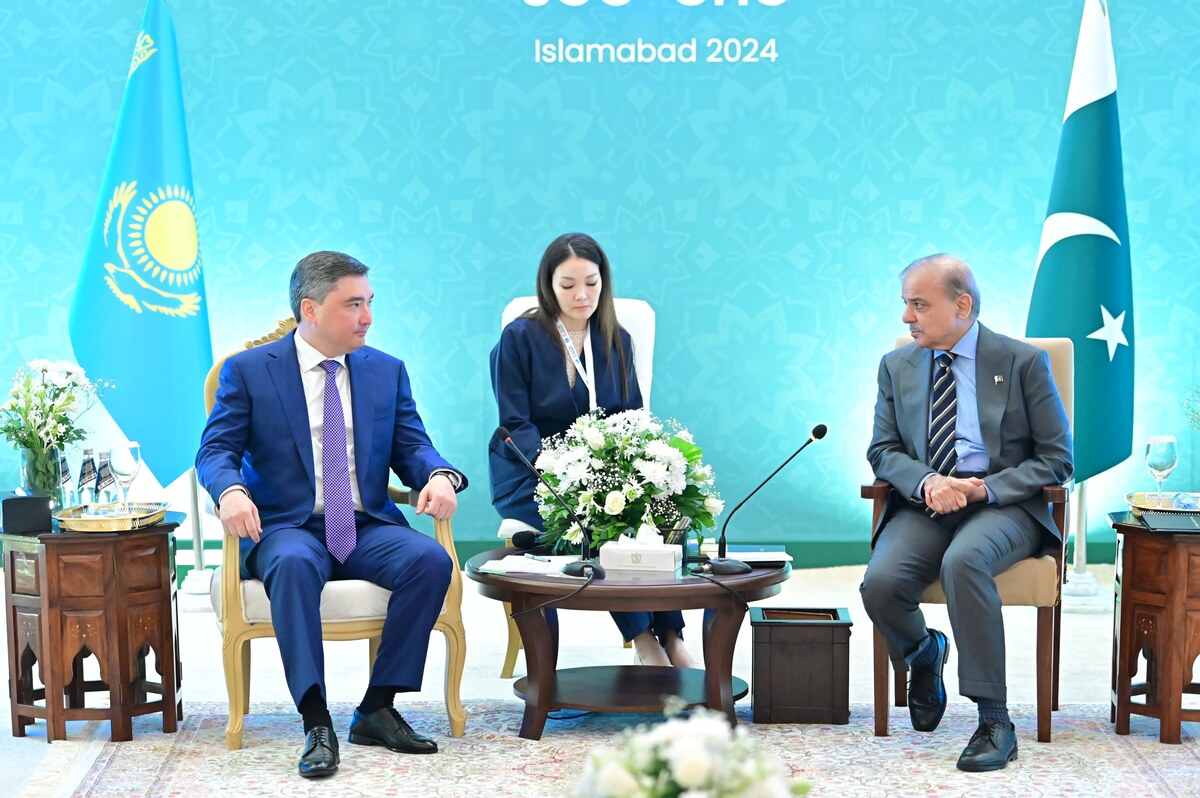
Prime Minister Shehbaz Sharif meets with Prime Minister of Kazakhstan Olzhas Bektenov on the sidelines of Shanghai Cooperation Organisation Head of Government Meeting on October 15, 2024. (Government of Pakistan)
“Noting the warm and excellent bilateral relations between the two countries, Prime Minister Sharif emphasized the need to enhance trade and investment, while also focusing on regional connectivity and security,” Sharif’s office said in a statement.
To achieve this shared objective, he stressed the need to maintain regular and high-level contacts, including through institutional mechanisms of bilateral engagement.
In his meeting with Tajikistan PM Qohir Rasulzoda, the Pakistan premier said both countries should further cement cooperation across all spheres of shared interest, according to Sharif’s office.
He conveyed Pakistan’s strong desire to strengthen ties with Kyrgyzstan in trade and investment during a meeting with Akylbek Japarov, chairman of the Cabinet of Ministers of the Kyrgyz Republic. In his meeting with Turkmen Foreign Affairs Minister Rashid Meredov, Sharif welcomed the participation of Turkmenistan in the summit as a “special guest.”
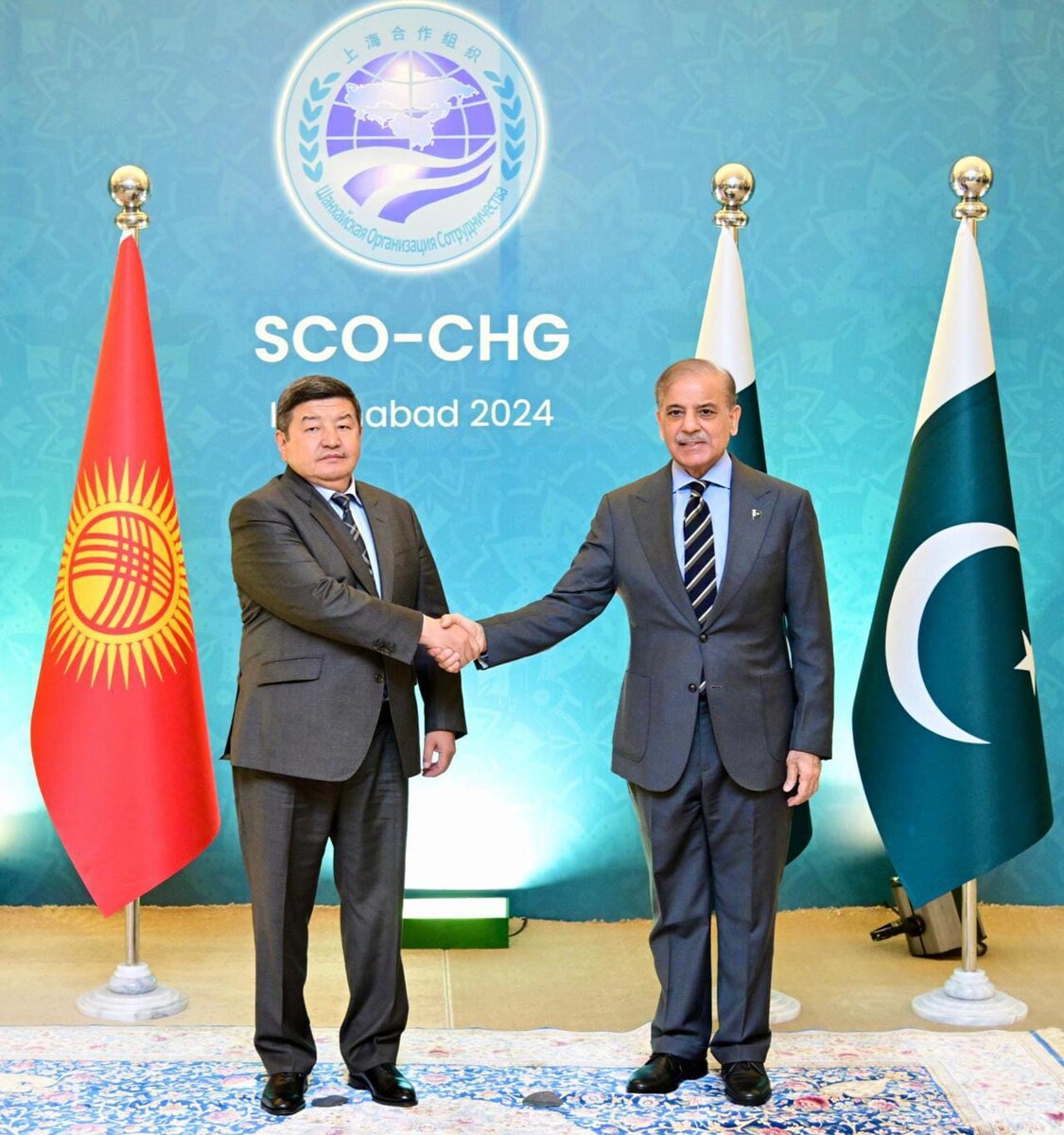
Prime Minister Shehbaz Sharif (R) meets Akylbek Japarov, Chairman of the Cabinet of Ministers of the Kyrgyz Republic, on the sidelines of SCO Council of Heads of Government (CHG) Meeting in Islamabad on October 15, 2024. (Government of Pakistan)
During the meetings, Central Asian leaders congratulated the Pakistani premier on the successful organization of the SCO summit and lauded Pakistan’s positive role as the SCO chair, Sharif’s office said.
Pakistan wants to position itself as a regional trade hub and to leverage its strategic geopolitical position and enhance its role as a pivotal trade and transit hub connecting China and Central Asia with the rest of the world. In recent months, there has been a flurry of visits, investment talks and economic activity between Pakistan, China and Central Asian states, including Uzbekistan, Azerbaijan, Tajikistan and Turkmenistan.
In a bilateral meeting with Belarusian PM Roman Golovchenko, Sharif noted that regular high-level exchanges had added positive momentum to the cordial ties between the two countries.
“This momentum needed to be sustained so as to realize the full potential of bilateral cooperation, particularly in the areas of trade, investment, agricultural machinery and joint production of tractors and connectivity,” he was quoted as saying.
On Tuesday, Sharif also hosted a dinner in honor of the visiting foreign dignitaries, wherein he was seen greeting and shaking hands with the attendees, including Indian External Affairs Minister Subrahmanyam Jaishankar.
Sharif is due to preside over a meeting of the SCO Council of Heads of Government and deliver the opening remarks on Wednesday, followed by statements from leaders of participating countries during the session, according to the Pakistani foreign office. The documents reflecting outcomes of the meeting will also be signed during the session, which will conclude with Sharif’s closing remarks.
Foreign office said Pakistan’s Deputy Prime Minister Ishaq Dar and SCO Secretary General Zhang Ming will interact with media to share a communiqué after the concluding session on Wednesday.
Pakistani authorities have locked down the capital to ensure security of foreign leaders attending the SCO summit. The government has deployed troops and blocked key roads, announcing alternate routes for the residents.


