

India-Canada relations reach historic lows as top diplomats expelled

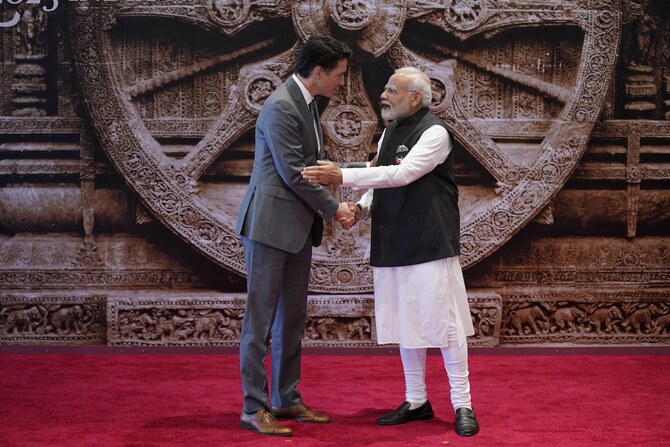
India's Prime Minister Narendra Modi (R) shakes hand with Canada's Prime Minister Justin Trudeau ahead of the G20 Leaders' Summit in New Delhi in Sept. 2023. (AFP/File Photo)
Short Url
Updated 16 October 2024
Follow

India-Canada relations reach historic lows as top diplomats expelled

  • Relations fraught since the murder of a Sikh separatist leader in British Columbia last year
  • Canadian PM says Indian officials identified as ‘persons of interest’ in the assassination plot

NEW DELHI: Relations between India and Canada have reached a historic low as the countries expelled each other’s diplomats in an ongoing row over the killing of a Sikh separatist activist on Canadian soil.

Canadian Prime Minister Justin Trudeau accused India’s government on Monday of “supporting criminal activity against Canadians here on Canadian soil,” and the country’s Foreign Ministry announced the expulsion of six Indian diplomats, including the high commissioner.

The ministry said Canadian police had gathered evidence, which identified them as “persons of interest” in last year’s killing of Hardeep Singh Nijjar, who was gunned down in Surrey, British Columbia.

India immediately rejected the accusations as absurd, and its Ministry of External Affairs said it was expelling Canada’s acting high commissioner, his deputy, and the embassy’s four first secretaries.

Before the announcement, it also summoned the Canadian charge d’affaires and said it was withdrawing its high commissioner and “other targeted diplomats,” contradicting Canada’s statement of expulsion.

“Prime Minister Trudeau has been making these public statements repeatedly, but the evidence that he claims to possess is not available to us so we cannot make any kind of a judgment,” Dr. Ajai Sahni, executive director of the Institute for Conflict Management in New Delhi, told Arab News.

“This is the first time the relationship is so low … It has created a lot of problems and it has done damage to relationships between the two countries for the time being.”

This is not the first time India-Canada relations have been strained. In 1974, after India conducted its first nuclear weapon test, it drew outrage from Canada, which accused it of extracting plutonium from a Canadian reactor, a gift intended for peaceful use.

Ottawa subsequently suspended its support for New Delhi’s nuclear energy program.

“The relationship was also low in the 1980s with the hijacking of an Indian Airlines plane and the bombing of the plane, in which many people died,” said Prof. Ronki Ram, political science lecturer at the Punjab University.

The explosion from a bomb planted by Canada-based militants killed 329 people — the worst terrorist attack in Canadian history. India had warned the Canadian government about the possibility of attacks and accused the Canadian Security Intelligence Service of not acting on it.

But the current strain in relations is the first in which diplomats have been withdrawn.

“This is the first time that the relationship has gone down so low,” Ram said.

“Allegations and counter-allegations will have serious implications both internationally and domestically. The Indian government should look into the allegations and try to address them.”

Nijjar, a Sikh Canadian citizen, was gunned down in June 2023 outside a Sikh temple in Surrey, which has a significant number of Sikh residents. He was an outspoken supporter of the Khalistan movement, which calls for a separate Sikh homeland in parts of India’s Punjab state.

The movement is outlawed in India, considered a national security threat by the government, and Nijjar’s name appears on the Indian Home Ministry’s list of terrorists.

Canada has the largest population of Sikhs outside their native state of Punjab — about 770,000 or 2 percent of its entire population.

“Many Panjabi diaspora are in Canada, and a mini-Punjab has been established there,” Ram said.

“The government is taking an electoral interest in the landscape of Canada also. Those things are becoming very critical.”


Rubio says technical talks with Denmark, Greenland officials over Arctic security have begun

Updated 29 January 2026
Follow

Rubio says technical talks with Denmark, Greenland officials over Arctic security have begun

  • US Secretary of State on Wednesday appeared eager to downplay Trump’s rift with Europe over Greenland

WASHINGTON: Technical talks between the US, Denmark and Greenland over hatching an Arctic security deal are now underway, Secretary of State Marco Rubio said on Wednesday.
The foreign ministers of Denmark and Greenland agreed to create a working group aimed at addressing differences with the US during a Washington meeting earlier this month with Vice President JD Vance and Rubio.
The group was created after President Donald Trump’s repeated calls for the US to take over Greenland, a Danish territory, in the name of countering threats from Russia and China — calls that Greenland, Denmark and European allies forcefully rejected.
“It begins today and it will be a regular process,” Rubio said of the working group, as he testified before the Senate Foreign Relations Committee. “We’re going to try to do it in a way that isn’t like a media circus every time these conversations happen, because we think that creates more flexibility on both sides to arrive at a positive outcome.”
The Danish Foreign Ministry said Wednesday’s talks focused on “how we can address US concerns about security in the Arctic while respecting the red lines of the Kingdom.” Red lines refers to the sovereignty of Greenland.
Trump’s renewed threats in recent weeks to annex Greenland, which is a semiautonomous territory of a NATO ally, has roiled US-European relations.
Trump this month announced he would slap new tariffs on Denmark and seven other European countries that opposed his takeover calls, only to abruptly drop his threats after a “framework” for a deal over access to the mineral-rich island was reached, with NATO Secretary-General Mark Rutte’s help. Few details of the agreement have emerged.
After stiff pushback from European allies to his Greenland rhetoric, Trump also announced at the World Economic Forum in Davos, Switzerland, last week that he would take off the table the possibility of using American military force to acquire Greenland.
The president backed off his tariff threats and softened his language after Wall Street suffered its biggest losses in months over concerns that Trump’s Greenland ambitions could spur a trade war and fundamentally rupture NATO, a 32-member transatlantic military alliance that’s been a linchpin of post-World War II security.
Rubio on Wednesday appeared eager to downplay Trump’s rift with Europe over Greenland.
“We’ve got a little bit of work to do, but I think we’re going to wind up in a good place, and I think you’ll hear the same from our colleagues in Europe very shortly,” Rubio said.
Rubio during Wednesday’s hearing also had a pointed exchange with Sen. Tim Kaine, D-Virginia, about Trump repeatedly referring to Greenland as Iceland while at Davos.
“Yeah, he meant to say Greenland, but I think we’re all familiar with presidents that have verbal stumbles,” Rubio said in responding to Kaine’s questions about Trump’s flub — taking a veiled dig at former President Joe Biden. “We’ve had presidents like that before. Some made a lot more than this one.”