

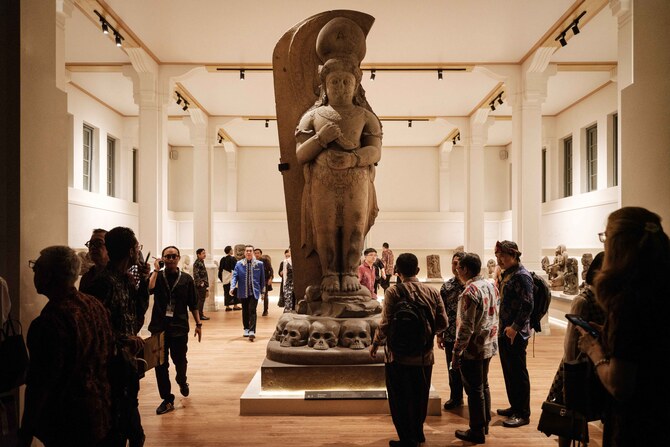

JAKARTA: Indonesia’s National Museum put on display on Tuesday hundreds of artifacts recently returned from the Netherlands, the bulk of which were looted by the Dutch during the bloody colonial conquest of Bali in the early 20th century.
Titled “Repatriation,” the exhibit features 300 items from a collection of over 1,700 stolen under colonial rule that the Netherlands has returned to Indonesia since 1978. It will run until Dec. 31.
Most of the artifacts on display comprise weapons, coins, jewelry, and textiles that the Netherlands had taken in the aftermath of wars in southern Bali between 1906 and 1908, when the Dutch military attacked the region’s kingdoms and killed at least 1,000 people.
It also includes large-scale Hindu-Buddhist sculptures, such as one of a likeness of the god Ganesha, which the Netherlands looted in the mid-19th century from a 13th-century Singhasari Kingdom’s temple complex in East Java.
“We hope that the public will learn that in the past, our country wasn’t an empty land that another nation chose to settle on. There were civilizations, kingdoms, and cultures, and all these artifacts are proof of those civilizations,” Bonnie Triyana, a historian and a member of the Indonesian Repatriation Committee, told Arab News.
“As such, people can learn from our history, the origins of our country, and how diverse we are, and how much we sacrificed to gain our independence.”
Indonesia declared independence in 1945, after a long colonial history under Dutch rule that began at the end of the 16th century.
Jakarta started to campaign for the Dutch government to return stolen Indonesian artifacts in 1951, but the Netherlands only started to return them in the 1970s in small numbers. The Indonesian Repatriation Committee has made big strides since last year with the repatriation of 472 artifacts, followed by 288 such items in September.
The repatriation process has been met with criticism, as some questioned how poorer countries like Indonesia will care for the returned artifacts. But Marieke van Bommel, director-general of the Netherlands’ National Museum of World Cultures, told the New York Times last month that “the thief cannot tell the rightful owners what to do with their property.”
For Triyana, who has served as secretary of the Indonesian Repatriation Committee since 2021, the National Museum exhibit is both a “gateway” and a “bridge” to connect Indonesians with their past.
“Colonialism came to our land and committed exploitation through conquest. Not only did they exploit our wealth and resources, but they also committed violence. It is a lesson for the current generation, both that colonialism was here and its character is still around,” he said.
“We must do decolonization to scrape off the remnants of colonialism, and one way to do this is by learning history … So, this exhibit is very important because repatriation isn’t solely about returning objects taken by our colonizers, but we also want to slowly collect pieces of knowledge about our civilization.”


