

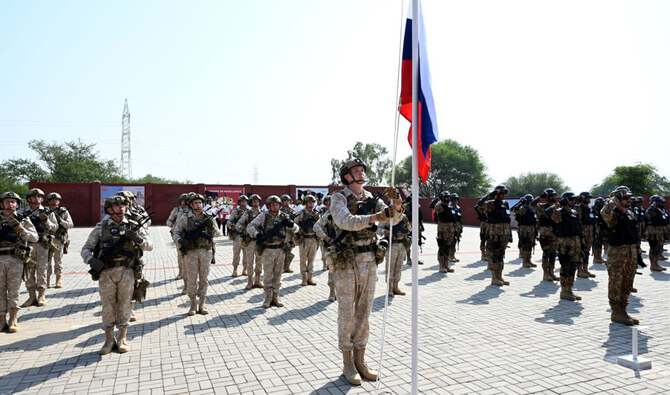
Pakistani, Russian armies kick off ‘Druzhba-VII’ joint counter-terror exercise

Pakistani, Russian armies kick off ‘Druzhba-VII’ joint counter-terror exercise in Pakistan. (Pakistan Army)
Short Url
Updated 15 October 2024
Follow

Pakistani, Russian armies kick off ‘Druzhba-VII’ joint counter-terror exercise

  • Exercise aims to harness military-to-military ties between Pakistan and Russia, says army’s media wing 
  • Two-week-long exercise kicked off in Pakistan’s northwestern town of Pabbi, says Inter-Services Public Relations

ISLAMABAD: The armies of Pakistan and Russia have kicked off a bilateral joint counter-terrorism exercise, “Druzhba VII” this week to refine their militaries joint training and enhance military-to-military relations, the army’s media wing said on Tuesday. 

The two-week-long exercise commenced on Oct. 13 at the National Counter Terrorism Center in the northwestern town of Pabbi, the Inter-Services Public Relations (ISPR), the army’s media wing, said. Pakistan army’s light commando troops and the Russian military contingent are taking part in Druzhba VII 

“The Exercise is aimed at refining professional skills through joint training besides harnessing the historic military-to-military relations among the friendly countries,” the ISPR said. “Participating troops are looking forward to benefit from mutual expertise/ experience.”

Pakistan and Russia have been deepening their military cooperation over the past few years. In 2014, Russia lifted a longstanding arms embargo imposed on Pakistan while in August 2015, it agreed to sell four Mi-35M attack helicopters to Pakistan.

The two countries have also warmed up to each other in recent years, with Islamabad and Moscow bolstering efforts to enhance bilateral trade and investment. Earlier this month, Pakistan’s commerce minister led a delegation of 70 businesspersons to an inaugural trade and investment forum between the two countries in Moscow. 

In order to escape a prolonged economic crisis, Islamabad seeks to enhance its role as a transit hub for landlocked economies in Central Asia. For this, it has expressed interest in connecting with Russia through Central Asian states for bilateral trade.

Islamabad’s ties with Russia also saw significant improvement last year after Pakistan started purchasing Russian crude oil at a discount rate. The development came after geopolitical tensions almost doubled the fuel prices in Pakistan last year, forcing the South Asian country to opt for cheaper sources of fuel.

Pakistan also received its first shipment of liquified petroleum gas from Russia in September 2023, marking Islamabad’s second major Russian energy purchase. Last month, Russia’s Deputy Prime Minister Alexei Overchuk arrived in Islamabad on a brief visit, seeking to expand trade and investment ties with Pakistan.


Pakistan business body writes to PM seeking ‘clear roadmap’ to spur investment

Updated 5 sec ago
Follow

Pakistan business body writes to PM seeking ‘clear roadmap’ to spur investment

  • Business confidence in Pakistan has fallen sharply amid rising inflation, high energy costs and unpredictable tax environment
  • In a letter written to PM Shehbaz Sharif, the Pakistan Business Forum president highlights challenges facing the business community

KARACHI: The Pakistan Business Forum (PBF), a representative body of traders and businesspersons in the country, on Monday urged Prime Minister Shehbaz Sharif’s intervention in outlining a “clear economic roadmap” to promote long-term investment in Pakistan.

Business confidence in Pakistan has fallen sharply amid rising inflation, high energy costs and an unpredictable tax environment. Currency volatility and slowing demand have prompted many firms to delay investments and scale back expansion plans.

In a letter to PM Sharif, PBF President Khawaja Mehboob-ur-Rehman highlighted the challenges facing the business community, including high input costs, soaring energy tariffs and an increasingly “uncompetitive” tax regime that weakens exports.

“Looking ahead to 2026, the Pakistan Business Forum urged the prime minister to provide the business community with a clear, credible, and forward-looking economic roadmap,” read a PBF statement.

“Such clarity... is essential to restore confidence, encourage investment, and enable long-term planning by businesses.”

The South Asian country of more than 241 million people is currently navigating a tricky path to economic recovery under a $7 billion International Monetary Fund (IMF) program since averting a default in 2023.

Besides introducing structural reforms relating to expansion of the country’s tax base and privatization of loss-making entities, the government of PM Sharif says it is taking various measures to boost foreign investment and trade.

The PBF highlighted the business community is ready to play its role in competing with regional markets, if provided with the “necessary competitive tools.” It outlined critical reforms relating to regionally competitive electricity tariffs and corporate tax rates.

An increase in electricity tariffs would put further strain on industries and could lead to widespread downsizing and the closure of industrial units, according to the PBF.

It urged the government to include business representatives in the policymaking process to ensure it understands “on-ground realities.”