

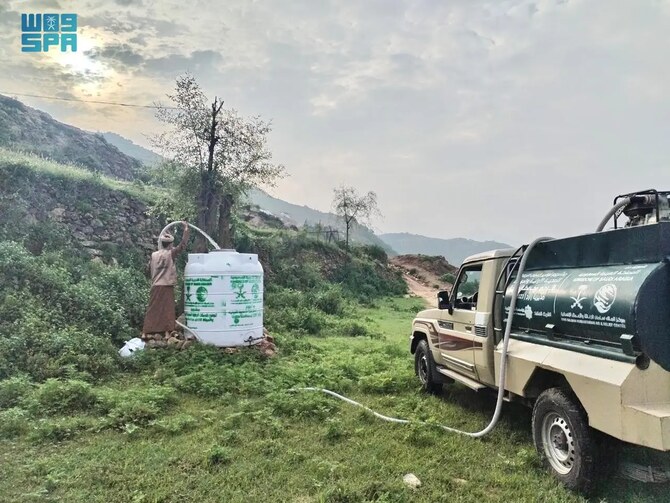
KSrelief continues water supply, healthcare project in Yemen

The King Salman Humanitarian Aid and Relief Center ontinues its water supply and environmental sanitation project in Yemen. (SPA)
Short Url
Updated 15 October 2024
Follow

KSrelief continues water supply, healthcare project in Yemen

RIYADH: The King Salman Humanitarian Aid and Relief Center (KSrelief) continues its water supply and environmental sanitation project in Yemen, providing drinking and non-potable water to residents in stricken areas

At the Al-Khawkhah District of Hodeidah Governorate, the relief agency pumped 266,000 liters of non-potable water and 140,000 liters of drinking water during the week from September 11 to 17, state news agency SPA reported.

Twenty-four transfers were also carried out to remove waste from internally displaced persons camps, five operations were carried out to dry sewage water, 80 swamps were drained and eight emergency bathrooms were maintained.

In the Razih district of Saada governorate, about 23,400 liters of potable water were also distributed to residents during the mentioned period.

On the healthcare side, internal medicine experts saw 69 patients; infectious-diseases doctors treated 35 patients; emergency services attended to 23 cases while reproductive health doctors attended to seven patients. More than 60 nursing care patients were also attended to while 134 individuals have been provided with medicines.

Meanwhile, KSrelief signed a cooperation agreement with a civil society group to implement a program for children involved in conflict particularly in Marib Governorate and Seiyun in Hadhramaut Governorate.

The program will directly benefit 460 children, parents and members of community. The effort aims to reintegrate of youngsters with the provision of a safe shelter, in addition to psychological, social, health and educational support.

Ahmed Al-Baiz, KSrelief’s Assistant General Supervisor, earlier met with Abdallah Alwardat, the UN World Food Programme’s Global Partner Countries Division Director, to discuss collaborative efforts to bolster food security for countries and populations in need worldwide.


Absher Hackathon finalists highlight scale of Saudi tech talent

Updated 14 December 2025
Follow

Absher Hackathon finalists highlight scale of Saudi tech talent

  • World’s largest hackathon underscores growing national enthusiasm for tech innovation

RIYADH: Saudi Arabia’s push to position itself as a global hub for digital innovation was on display this weekend as the Absher Tuwaiq Hackathon 2025 — billed as the world’s largest hackathon — concluded with the announcement of finalist teams competing for prizes totaling SR1 million ($266,000). 

The three-day hackathon, organized by the Ministry of Interior in partnership with Tuwaiq Academy, brought together innovators from across the Kingdom to develop digital solutions aligned with the ministry’s digital transformation goals. 

The finalist teams recognized for their projects were: Shadow, Wusool, Watheeq , Tanabbah, HRS, Ikhlaa, Amal, Mustabiq, Al‑Dahna, Inspire, Saqour Al‑Watan, Thaqib, Sawt Al‑Mustaqbal, Manee, and YS Advance International. 

The finalists were announced at the end of the three-day Absher Tuwaiq Hackathon organized by the Ministry of Interior in partnership with Tuwaiq Academy. (AN photo/Supplied)

In addition to cash prizes, the competition offered SR450,000 in support from the National Technology Development Program, along with incubation opportunities at Invi Lab to help teams turn prototypes into market-ready products.   

Tariq Al‑Hamid, official spokesperson for the Absher Conference, told Arab News that the hackathon has generated strong momentum nationwide.  

This year’s event included more than 4,000 participants from all regions of the Kingdom — “a reflection of the growing national enthusiasm for digital innovation,” he said. 

HIGHLIGHT

The Absher Tuwaiq Hackathon brought together innovators from across the Kingdom to develop digital solutions aligned with the ministry’s digital transformation goals. 

According to Al‑Hamid, the 2025 event was structured around four specialized tracks: digital identity and security applications; artificial intelligence for predictive and proactive security; Internet of Things applications supporting field operations; and innovations to enhance or expand services on the Absher Platform. 

Tariq Al-Hamid (center) said that the hackathon’s impact extends beyond prize money. (Supplied)

He added that this focused approach allowed participants “to present high‑quality ideas and advanced prototypes at levels comparable to international competitions.” 

Participants also took part in more than 80 training programs delivered by global partners including Google Cloud, Meta, NVIDIA, and Huawei, an experience Al-Hamid said significantly strengthened both the competition and participants’ skills. 

Al-Hamid said that the hackathon’s impact extends beyond prize money. “More important than the cash reward is the opportunity to turn creative ideas into real products that make an impact on citizens, residents, and visitors.” 

Standout participants often attract the attention of leading national technology companies seeking new talent, he added. 

Participation was open to individuals and teams from across Saudi Arabia, from high school students to industry professionals, highlighting the inclusivity of the event and the breadth of the Kingdom’s innovation ecosystem.  

The hackathon forms part of the wider Absher Tuwaiq initiative, a core pillar of the upcoming Absher Conference 2025, which will empower more than 100,000 participants across seven technical tracks in 16 cities, in partnership with 20 local and international organizations. 

The conference, organized by the Ministry of Interior and Tuwaiq Academy, sponsored by Elm Company and held in strategic partnership with the Saudi Data and Artificial Intelligence Authority, will take place in Riyadh from Dec. 17 -19. 

The event will showcase national digital innovations and reinforce Saudi Arabia’s role in global technology.