

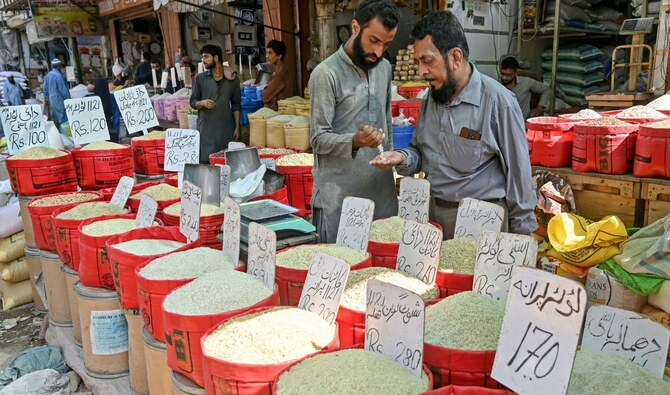
Pakistan’s rice exports surged to $4 billion in FY24 compared to $2.15 billion last year

1 / 2
Men check quality of rice at a grocery shop in Karachi on September 26, 2024. (AFP/ File)
2 / 2
A photograph taken on June 7, 2023 shows large bags of rice displayed for sale in Sonali Supermarket in the 'Balti Triangle' area of Birmingham, central England. (AFP/File)
Short Url
Updated 14 October 2024
Follow

Pakistan’s rice exports surged to $4 billion in FY24 compared to $2.15 billion last year

  • State media says favorable weather, “abundant” resources helped Pakistan export six million tons of rice 
  • Pakistan’s commerce minister said country aims to increase revenue from rice exports to $7 billion this year

ISLAMABAD: Pakistan generated $4 billion in revenue during financial year 2024 by exporting six million tons of different types of rice, state media reported on Monday, citing favorable weather conditions and “abundant” agricultural resources as the main reasons for the surge in exports. 

Pakistan exported rice worth $4 billion this year compared to $2.15 billion last year, benefiting largely from India’s more-than-a-year-long ban on rice exports to fulfill its domestic needs. India announced in September it was lifting the ban, prompting Pakistan to lift the minimum export price for all rice varieties in the country. 

India and Pakistan are the only two countries that produce basmati rice which is famous for its unique flavor and aroma. India has been the largest exporter of rice worldwide, followed by Pakistan, Thailand and Vietnam.

“With the support of the Special Investment Facilitation Council, Pakistan has earned revenue of four billion dollars from rice exports,” state broadcaster Radio Pakistan reported, referring to Pakistan’s top hybrid civil-military body formed last year to attract foreign investment in the country’s vital economic sectors. 

“During the fiscal year 2024, Pakistan exported more than 6 million tons of different varieties of rice due to favorable weather conditions and abundant availability of agricultural resources.”

Shahjahan Malik, former chairman of the Rice Exporters Association of Pakistan, said exporters have set a fresh target of $5 billion for rice exports for the next financial year. He added that a comprehensive strategy based on “modern seed research and quality agricultural practices” would be developed to enhance exports further. 

Earlier this month, Pakistan’s Commerce Minister Jam Kamal had said the country aimed to boost its rice exports to as much as $7 billion to support its dwindling economy. 


Pakistan PM calls PIA privatization ‘vote of confidence’ as government pushes reforms

Updated 4 sec ago
Follow

Pakistan PM calls PIA privatization ‘vote of confidence’ as government pushes reforms

  • The loss-making national flag carrier was sold to a Pakistani consortium for $482 million after two failed attempts
  • Finance minister vows to continue economic reforms, engage international partners through trade and investment

KARACHI: Prime Minister Shehbaz Sharif said on Tuesday the privatization of state-owned Pakistan International Airlines marked a “vote of confidence” in the country’s economy, as the government presses ahead with structural reforms aimed at easing pressure on public finances and attracting investment.

The sale of the loss-making national carrier by a Pakistani consortium, which secured a 75 percent stake for Rs135 billion ($482 million), follows two previous attempts to privatize PIA. The development comes as Pakistan seeks to build on macroeconomic stabilization after a prolonged balance-of-payments crisis, with authorities trying to shift the economy toward export-led growth and policy continuity.

“It was our firm commitment to the people of Pakistan that speedy and concrete steps would be taken to privatize loss-making state-owned enterprises that have been a burden on the economy,” Sharif said in a post on X. “The successful completion of the transparent and highly competitive bidding process for the privatization of PIA marks an important milestone in fulfilling that commitment.”

“The strong participation of our leading business groups and some of Pakistan’s most seasoned and respected investors is a powerful vote of confidence in our economy and its future,” he added.

https://x.com/cmshehbaz/status/2003498418984128908?s=46&t=SApcAZAv0zK56lMSgiF_fg

The government has made privatization of state-owned enterprises a key pillar of its reform agenda, alongside changes to taxation, energy pricing and trade policy, as it seeks to stabilize the economy and restore investor confidence.

Meanwhile, Finance Minister Muhammad Aurangzeb told an international news outlet Pakistan had reached a critical turning point, with macroeconomic stability and sustained reforms helping shift the economy from stabilization toward growth.

“Macroeconomic stability, sustained reforms and policy continuity are restoring confidence, shifting the economy from stabilization to export-led growth,” he said in an interview with USA Today, according to a statement issued by the finance ministry, adding that the government was opening new opportunities for domestic and global investors.

Aurangzeb said inflation had eased sharply, external balances had improved and foreign exchange reserves had risen above $14.5 billion, while Pakistan had recorded both a primary fiscal surplus and a current account surplus for the first time in several years.

The finance minister noted that economic growth remained insufficient to meet the needs of a fast-growing population, pointing out the importance of continuing structural reforms and encouraging investment in sectors such as agriculture, minerals, information technology and climate resilience.

Despite ongoing risks from global commodity prices, debt pressures and political uncertainty, Aurangzeb said the government remained committed to staying the reform course and engaging international partners through trade and investment.