

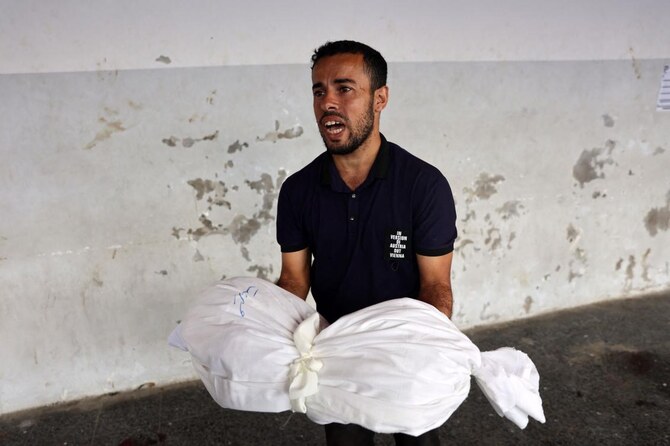

GAZA: At least 10 people were killed and 40 injured in northern Gaza on Monday after Israeli tank shells hit people queuing for food, Palestinian medics said, as fears mounted in the enclave that Israel plans to displace all residents from the north.
Medics said an Israeli drone had also opened fire where dozens of residents had gathered to receive food in Jabalia, one of Gaza’s eight historic refugee camps. Women and children were among the victims, they said.
The Israeli military said it was looking into the incident.
Jabalia has been the focus of an Israeli offensive for around 10 days and the military has now encircled the camp and sent tanks into nearby Beit Lahiya and Beit Hanoun towns, with the declared aim of stamping out Hamas fighters who are trying to regroup there.
With the Israeli military calling on Palestinians to evacuate south as they step up pressure on Hamas — and Hamas telling them not to leave because it was too risky — the past few days resemble earlier phases of the war.
The northern part of Gaza, home to well over half the territory’s 2.3 million people, was heavily bombed in the first phase of Israel’s assault on the territory which began a year ago.
Hundreds of thousands of northern Gaza residents quit their homes in the early months of the war, driven by Israeli evacuation orders and a military ground offensive in their areas, while around 400,000 people remained, according to United Nations estimates.
But months after intense ground fighting there, Israel sent troops back to Jabalia to root out Hamas fighters it said were regrouping for more attacks.
The armed wings of Hamas and the Islamic Jihad said their fighters have been staging attacks against the Israeli forces with anti-tank rockets and mortar bombs. For residents, there has been no reprieve. “We have been hit from the air and the ground, non-stop for a week, they want us to leave, they want to punish us for refusing to leave our homes,” said Marwa, 26, who left with her family to a school in Gaza City.
People were afraid they would never be able to return if they head south, she said.
Later on Monday, Hamas said Israel aimed to displace the people of northern Gaza by force through constant bombardment, and the blocking of aid, food and fuel.
“The international community should act against this war crime as the occupation is closing the territory and preventing the entry of relief goods and medication,” senior Hamas official Sami Abu Zuhri told Reuters.
“By doing so it causes slow death, that is in addition to daily direct killings it has been conducting,” said Abu Zuhri.
Concern over Israel plans to empty Jabalia
Some residents also fear that Israel plans to empty Jabalia and possibly, the entire northern area under a proposal floated by former Israeli generals, which calls for north Gaza to be cleared of civilians and remaining militants to be put under siege until they surrender.
Israel flatly denies such designs.
“We have not received a plan like that,” military spokesman Nadav Shoshani told reporters. “We are making sure we’re getting civilians out of harm’s way while we operate against those terror cells in Jabalia,” he said.
The proposal’s main author, Giora Eiland, said that his plan is meant to pressure Hamas to release hostages by ending its control of territory and aid, rather than sending Israeli forces in to battle its fighters.
“What they’re doing in Jabalia now is more of the same,” Eiland told Army Radio on Sunday. “My plan is not being implemented.”
Israel’s plans for the future of Gaza are unclear, beyond its stated aim of dismantling Hamas as a military and governing force.
The United Nations has described dire conditions affecting the civilian population remaining in Jabalia.
“Over 50,000 people have been displaced from the Jabalia area, which is cut off, while others remain stranded in their homes amid increased bombardment and fighting,” The UN’s Humanitarian Coordinator Muhannad Hadi said on Sunday.
“The latest military operations in northern Gaza have forced the closure of water wells, bakeries, medical points and shelters, as well as the suspension of protection services, malnutrition treatment, and temporary learning spaces. At the same time, hospitals have seen an influx of trauma injuries.”
The Israeli military did not immediately comment. Israel launched the offensive against Hamas after its Oct. 7 attack on Israel, in which 1,200 people were killed and around 250 taken hostage to Gaza, by Israeli tallies. More than 42,000 Palestinians have been killed in the offensive so far, according to Gaza’s health authorities.


