MULTAN: Australia pace legend Dennis Lillee denounced a pitch in Pakistan as a “graveyard for bowlers” in 1980, but more than 40 years later little has changed.
Lillee vented his anger after toiling for 21 wicketless overs in Faisalabad in a turgid draw.
All 11 Australian players, even wicketkeeper Rod Marsh, had a turn bowling in Pakistan’s second innings of 382-2 in reply to Australia’s 617 all out as the game petered out into near farce.
Last week, on a wicket described as “a road” by former captain Michael Vaughan, England rewrote the record books as they piled up 823-7 declared in reply to Pakistan’s 556 in the first Test in Multan.
The total was the fourth highest single innings in Test history.
Harry Brook plundered 317 at almost a run a ball and Joe Root became England’s highest Test run scorer during his career-best 262.
Their stand of 454 for the fourth wicket was an England record, the fourth highest in history and the most by any pair playing overseas.
Despite the lifeless pitch, England’s bowlers pulled off an innings and 47 run victory after Pakistan crumbled to 220 all out in their second innings.
It gave Pakistan an unwanted record — the first team to score 500 or more and lose a Test by an innings.
England batting great Kevin Pietersen said on X that the lack of help for bowlers in Multan, where the second Test begins on Tuesday, was “helping destroy Test cricket.”
It is a “perennial problem,” former Pakistan captain Wasim Akram told AFP. “For years it has been the same old story. Very rarely we used to get green and lively pitches in the 1990s and had to bowl long spell for wickets.”
Rashid Latif, a former Pakistan captain who has studied pitch preparation, said there was no need for the pitches to be curated so overwhelmingly in the batsmen’s favor.
“We can prepare good pitches but our mindset is negative,” Latif told AFP.
“There was good grass on the Multan pitch but it was shaved off, I don’t know on whose wishes.”
Former spinner and ex-selector Tauseef Ahmed, a member of Pakistan team who played in the infamous 1980 Faisalabad Test, said: “Our batters want a flat pitch to score runs.
“Even in domestic matches we have such pitches so that players score big and get prominence.”
The last two years has seen Pakistan pitches get even more docile. Each Test wicket there now costs an average of 42.13 runs, the highest anywhere in the world.
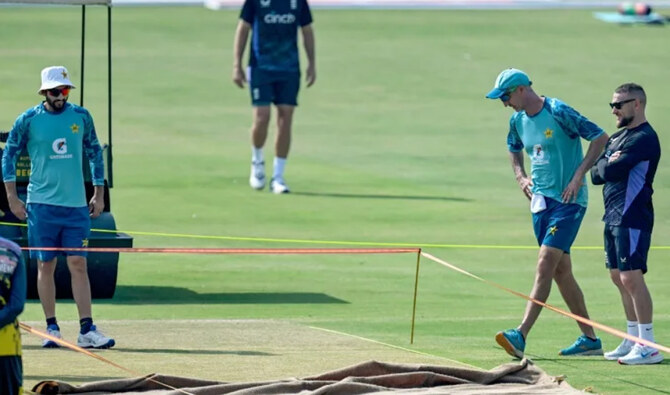
Pitch preparation is a science, with experts saying the ideal soil mix is around 60 percent clay with less sand, such as that found in Australia.
It produces firm and bouncy tracks which begin to take more spin over five days, providing a balance between ball and bat.
One local groundsman said pitches were a big problem in Pakistan.
“There are multiple factors from weather to interference from the team management who want it to suit them,” said the curator, who did not want to be named.
“That makes the process complex. A good pitch needs sun to bake it but in some weather we do not get that,” he said.
“A Test pitch needed to be cared for six months or a year but our pitches are over-used so they become flat.”
Latif said serious work was needed to lift the standard of pitches.
“There should be a research department under a good geologist to ascertain how a good pitch can be prepared,” said Latif.
He also wanted to see Australian Kookaburra balls used in Pakistan ditched for those with a more prominent seam to help bowlers.
“We need to have Grays, Duke or SG balls for our type of clay, which are hand-stitched,” said Latif.
Two years ago, Pakistan and Australia scored 1,187 runs with just 14 wickets taken in a soporific draw in Rawalpindi.
The then Pakistan cricket chief Ramiz Raja blasted the playing surface: “We live in the dark ages of pitches in Pakistan. This is not a good advert for Test cricket.”
With the second Test starting in Multan Tuesday and the third in Rawalpindi next week, it seems unlikely the bowlers will get any respite soon.


![]()

Bowlers’ graveyards: Pakistan’s placid pitches under fresh fire
Short Url
https://arab.news/97ksy
Bowlers’ graveyards: Pakistan’s placid pitches under fresh fire
- England piled up 823-7 last week in Multan on wicket described as a “road” by ex-cricketer Michael Vaughan
- Pakistani pitches have become more docile in past 2 years, each Test wicket now costing an average of 42.13 runs
Latest updates






© 2026 SAUDI RESEARCH & PUBLISHING COMPANY, All Rights Reserved And subject to Terms of Use Agreement.