

Pakistan deputy PM discusses Gaza and Lebanon conflicts with Saudi foreign minister

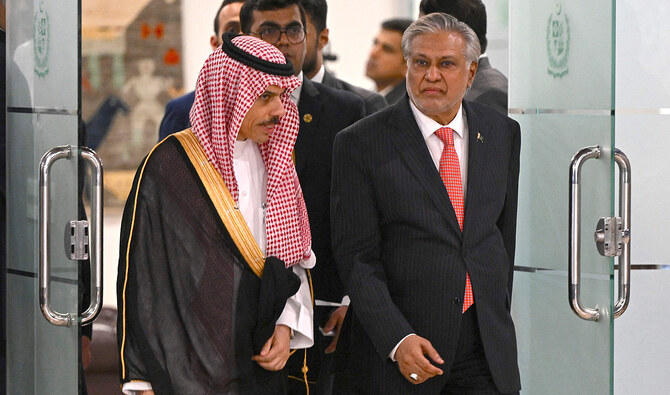
In this file photo, taken on April 16, 2024, Saudi Foreign Minister Prince Faisal bin Farhan (L) and his Pakistani counterpart Ishaq Dar arrive to address a joint press conference at the foreign ministry in Islamabad. (AFP/File)
Short Url
Updated 13 October 2024
Follow

Pakistan deputy PM discusses Gaza and Lebanon conflicts with Saudi foreign minister

  • The conversation between both leaders come at a time when Israel’s war in Gaza has lasted over a year
  • Both countries support each other on international forums and regularly consult on global developments

ISLAMABAD: Pakistan’s Deputy Prime Minister Ishaq Dar on Saturday discussed the regional situation with Saudi Foreign Minister Prince Faisal bin Farhan over the phone, with special focus on the conflict in Gaza and Lebanon, according to official statements released by both countries.
The conversation between both leaders come at a time when Israel’s war in Gaza has lasted over a year, leading to nearly 43,000 Palestinian deaths, mostly of women and children.
Israel also opened another front in Lebanon more recently, with the stated objective of destroying Hezbollah targets, raising fears of a wider war in the region, potentially involving Iran.
“Deputy Prime Minister and Foreign Minister Senator Mohammad Ishaq Dar @MIshaqDar50 today held a telephone call with the Foreign Minister of Saudi Arabia Prince Faisal bin Farhan Al Saud @faisalBinFarhan,” Pakistan’s foreign office informed in a social media post.
“They discussed the situation in Palestine and Lebanon and expressed their deep commitment and support for the people of Palestine and Lebanon,” it added.

 
The Saudi Press Agency also shared a brief statement mentioning the development, saying that both leaders reviewed bilateral relations and discussed regional and international developments.
Pakistan and Saudi Arabia enjoy close defense, diplomatic and economic relations, with both nations maintaining strong collaborative efforts across these sectors.
The two countries have consistently supported each other on international platforms and regularly consult on significant regional and global developments.


Sindh cabinet approves compensation for Gul Plaza victims after deadly Karachi fire

Updated 5 sec ago
Follow

Sindh cabinet approves compensation for Gul Plaza victims after deadly Karachi fire

  • Over 70 people were killed in one of Karachi’s worst fires, which took three days to extinguish
  • Deadly blazes have become frequent in the city amid weak fire safety, limited response capacity

ISLAMABAD: The Sindh cabinet on Tuesday approved a major relief and rehabilitation package for victims of the Gul Plaza fire, one of Karachi’s deadliest blazes, which killed more than 70 people and took three days to bring under control earlier this month.

The decision comes weeks after the fire ripped through the multi-story commercial building in the city’s Saddar area, trapping workers and traders as flames spread rapidly through the structure, exposing severe gaps in fire safety enforcement and emergency response.

Under the cabinet-approved package, families of those who died will receive Rs10 million ($35,800) each in compensation, while affected shopkeepers will be provided interest-free loans of Rs10 million per unit, with the provincial government bearing the cost of interest.

An additional Rs500,000 ($1,790) per shopkeeper has been approved as immediate subsistence support.

“There can be no compromise on human life,” Chief Minister Syed Murad Ali Shah said during the cabinet meeting, adding that the government’s priority was to support affected families while ensuring accountability.

“Relief, justice and prevention must go hand in hand,” he added.

The cabinet also constituted a high-level subcommittee, headed by the chief minister, to review the findings of an inquiry committee tasked with determining responsibility for the incident and recommending further action.

Fires have become an increasingly frequent occurrence in Karachi, a megacity of more than 20 million people, where fire services remain severely overstretched and under-resourced relative to population density and the scale of commercial activity.

Successive deadly incidents have drawn criticism of the Sindh administration over lax enforcement of building codes, inadequate inspections and limited emergency response capacity.