

North Kosovo ethnic tensions remain risk for violence, NATO official says

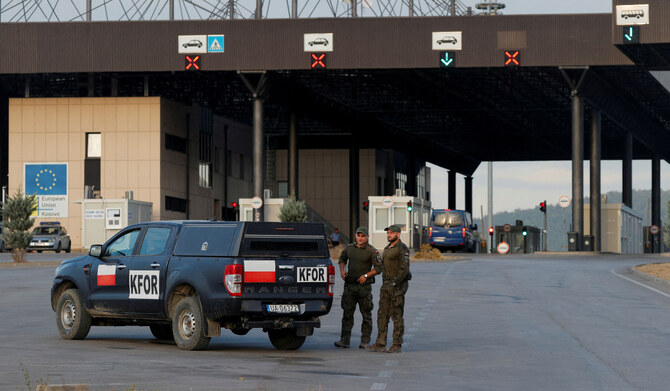
Polish soldiers part of the NATO-led peacekeeping mission stand as they monitor the main Kosovo-Serbia border crossing in Merdare, Kosovo September 6, 2024. (REUTERS)
Short Url
Updated 13 October 2024
Follow

North Kosovo ethnic tensions remain risk for violence, NATO official says

  • The US and the European Union, Kosovo’s leading global allies, have criticized the Pristina government for taking unilateral actions in the north that could spark ethnic violence and risk the lives of some 4,000 NATO troops on duty there

PRISTINA: Persistent ethnic tension in north Kosovo could trigger a repeat of violence seen in the area last year, when four people died in a gunbattle and NATO peacekeepers were hurt in clashes, a senior official from the military alliance warned on Saturday.
Kosovo is predominantly ethnic Albanian but about 50,000 Serbs in the north reject Pristina’s government and see Belgrade as their capital. A former Serbian province, Kosovo declared independence in 2008 a decade after a guerrilla uprising.
US Navy Admiral Stuart B. Munsch, commander of the Allied Joint Force Command Naples — which oversees NATO’s peacekeeping in force in Kosovo — said the alliance remained concerned about the risk of repeated violence in the volatile north.
“Heated political rhetoric could inspire some non-government forces to commit violence such as what happened last year,” Munsch told reporters in Pristina.
“I would not say that definitely conflict is coming, I think there is a persistent risk,” he said, referring to a lack of progress in EU-mediated talks between Kosovo’s government and Serbia.
A police officer and three gunmen were killed in September 2023 when a group of heavily armed attackers entered from Serbia and attacked police in the village of Banjska.
Four months earlier, more than 90 soldiers were injured when Serb protesters attacked NATO peacekeepers.
Kosovo has accused Serbia of being behind the Banjska attack but Belgrade has denied the accusations.
The US and the European Union, Kosovo’s leading global allies, have criticized the Pristina government for taking unilateral actions in the north that could spark ethnic violence and risk the lives of some 4,000 NATO troops on duty there.
Kosovo rejects such criticism, and the issue has strained Pristina’s ties with its Western supporters.
As part of the EU-mediated dialogue, Kosovo and Serbia have been holding talks for more than a decade to normalize their relations, but there has been little progress.
Like the Serbs living in north Kosovo, Belgrade also considers Kosovo to be part of Serbia and refuses to recognize it as a state.


India to provide $450 million to cyclone-ravaged Sri Lanka

Updated 23 December 2025
Follow

India to provide $450 million to cyclone-ravaged Sri Lanka

COLOMBO: India has committed $450 million in humanitarian assistance to help Sri Lanka recover from the devastating damage caused by Cyclone Ditwah, foreign minister Subrahmanyam Jaishankar said Tuesday on a visit to the country.
The cyclone killed more than 640 people when it swept across the South Asian island last month, causing floods and landslides that inflicted about $4 billion in damage, according to the World Bank, or 4 percent of the country’s GDP.
Sri Lankan President Anura Kumara Dissanayake has described the storm, which affected more than two million people, as the most challenging natural disaster in the island’s history.
Jaishankar, who is on a two-day visit, told a media briefing in Colombo he had handed a letter from Prime Minister Narendra Modi to Dissanayake, committing to a “reconstruction package of $450 million.”
While $350 million will take the form of “concessional lines of credit,” the remaining $100 million will be given as grants.
Jaishankar also noted the 1,100 tons of relief material, along with medicine and other necessary equipment, sent to India’s southern neighbor in the cyclone’s immediate aftermath.
“Given the scale of damage, restoring connectivity was clearly an immediate priority,” he said, detailing the Indian military’s assistance in providing portable bridges.
Jaishankar said India would also look at other ways to mitigate the losses, including encouraging Indian tourism to Sri Lanka.
“Similarly, an increase in foreign direct investment from India can boost your economy at a critical time,” he added.
The cyclone struck as Sri Lanka was emerging from its worst-ever economic meltdown in 2022, when it ran out of foreign exchange reserves to pay for essential imports such as food, fuel and medicines.
Following a $2.9 billion bailout from the International Monetary Fund approved in early 2023, the country’s economy has stabilized.
str-abh/cwl