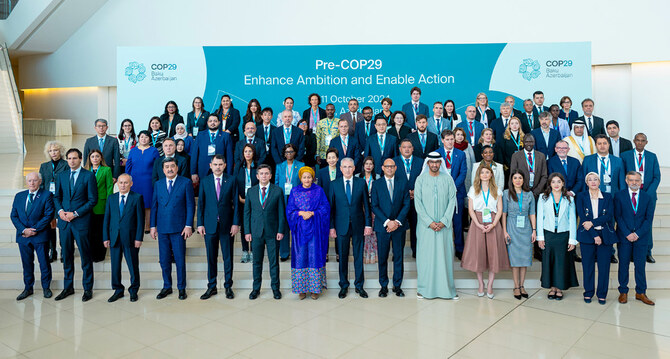
Global leaders gather in Baku to advance climate negotiations before COP29

Participants of the Pre-COP, which include global climate leaders, government officials, constituencies, and delegates, pose for a family picture at the opening of gathering in Baku, Azerbaijan on Oct. 10, 2024. (COP29 photo)
Short Url
Updated 03 November 2024
Follow

Global leaders gather in Baku to advance climate negotiations before COP29

  • Talks focus on finance and support for vulnerable communities
  • Azerbaijan’s President Ilham Aliyev urges agreement on key issues

The COP29 Presidency is hosting global climate leaders, government officials, constituencies, and delegates at Pre-COP in Baku, Azerbaijan, to discuss key environmental issues facing the planet.

The 3-day Pre-COP meeting, which started Oct. 10, provides an important platform for parties to advance climate negotiations ahead of the 29th Conference of the Parties to the UN Framework Convention on Climate Change, set to take place in November.

Pre-COP discussions are focusing on making progress on key priorities before COP29, including climate finance, the New Collective Quantified Goal, mitigation, adaptation, and supporting vulnerable communities, according to a press release issued by the organizers.

In an address delivered on his behalf by COP29 president-designate Mukhtar Babayev, President Ilham Aliyev of Azerbaijan emphasized the importance of agreeing an NCQG at COP29 that “meets the needs of the developing, least developed and small island developing states” and represents a “substantial increase” over the prior goal.

Aliyev said reaching this goal would require the collaboration of the international community. “Neither Azerbaijan in its capacity of the COP29 Presidency, nor any other state, can take decisions on behalf of others.

“Our role is to provide the platform for facilitating negotiations, which we believe we have been fulfilling impartially,” he said.

In his own address at the opening ceremony, Babayev recognized the progress made, while also calling for participants to act with urgency and use the Pre-COP meeting to build the foundation for a successful outcome at COP29.

“We are building bridges and momentum, but we need much more,” said Babayev. “We make progress when we come together, put differences aside, and engage in open and honest dialogue.”

Setting out clear goals for each priority, he identified the need to “take seriously the responsibility for identifying a number over a timeframe and come forward with solutions.

“Qualitative elements of the goal such as transparency and accessibility are also essential to ensuring that the goal is both fair and ambitious.”

Babayev also outlined goals for each of the other top negotiating priorities, including concluding work on Article 6 as a much-needed priority “crucial for directing financial and technical resources.”

The aim was to turn pledges into signed contributor agreements to the fund for responding to loss and damage, and attracting “significantly greater contributions” to all funds.

This includes the Green Climate Fund and the Adaptation Fund, and responding to the call of the UAE Consensus to transition away from fossil fuels in a just and orderly manner.

Pre-COP is the latest milestone in Azerbaijan’s preparations for COP29, which will be a key moment in the global effort to limit global warming to 1.5 degrees Celsius and build resilience to climate impacts.

In the lead up to Pre-COP, the COP29 Presidency also convened an informal Heads of Delegation meeting on Oct. 8 in Baku, followed by the formal High-Level Ministerial Dialogue on the NCQG on Oct. 9.

Another Heads of Delegation meeting is scheduled for Oct. 12.

“COP29 will be a defining test for both the Paris Agreement and for multilateralism,” stated Babayev.

“The world is watching, and history will judge us on the outcomes we achieve. Success or failure at COP29 will be collective and each of us has a role to play. We must all offer the best of ourselves.”


Saudi designer creating jewelry and prayer beads for spirituality

Updated 9 sec ago
Follow

Saudi designer creating jewelry and prayer beads for spirituality

  • Tasneem Anwar Eshki: I create these pieces not only as wearable art, but also to help people go through their hard times in life with a spiritual journey, through prayer and being closer to God
  • Tasneem Anwar Eshki: My jewelry is inspired by prayer beads and uses the same numbers, so tpieces carry a spiritual meaning and remind people of faith and reflection

JEDDAH: Designing prayer beads has always been considered a decorative pursuit, but for Saudi designer Tasneem Anwar Eshki, strings of breads take on a deeper meaning, becoming tools for prayer and spiritual focus.

“I create these pieces not only as wearable art, but also to help people go through their hard times in life with a spiritual journey, through prayer and being closer to God,” she told Arab News.

“My jewelry is inspired by prayer beads and uses the same numbers, so the pieces carry a spiritual meaning and remind people of faith and reflection.”

She continued: “My idea in inventing prayer beads is that a person’s relationship with God is the highest relationship in the universe, and for this reason I design it and perfect it with all the feeling I have so that each piece, just by looking at it, tells what it carries of feelings.”

Eshki has been creating unique art pieces with stories and messages since 2014.

Today, through determination, practice and perseverance, she has earned a name for herself and became known for creating unique, colorful prayer beads as art pieces, blending spiritual significance with jewelry design.

Though Eshki graduated with a degree in French literature at King Abdulaziz University, designing was her passion that gradually grew into an inspiring concept.

“I studied art and jewelry making, and I am still studying with the GIA,” she said.

“It all started when I was very young. I always had a love for art, gemstones, and nature. When I travel, I like to meet people who have the same passion.

“After getting married, my husband and my sisters encouraged me to turn this passion into something real. It was a big challenge for me to sell something that has a very high emotional and spiritual value and to put a price on it. That is when I came up with the idea of limited editions. Every release has its own story and symbol,” she added.

“I used to make a piece for every person around me who felt distressed and whom I couldn’t help. I would give them a gift that carried feelings of love and support, but I would ask that person to praise God because he alone is capable of everything.”

The Jeddah-based designer studied at the International Career Institute and ended with an executive diploma in jewelry design, and now runs her own business, Tasneem Ekshi.

“The brand focuses on limited editions, and every piece is handmade with messages and symbols. All pieces come with a lifetime warranty and are created from a true soul. I believe this sincerity is what makes any artwork stand out.”

She believes that simply running her own business online helped her to reach out to her costumers easily. “Saudi brands today have strong international exposure, which pushes us to reach the highest international standards,” she stated.

“I always believe that when you do your work with authenticity and dedication, it will naturally reach the world, and Saudi designers are already moving strongly in that direction.”

Eshki presented her latest collection at her annual event, which took place in Jeddah. “During my recent annual event, I launched my second signature scent. I also introduced new pieces that are more practical, from the Madinah collection.

“Since the brand is about helping people go through hard times with a spiritual journey, every year I celebrate the brand with a theme. This year’s theme is ‘Human Being,’ which aims to inspire people with deeper ideas that connect to the main purpose of the brand.”

Explaining her idea behind merging gems and beads, she said: “For me, it is about prayer and reflection. Each gemstone reflects the beauty of God’s creations, and the beads connect to spirituality and mindfulness.

“Gemstones, wood, oud wood, and spirituality. These elements are deeply connected to our culture and nature, and I like to reflect them in my pieces.”

Asked about what inspires her creative process the most, she said: “Nature, my journey in life, and my roots inspire me the most.

“Sometimes my work even surprises me, especially with the haute couture pieces. For example, the piece I created for Riyadh Fashion Week. When I saw the final result, I understood more about myself. My designs often reflect my personal journey.”

Despite the challenges earlier in her life as a designer, Eshki found ways and means to overcome them with her passion and perseverance.

“Balancing family, work, life, and health is something I am always working on. But as a Saudi business, we are lucky because the process today is much easier. I can create and run a whole business from wherever I am, since many things can be done online and reach people smoothly.”

While taking creative leaps as a designer, she has also remained firmly rooted in her culture, values her heritage, and is keen to preserve it.

“To be honest, I try to combine international exposure and experiences with my roots. This balance helps create something modern while still connected to my culture,” she concluded.