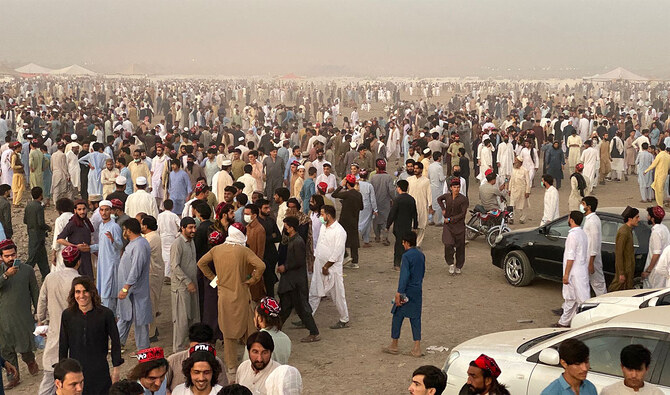
PESHAWAR/ DERA ISMAIL KHAN: Thousands of people gathered in the Khyber tribal district in Pakistan’s northwest on Friday to attend a three-day grand council organized by the recently banned Pashtun Tahafuz Movement (PTM) to address issues in the volatile region, though proceedings were delayed due to insufficient arrangements.
The provincial administration of Khyber Pakhtunkhwa (KP) allowed PTM to hold the Pashtun National Jirga after extensive deliberations involving representatives of different political parties a day earlier.
The dialogue over the issue was arranged by KP Chief Minister Ali Amin Gandapur and took place after federal authorities in Pakistan banned PTM on charges of supporting the Pakistani Taliban militants and promoting anti-state narratives and activities.
The PTM leadership, which has consistently denied these allegations and claims it only advocates for Pashtun rights, said it would proceed with the jirga to discuss security challenges in the province. The group lost three of its supporters in a clash with police on Wednesday while preparing for the ethnic gathering.
“The arrangements were delayed as we had an issue [with the police] some two days ago and faced a crackdown that impeded the preparations,” Zakim Wazir, a member of PTM’s central committee, told Arab News.
“Around 80 camps had to be set up for the jirga, and we were only allowed to do that by the provincial authorities the night before,” he added.
PTM founder Manzoor Ahmad Pashteen also highlighted these challenges while speaking to those attending the gathering.
“The proceedings of the first day will be held tomorrow [Saturday] along with the second day’s proceedings,” he said.
Earlier, the KP administration released a statement saying it had imposed several conditions on PTM before allowing the gathering.
“There will be no anti-state or anti-military slogans during the three-day tribal council meeting,” Barrister Muhammad Ali Saif, the KP administration’s spokesperson, said. “No one will also be allowed to raise the flag of any other country.”
Founded in 2014, PTM has long advocated against extrajudicial killings and enforced disappearances of Pashtuns and other ethnic minorities, for which the state is sometimes blamed, though it has always denied the charge.
The KP spokesperson emphasized that the protection of public life and property, along with the restoration of peace and security in the province, were the top priorities of the provincial administration.


![]()

Thousands gather in northwest Pakistan as grand council of banned Pashtun groups is delayed
Short Url
https://arab.news/93t5d
Thousands gather in northwest Pakistan as grand council of banned Pashtun groups is delayed
- PTM leaders say the ‘crackdown’ against them impeded the preparations for the Pashtun gathering
- KP government says it allowed the gathering on condition that no anti-state slogans will be raised
Latest updates




Recommended


© 2026 SAUDI RESEARCH & PUBLISHING COMPANY, All Rights Reserved And subject to Terms of Use Agreement.