MOGADISHU: Somalia says Egypt has offered to deploy peacekeeping troops to the Horn of Africa nation in a security partnership that is emerging as the mandate of a long-time group of African Union peacekeepers winds down.
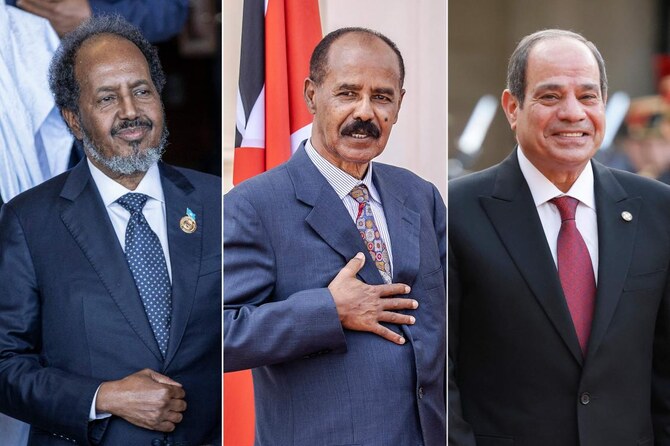
Egyptian President Abdel Fattah El-Sisi on Thursday attended a summit in the Eritrean capital, Asmara, where he and the leaders of Somalia and Eritrea pledged strong cooperation in regional security.
Somali authorities said in a statement at the end of the summit that they welcomed Egypt’s offer to deploy troops in Somalia as part of a stabilization force when the present African Union force disbands in December.
The statement said the leaders welcomed the African Union Peace and Security Council’s decision to launch the African Union Mission to Support Stabilization in Somalia, or AUSSOM, under whose mandate the Egyptians or others would be deployed.
A separate statement following the summit signed by representatives of Somalia, Egypt and Eritrea asserted Somalia’s sovereign right to determine the composition, tasks and deployment timeline for the AUSSOM troops.
Somalia’s federal government has been supported by an African Union peacekeeping mission since 2007 in fighting the Islamic extremist group Al-Shabab, which has ties with Al-Qaeda and is responsible for deadly attacks in the country.
The summit in Asmara followed a period of tensions in the region stemming from disputes pitting Ethiopia against others.
The first dispute — between Ethiopia and Egypt — is over Ethiopia’s construction of a $4 billion dam on the Blue Nile, a key tributary of the Nile River. Egypt fears it will have a devastating effect on water and irrigation supplies downstream in Egypt unless Ethiopia takes its needs into account. Ethiopia plans to use the dam to generate badly needed electricity.
The second dispute — between Ethiopia and Somalia — is over Somalia’s breakaway region of Somaliland.
Somalia has sought to block landlocked Ethiopia’s ongoing efforts to gain access to the Red Sea via a contentious agreement with Somaliland to lease a stretch of land along its coastline, where Ethiopia would establish a marine force base. In return, Ethiopia would recognize Somaliland as an independent country, according to Somaliland authorities.
Somaliland seceded from Somalia more than 30 years ago but is not recognized by the African Union or the United Nations as an independent state. Somalia still considers Somaliland part of its territory.

Somalia says it welcomes Egypt’s offer to deploy peacekeepers there
Short Url
https://arab.news/9c2g9
Somalia says it welcomes Egypt’s offer to deploy peacekeepers there
- Egyptian President Abdel Fattah El-Sisi on Thursday attended a summit in the Eritrean capital, Asmara
- Somali authorities said at the end of the summit that they welcome Egypt’s offer to deploy troops in Somalia as part of a stabilization force
Syrian Alawites protest in coastal heartland after mosque bombing
- Syrian Alawites took to the streets on Sunday in the coastal city of Latakia to protest after a mosque bombing that killed eight people in Homs two days before
LATAKIA: Syrian Alawites took to the streets on Sunday in the coastal city of Latakia to protest after a mosque bombing that killed eight people in Homs two days before.
The attack, which took place in an Alawite area of Homs city, was the latest against the religious minority, which has been the target of several episodes of violence since the December 2024 fall of longtime ruler Bashar Assad, himself an Alawite.
Security forces were deployed in the area, and intervened to break up clashes between demonstrators and counter-protesters, an AFP correspondent witnessed.
“Why the killing? Why the assassination? Why the kidnapping? Why these random actions without any deterrent, accountability or oversight?” said protester Numeir Ramadan, a 48-year-old trader.
“Assad is gone, and we do not support Assad... Why this killing?“
Sunday’s demonstration came after calls from prominent spiritual leader Ghazal Ghazal, head of the Islamic Alawite Council in Syria and Abroad, who on Saturday urged people to “show the world that the Alawite community cannot be humiliated or marginalized.”
“We do not want a civil war, we want political federalism. We do not want your terrorism. We want to determine our own destiny,” he said in a video message on Facebook.
Protesters carried pictures of Ghazal along with banners expressing support for him, while chanting calls for decentralized government authority and a degree of regional autonomy.
“Our first demand is federalism to stop the bloodshed, because Alawite blood is not cheap, and Syrian blood in general is not cheap. We are being killed because we are Alawites,” Hadil Salha, a 40-year-old housewife said.
Most Syrians are Sunni Muslim, and the city of Homs — where Friday’s bombing took place — is home to a Sunni majority but also has several areas that are predominantly Alawite, a community whose faith stems from Shiite Islam.
The community is otherwise mostly present across their coastal heartland in Latakia and Tartus provinces.
Since Assad’s fall, the Syrian Observatory for Human Rights monitor and Homs province residents have reported kidnappings and killings targeting members of the minority community.
- Alawite massacres -
The country has also seen several bloody flare-ups of sectarian violence.
Syria’s coastal areas saw the massacre of Alawite civilians in March, with authorities accusing armed Assad supporters of sparking the violence by attacking security forces.
A national commission of inquiry said at least 1,426 members of the minority were killed, while the Syrian Observatory for Human Rights monitor put the toll at more than 1,700.
Late last month, thousands of people demonstrated on the coast to protest fresh attacks targeting Alawites in Homs and other regions.
Before and after the March bloodshed, authorities carried out a massive arrest campaign in predominantly Alawite areas, which are also former Assad strongholds.
Protesters on Sunday also demanded the release of detainees.
On Friday, Syrian state television reported the release of 70 detainees in Latakia “after it was proven that they were not involved in war crimes,” saying more releases would follow.
Despite assurances from Damascus that all Syria’s communities will be protected, the country’s minorities remain wary of their future under the new Islamist authorities, who have so far rejected calls for federalism.
The attack, which took place in an Alawite area of Homs city, was the latest against the religious minority, which has been the target of several episodes of violence since the December 2024 fall of longtime ruler Bashar Assad, himself an Alawite.
Security forces were deployed in the area, and intervened to break up clashes between demonstrators and counter-protesters, an AFP correspondent witnessed.
“Why the killing? Why the assassination? Why the kidnapping? Why these random actions without any deterrent, accountability or oversight?” said protester Numeir Ramadan, a 48-year-old trader.
“Assad is gone, and we do not support Assad... Why this killing?“
Sunday’s demonstration came after calls from prominent spiritual leader Ghazal Ghazal, head of the Islamic Alawite Council in Syria and Abroad, who on Saturday urged people to “show the world that the Alawite community cannot be humiliated or marginalized.”
“We do not want a civil war, we want political federalism. We do not want your terrorism. We want to determine our own destiny,” he said in a video message on Facebook.
Protesters carried pictures of Ghazal along with banners expressing support for him, while chanting calls for decentralized government authority and a degree of regional autonomy.
“Our first demand is federalism to stop the bloodshed, because Alawite blood is not cheap, and Syrian blood in general is not cheap. We are being killed because we are Alawites,” Hadil Salha, a 40-year-old housewife said.
Most Syrians are Sunni Muslim, and the city of Homs — where Friday’s bombing took place — is home to a Sunni majority but also has several areas that are predominantly Alawite, a community whose faith stems from Shiite Islam.
The community is otherwise mostly present across their coastal heartland in Latakia and Tartus provinces.
Since Assad’s fall, the Syrian Observatory for Human Rights monitor and Homs province residents have reported kidnappings and killings targeting members of the minority community.
- Alawite massacres -
The country has also seen several bloody flare-ups of sectarian violence.
Syria’s coastal areas saw the massacre of Alawite civilians in March, with authorities accusing armed Assad supporters of sparking the violence by attacking security forces.
A national commission of inquiry said at least 1,426 members of the minority were killed, while the Syrian Observatory for Human Rights monitor put the toll at more than 1,700.
Late last month, thousands of people demonstrated on the coast to protest fresh attacks targeting Alawites in Homs and other regions.
Before and after the March bloodshed, authorities carried out a massive arrest campaign in predominantly Alawite areas, which are also former Assad strongholds.
Protesters on Sunday also demanded the release of detainees.
On Friday, Syrian state television reported the release of 70 detainees in Latakia “after it was proven that they were not involved in war crimes,” saying more releases would follow.
Despite assurances from Damascus that all Syria’s communities will be protected, the country’s minorities remain wary of their future under the new Islamist authorities, who have so far rejected calls for federalism.
© 2025 SAUDI RESEARCH & PUBLISHING COMPANY, All Rights Reserved And subject to Terms of Use Agreement.