

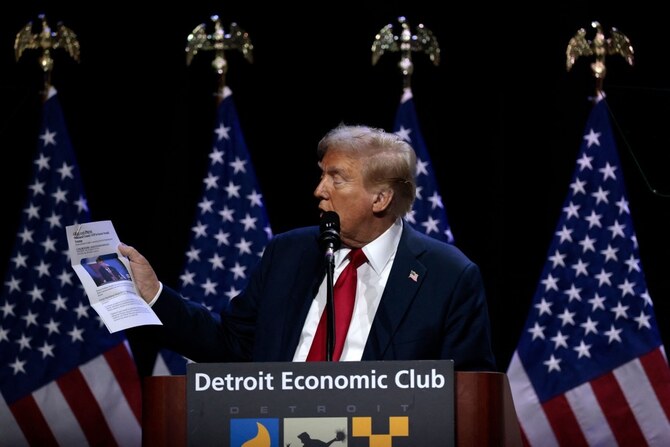
Trump insults Detroit while campaigning in the city

Democrats in the state were quick to criticize Trump for his comments. (AFP)
Short Url
Updated 11 October 2024
Follow

Trump insults Detroit while campaigning in the city

DETROIT: Former President Donald Trump criticized Detroit while delivering remarks to an economic group there on Thursday, saying the whole country would end up like the city if his Democratic opponent, Vice President Kamala Harris, is elected.
“The whole country will be like — you want to know the truth? It’ll be like Detroit,” the Republican presidential nominee said. “Our whole country will end up being like Detroit if she’s your president.”
Trump’s remarks came as he addressed the Detroit Economic Club in a speech appealing to the auto industry, a key segment of the population in battleground Michigan’s largest city. But he made conflicting remarks about Detroit throughout the speech, saying it was a “developing” city in an apparent compliment.
Democrats in the state were quick to criticize Trump for his comments. Detroit Mayor Mike Duggan lauded the city’s recent drop in crime and growing population.
“Lots of cities should be like Detroit. And we did it all without Trump’s help,” he said on social media.
US Rep. Shri Thanedar, who represents Detroit, said on social media that Trump should “keep Detroit and our people out of your mouth.” Referring to Trump’s efforts to win Michigan, Attorney General Dana Nessel said on X, “This guy is calling us ugly and then asking us out on a date.”
Gov. Gretchen Whitmer, who has been a major surrogate for the Democratic presidential ticket, shot back at Trump, saying on X, “And you better believe Detroiters won’t forget this in November.”
Wayne County, which is home to Detroit, hasn’t been kind to Trump in previous elections. In both 2016 and 2020, Trump got about 30 percent of the vote in Wayne, losing the county by huge margins.

Trump’s campaign said in a statement after his appearance that Detroit has “suffered from globalist policies championed by Kamala Harris” that have led to manufacturing moving overseas.
“As President Trump emphasized in his speech, his policies will usher in a new era of economic success and stability for Detroit, helping the city reach its fullest potential,” said Victoria LaCivita, Trump’s Michigan communications director.
Trump’s comments come as many in the city feel that Detroit has turned the corner from national joke to national attraction. Nearly a decade from exiting its embarrassing bankruptcy, the Motor City has stabilized its finances, improved city services, stanched the population losses that saw more than a million people leave since the 1950s and made inroads in cleaning up blight across its 139 square miles.
Detroit is now a destination for conventions and meetings. In April, Detroit set an attendance record for the NFL draft when more than 775,000 fans poured into the city’s downtown for the three-day event. And just a few hours after Trump’s remarks, thousands of people were expected to pour into the same area as the city’s baseball team, the Tigers, aimed to win their AL Division Series.
Some event attendees understood Trump’s Detroit comment to be in reference to the city’s previous financial woes.
“I don’t think it was intentional on his part,” said Judy Moenck, 68. “There was blight. Now tremendous work has been done, and Detroiters will feel probably a little bit hurt by that.”
Her husband, Dean Moenck, 74, who said he no longer considers himself a Republican in Trump’s GOP, said the comment fits into his campaign rhetoric style, “bringing out the negative things of Detroit.”
This isn’t the first time Trump has insulted the city he’s campaigning in.
While in New York for his civil fraud and criminal trials, he routinely bashed the city, calling it dirty and crime-ridden and arguing that its overwhelmingly Democratic residents might be swayed to vote for him over concerns about migrants and safety.


Somali president to Asharq Al-Awsat: Working with Saudi-led partners to void Israel’s Somaliland recognition

Updated 59 min 8 sec ago
Follow

Somali president to Asharq Al-Awsat: Working with Saudi-led partners to void Israel’s Somaliland recognition

  • Hassan Sheikh Mohamud unveils three-pronged diplomatic and legal strategy to defend Somalia’s sovereignty and territorial unity
  • Says Mogadishu coordinates with Saudi Arabia and Arab, African partners to counter what he calls a dangerous precedent

RIYADH: Somali President Hassan Sheikh Mohamud unveiled a three-pronged political and legal strategy to nullify what he described as Israeli recognition of the breakaway region of Somaliland, warning that such a move threatens Somalia’s sovereignty and regional stability.

Speaking to Asharq Al-Awsat, Mohamud said his government is acting in close coordination with partners led by Saudi Arabia to safeguard stability and shield the Horn of Africa from what he called “reckless escalation.”

Without naming specific countries, the Somali leader said some regional states may see the Israeli recognition as an opportunity to pursue “narrow, short-term interests at the expense of Somalia’s unity and regional stability.”

“I do not wish to name any particular country or countries,” he said. “But it is clear that some may view this recognition as a chance to achieve limited gains.”

Somali President Hassan Sheikh Mohamud visiting the country's soldiers in the frontline. (X)

He stressed that Somalia’s unity is a “red line,” adding that Mogadishu has taken firm positions to protect national sovereignty. “We warn against being misled by reckless Israeli adventurism,” he said.

Mohamud was referring to recognition announced by Israeli Prime Minister Benjamin Netanyahu of the self-declared Republic of Somaliland as an independent state.

“I affirm with the utmost clarity and firmness that any recognition of Somaliland as an independent state constitutes a blatant violation of the sovereignty and unity of the Federal Republic of Somalia,” he said.

He described the move as a grave breach of international law, the UN Charter, and African Union resolutions that uphold respect for inherited African borders.

On that basis, Somalia has adopted and will continue to pursue three parallel measures, he revealed.

The first involves immediate diplomatic action through the UN, African Union, and Organization of Islamic Cooperation to reject and legally and politically invalidate the recognition.

Mohamud said Somalia called for and secured a formal session at the UN Security Council to address what he termed a “flagrant Israeli violation” of Somalia’s sovereignty and territorial integrity.

The session, he said, marked a significant diplomatic victory for Mogadishu, particularly given Somalia’s current membership on the council.

He expressed “deep appreciation” for statements of solidarity and condemnation issued by the African Union, Arab League, OIC, Gulf Cooperation Council, Intergovernmental Authority on Development (IGAD), and the EU, among others.

The second step centers on coordinating a unified Arab, Islamic, and African position. Mohamud praised Saudi Arabia for being among the first to issue a clear statement rejecting any infringement on Somalia’s unity.

He said the Saudi position reflects the Kingdom’s longstanding commitment to state sovereignty and territorial integrity, reinforced by the Saudi cabinet’s “firm and principled” support for Somalia during what he described as a delicate moment.

The third step focuses on strengthening internal national dialogue to address political issues within the framework of a single Somali state, free from external interference or dictates.

Mohamud warned that if left unchecked, the recognition could set a “dangerous precedent and undermine regional and international peace and security.”

He said it could embolden separatist movements not only in the Horn of Africa but across Africa and the Arab world, citing developments in countries such as Sudan and Yemen as evidence of the high cost of state fragmentation.

“This concerns a vital global shipping artery and core Arab national security,” he said, referring to the Red Sea.

“Any political or security tension along Somalia’s coast will directly affect international trade and energy security.”

He added that instability would impact Red Sea littoral states, particularly Saudi Arabia, Egypt, Sudan, Eritrea, Yemen, and Jordan. “Preserving Somalia’s unity is a cornerstone of collective Red Sea security,” he said.

Mohamud argued that Israel’s objective goes beyond political recognition. 

“We believe the goal extends beyond a political gesture,” he told Asharq Al-Awsat. “It includes seeking a strategic foothold in the Horn of Africa near the Red Sea, enabling influence over the Bab Al-Mandeb Strait and threatening the national security of Red Sea states.”

He described the move as a test of Somali, Arab, and African resolve on issues of sovereignty and territorial unity, emphasizing that Somalia’s opposition to secession is a principled and enduring national stance supported widely in the Arab and African worlds, “foremost by Saudi Arabia.”

He rejected any attempt to turn Somalia into a battleground for regional or international rivalries. “We will not allow Somalia to become an arena for settling conflicts that do not serve our people’s interests or our region’s security,” he declared.

Regarding Saudi-Somali relations, Mohamud described the partnership as “deep-rooted and strategic, rooted in shared history, religion, and a common destiny.” Saudi Arabia, he said, “remains a central partner in supporting Somalia’s stability, reconstruction, development, and Red Sea security.”

He voiced admiration for Saudi Arabia’s Vision 2030 and the economic and development gains achieved under the leadership of Custodian of the Two Holy Mosques King Salman bin Abdulaziz and Prince Mohammed bin Salman, Crown Prince and Prime Minister.

Asked about the recent Saudi Cabinet decision rejecting any attempt to divide Somalia, Mohamud said the federal government received it with “great appreciation and relief.”

He said the position extends the Kingdom’s historic support for Somalia’s territorial unity and sovereignty, reinforces regional stability, and sends an important message to the international community on the need to respect state sovereignty and refrain from interference in internal affairs.