

Efforts at reconciliation in northwest Pakistan after clashes at gathering by ‘banned’ Pashtun group

Governor of Khyber Pakhtunkhwa, Faisal Karim Kundi (second left), Chief Minister of Khyber Pakhtunkhwa, Ali Amin Gandapur (third from left) and Federal Interior Minister Mohsin Naqvi (second from right) are pictured as they address media in Peshawar, Pakistan, on October 10, 2024. (PID)
Short Url
Updated 10 October 2024
Follow

Efforts at reconciliation in northwest Pakistan after clashes at gathering by ‘banned’ Pashtun group

  • Thursday’s jirga was called by KP CM Gandapur, with archrivals Interior Minister Mohsin Naqvi and KP Governor Faisal Karim Kundi in attendance
  • At least three people were killed in clashes Wednesday between Pakistani police and supporters of the recently banned PTM civil rights group

PESHAWAR: A grand assembly of political and tribal leaders held on Thursday in the northwestern Pakistani city of Peshawar designated the provincial chief minister to resolve peace-related issues in Khyber Pakhtunkhwa province ahead of a three-day gathering being organized by the recently banned Pashtun Tahafuz Movement (PTM).
At least three people were killed in clashes Wednesday between Pakistani police and supporters of the PTM rights group advocating for ethnic Pashtuns. The violence came after the government on Monday banned the PTM saying it supports the Pakistani Taliban, an outlawed militant group. It also banned rallies by the group in the restive northwest, saying the demonstrations are against the interests of Pakistan. The PTM denies backing the Pakistani Taliban and says despite the ban on public gatherings, it will go ahead with holding a Qaumi Jirga grand assembly on October 11 to discuss peace and security in KP province.
Thursday’s jirga, a traditional assembly in Pashtun communities used to resolve disputes and make decisions on social and political matters, was called by KP Chief Minister Ali Amin Gandapur, with archrivals Federal Interior Minister Mohsin Naqvi and KP Governor Faisal Karim Kundi also in attendance.
The PTM, founded in 2014, has long advocated against extrajudicial killings and enforced disappearances of Pashtuns and other ethnic minorities in Pakistan, charges the government and military deny. The group has since been waging a campaign to force the military to leave the former tribal regions in the northwest that border Afghanistan.
“The purpose of the jirga is to find a peaceful solution to the conflict through dialogue and mutual understanding,” Barrister Muhammad Ali Saif, the KP government spokesperson, said in a statement about Thursday’s gathering. “The jirga has given Chief Minister Ali Amin Gandapur full authority to resolve the conflict through dialogue and understanding.”
The statement did not mention how the KP government plans to deal with the PTM’s Qaumi Jirga, but Mohsin Dawar, a former lawmaker from North Waziristan who was previously affiliated with the PTM, said authorities had agreed to allow the gathering.
“Participated in the meeting called by the Chief Minister on PTM’s Pashtuns National Jarga,” he said in a social media post. “We demanded from all the political parties in the meeting to allow PTM’s Jirga to be held. Our demand has been accepted and the federal and provincial govts will allow the Jarga tomorrow.”

Amnesty International on Wednesday called on the Pakistan government to revoke the ban on the Pashtun group.
The “latest arbitrary ban under over-broad powers of the terror law is only the tip of the iceberg,” said Babu Ram Pant, Amnesty’s deputy regional director for South Asia, accusing the authorities of “resorting to unlawful use of force, enforced disappearances, and media bans on the coverage of protests or rallies.”

Pakistan reports current account surplus in Jan. owing to improved trade, remittances

Updated 17 February 2026
Follow

Pakistan reports current account surplus in Jan. owing to improved trade, remittances

  • Pakistan’s exports crossed the $3 billion mark in Jan. as the country received $3.5 billion in remittances
  • Last month, IMF urged Pakistan to accelerate pace of structural reforms to strengthen economic growth

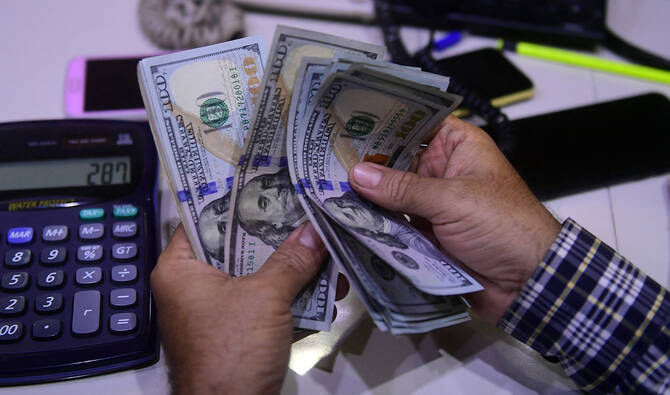
ISLAMABAD: Pakistan recorded a current account surplus of more than $120 million in January, the country’s finance adviser said on Tuesday, attributing it to improved trade balance and remittance inflows.

Pakistan’s exports rebounded in January 2026 after five months of weak performance, rising 3.73 percent year on year and surging 34.96 percent month on month, according to data released by the country’s statistics bureau.

Exports crossed the $3 billion mark for the first time in January to reach $3.061 billion, compared to $2.27 billion in Dec. 2025. The country received $3.5 billion in foreign remittances in Jan. 2026.

Khurram Schehzad, an adviser to the finance minister, said Pakistan reported a current account surplus of $121 million in Jan., compared to a current account deficit of $393 million in the same month last year.

“Improved trade balance in January 2026, strong remittance inflows, and sustained momentum in services exports (IT/Tech) continue to reinforce the country’s external account position,” he said on X.

Pakistan has undergone a difficult period of stabilization, marked by inflation, currency depreciation and financing gaps, and international rating agencies have acknowledged improvements after Islamabad began implementing reforms such as privatizing loss-making, state-owned enterprises (SOEs) and ending subsidies as part of a $7 billion International Monetary Fund (IMF) loan program.

Late last month, the IMF urged Pakistan to accelerate the pace of these structural reforms to strengthen economic growth.

Responding to questions from Arab News at a virtual media roundtable on emerging markets’ resilience, IMF’s director of the Middle East and Central Asia Jihad Azour said Islamabad’s implementation of the IMF requirements had been “strong” despite devastating floods that killed more than 1,000 people and devastated farmland, forcing the government to revise its 4.2 percent growth target to 3.9 percent.

“What is important going forward in order to strengthen growth and to maintain the level of macroeconomic stability is to accelerate the structural reforms,” he said at the meeting.

Azour underlined Pakistan’s plans to privatize some of the SOEs and improve financial management of important public entities, particularly power companies, as an important way for the country to boost its capacity to cater to the economy for additional exports.

“This comes in addition to the effort that the authorities have made in order to reform their tariffs, which will allow the private sector of Pakistan to become more competitive,” the IMF official said.