Efforts at reconciliation in northwest Pakistan after clashes at gathering by ‘banned’ Pashtun group

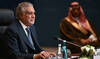
Governor of Khyber Pakhtunkhwa, Faisal Karim Kundi (second left), Chief Minister of Khyber Pakhtunkhwa, Ali Amin Gandapur (third from left) and Federal Interior Minister Mohsin Naqvi (second from right) are pictured as they address media in Peshawar, Pakistan, on October 10, 2024. (PID)
Short Url
Updated 10 October 2024
Follow

Efforts at reconciliation in northwest Pakistan after clashes at gathering by ‘banned’ Pashtun group

  • Thursday’s jirga was called by KP CM Gandapur, with archrivals Interior Minister Mohsin Naqvi and KP Governor Faisal Karim Kundi in attendance
  • At least three people were killed in clashes Wednesday between Pakistani police and supporters of the recently banned PTM civil rights group

PESHAWAR: A grand assembly of political and tribal leaders held on Thursday in the northwestern Pakistani city of Peshawar designated the provincial chief minister to resolve peace-related issues in Khyber Pakhtunkhwa province ahead of a three-day gathering being organized by the recently banned Pashtun Tahafuz Movement (PTM).
At least three people were killed in clashes Wednesday between Pakistani police and supporters of the PTM rights group advocating for ethnic Pashtuns. The violence came after the government on Monday banned the PTM saying it supports the Pakistani Taliban, an outlawed militant group. It also banned rallies by the group in the restive northwest, saying the demonstrations are against the interests of Pakistan. The PTM denies backing the Pakistani Taliban and says despite the ban on public gatherings, it will go ahead with holding a Qaumi Jirga grand assembly on October 11 to discuss peace and security in KP province.
Thursday’s jirga, a traditional assembly in Pashtun communities used to resolve disputes and make decisions on social and political matters, was called by KP Chief Minister Ali Amin Gandapur, with archrivals Federal Interior Minister Mohsin Naqvi and KP Governor Faisal Karim Kundi also in attendance.
The PTM, founded in 2014, has long advocated against extrajudicial killings and enforced disappearances of Pashtuns and other ethnic minorities in Pakistan, charges the government and military deny. The group has since been waging a campaign to force the military to leave the former tribal regions in the northwest that border Afghanistan.
“The purpose of the jirga is to find a peaceful solution to the conflict through dialogue and mutual understanding,” Barrister Muhammad Ali Saif, the KP government spokesperson, said in a statement about Thursday’s gathering. “The jirga has given Chief Minister Ali Amin Gandapur full authority to resolve the conflict through dialogue and understanding.”
The statement did not mention how the KP government plans to deal with the PTM’s Qaumi Jirga, but Mohsin Dawar, a former lawmaker from North Waziristan who was previously affiliated with the PTM, said authorities had agreed to allow the gathering.
“Participated in the meeting called by the Chief Minister on PTM’s Pashtuns National Jarga,” he said in a social media post. “We demanded from all the political parties in the meeting to allow PTM’s Jirga to be held. Our demand has been accepted and the federal and provincial govts will allow the Jarga tomorrow.”

Amnesty International on Wednesday called on the Pakistan government to revoke the ban on the Pashtun group.
The “latest arbitrary ban under over-broad powers of the terror law is only the tip of the iceberg,” said Babu Ram Pant, Amnesty’s deputy regional director for South Asia, accusing the authorities of “resorting to unlawful use of force, enforced disappearances, and media bans on the coverage of protests or rallies.”


Pakistan, ADB ink $61.8 million agreements for three development projects

Updated 4 sec ago
Follow

Pakistan, ADB ink $61.8 million agreements for three development projects

  • Agreements pertain to the upgradation of ML-1 railway link, key bus project in Quetta and water sector development in Balochistan
  • Pakistani official says projects will “significantly contribute” to long-term, sustainable economic growth, address infrastructure needs

ISLAMABAD: Pakistan and the Asian Development Bank (ADB) on Friday signed agreements for three major development initiatives worth $61.8 million to boost connectivity, urban transport and water sector in various parts of the country, state-run media reported. 

The two side signed agreements relating to project readiness financing for the Karachi-Rohri Section of the Main Line-I, a critical link needed to transport copper and gold from the Reko Diq mine in southwestern Pakistan to export hubs, for $10 million. 

Another project readiness financing agreement was signed for a bus rapid transit project in the southwestern city of Quetta worth $3.8 million. The last agreement pertained to additional financing for the Balochistan Water Resources Development Sector Project, which amounts to $48 million. 

“The secretary, Ministry of Economic Affairs, expressed appreciation for ADB’s role as a trusted development partner, and its continued support to Pakistan to complement the development agenda of the country,” the state-run Associated Press of Pakistan (APP) said. 

He said the critical projects would “significantly contribute” to Pakistan’s long-term and sustainable economic growth, address urban infrastructure needs of the provincial capital of Quetta, and enhance agricultural productivity in Balochistan.

ADB’s Country Director for Pakistan Emma Fan appreciated Pakistan’s commitment toward development initiatives. 

“She also reaffirmed ADB’s continued commitment to working closely with the Ministry of Economic Affairs and other stakeholders to ensure its support remains aligned with Pakistan’s development priorities,” APP said. 

ADB has undertaken initiatives to support Pakistan’s economic recovery by strengthening its public finances, social protection systems and helping Islamabad with its post-flood reconstruction efforts. 

The bank says it has committed 764 public sector loans, grants, and technical assistance to the South Asian country totaling $43.4 billion to date.