3 protesters are killed in clashes with police after Pakistan banned an ethnic rights group

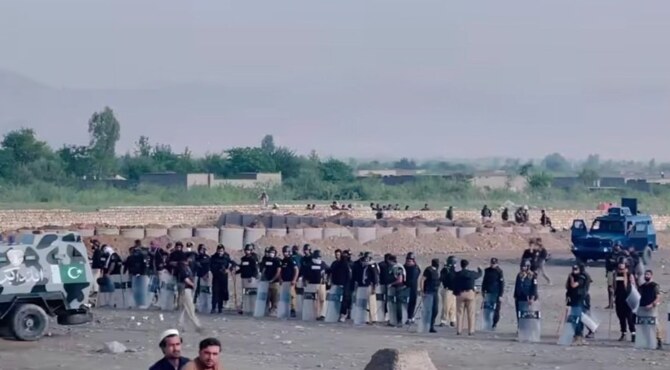
At least three people were killed in clashes Wednesday between Pakistani police and supporters of a rights group advocating for the Pashtun ethnic minority, angered by a government ban imposed on the organization this week, local officials said. (X/@BalochYakjehtiC)
Short Url
Updated 09 October 2024
Follow

3 protesters are killed in clashes with police after Pakistan banned an ethnic rights group

  • Officers fired tear gas and swung batons to disperse hundreds of protesters who had gathered in the town of Jamrud
  • Footage on social media showed police firing in the air, unleashing tear gas and wielding batons among the crowd

PESHAWAR: At least three people were killed in clashes Wednesday between Pakistani police and supporters of a rights group advocating for the Pashtun ethnic minority, angered by a government ban imposed on the organization this week, local officials said.
Officers fired tear gas and swung batons to disperse hundreds of protesters who had gathered in the town of Jamrud, near the city of Peshawar to denounce the ban. Roohul Ameen, a doctor at a main local hospital said they received three bodies brought in following the clashes and about a dozen injured protesters.
Footage on social media showed police firing in the air, unleashing tear gas and wielding batons among the crowd, which responded by throwing stones at the officers.
The violence came after the government on Monday banned the Pashtun Protection Movement, saying it supports the Pakistani Taliban, an outlawed militant group.
It also banned rallies by the group in the restive northwest, allegedly because the demonstrations are against the interests of Pakistan. The Pashtun Protection Movement denies backing the Pakistani Taliban.
The group was founded in 2014, after its leaders accused the Pakistani military and local police of abuses against the Pashtuns in their war against militants.
The group also says Pakistani security forces have been illegally detaining its members. The military and the government have denied all the allegations, saying their operations only target insurgents.
The group has since been waging a campaign to force the military to leave the former tribal regions in the northwest that border Afghanistan. Ethnic Pashtuns live mainly in eastern and southern Afghanistan but also all across Pakistan, in particular in parts along the Afghanistan-Pakistan border.
The Pakistani Taliban are a militant group that is separate but also a close ally of the Afghan Taliban, who seized power in Afghanistan in August 2021. They have stepped up attacks in recent years mainly targeting Pakistani security forces but hundreds of civilians have also been killed in the crossfire.
Manzoor Pashteen, who heads the Pashtun Protection Movement, said the group does not accept the government ban and was determined to hold a peaceful meeting of elders on Friday in the town of Regi, a former militant stronghold in the Khyber Pakhtunkhwa province.
Amnesty International on Wednesday also asked Pakistan’s government to revoke the ban on the Pashtun group.
The “latest arbitrary ban under over-broad powers of the terror law is only the tip of the iceberg,” said Babu Ram Pant, Amnesty’s deputy regional director for South Asia, accusing the authorities of “resorting to unlawful use of force, enforced disappearances, and media bans on the coverage of protests or rallies.”


Ukraine president to meet European allies after Trump criticism

Updated 58 min 10 sec ago
Follow

Ukraine president to meet European allies after Trump criticism

  • Talks between Ukrainian and US officials in Miami ended on Saturday with no apparent breakthrough
  • President Donald Trump accuses Ukrainian leader of not reading the US proposal to end the war with Russia

LONDON: Ukrainian leader Volodymyr Zelensky was due to meet with European allies in London on Monday, after President Donald Trump accused him of not reading the US proposal to end the war with Russia.

It comes after days of talks between Ukrainian and US officials in Miami ended on Saturday with no apparent breakthrough, with Zelensky committing to further negotiations.

The Ukrainian president will be received in London by British Prime Minister Keir Starmer, along with the German chancellor and French president to discuss the negotiations.

British Foreign Secretary Yvette Cooper is meanwhile expected in Washington on Monday, where she will meet her American counterpart Marco Rubio.

“The UK and US will reaffirm their commitment to reaching a peace deal in Ukraine,” the Foreign Office in London said, announcing Cooper’s visit.

Moscow has meanwhile continued to strike its neighbor, wounding at least nine people overnight Sunday to Monday, according to Ukrainian officials.

‘Disappointed’

Zelensky said he joined his negotiators for a “very substantive and constructive” call with US envoys Steve Witkoff and Jared Kushner during the Miami negotiations.

“Ukraine is committed to continuing to work honestly with the American side to bring about real peace,” Zelensky said on Telegram, adding that the parties agreed “on the next steps and the format of the talks with America.”

But Trump criticized his Ukrainian counterpart on Sunday, telling reporters “I have to say that I’m a little bit disappointed that President Zelensky hasn’t yet read the proposal, that was as of a few hours ago.”

Witkoff and Kushner had met Russian President Vladimir Putin at the Kremlin last week, with Moscow rejecting parts of the US proposal.

French President Emmanuel Macron ahead of Monday’s talks slammed what he called Russia’s “escalatory path.”

“We will continue these efforts with the Americans to provide Ukraine with security guarantees, without which no robust and lasting peace will be possible,” Macron wrote on X.

He added: “We must continue to exert pressure on Russia to compel it to choose peace.”

Hot and cold

Washington’s initial plan to bring an end to the almost four-year war involved Ukraine surrendering land that Russia has not been able to win on the battlefield in return for security promises that fall short of Kyiv’s aspirations to join NATO.

But the nature of the security guarantees that Ukraine could get has so far been shrouded in uncertainty, beyond an initial plan saying that jets to defend Kyiv could be based in Poland.

Trump has blown hot and cold on Ukraine since returning to office in January, initially embracing Putin and chastising Zelensky for not being grateful for US support.

But he has also grown frustrated that his efforts to persuade Putin to end the war, including a summit in Alaska, have failed to produce results and he recently slapped sanctions on Russian oil firms.