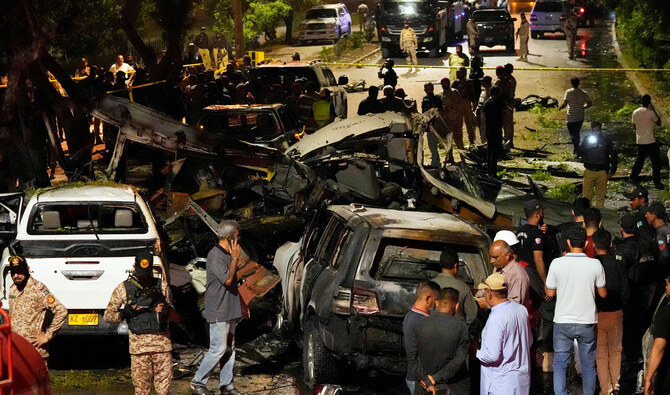
ISLAMABAD: China has warned its nationals against traveling to Pakistan’s two western provinces, South China Morning Post reported on Tuesday, following a deadly suicide bombing in Karachi that killed two of its citizens on Sunday.
The attack occurred just before the Shanghai Cooperation Organization (SCO) Summit, scheduled for next week, and was claimed by the separatist armed group, Balochistan Liberation Army (BLA), which said it used a vehicle-borne improvised explosive device for the explosion.
This was not the first attack against Chinese nationals in Karachi, where the same militant group killed three Chinese academics and their local driver in a suicide bombing in April 2022.
Pakistan announced plans to strengthen security protocols for Chinese workers in the country earlier this year after another suicide attack killed five Chinese workers on the Dasu Hydropower Project, and took strict disciplinary action against five senior officials for their “negligence.”
“In a statement on Monday, the embassy advised Chinese citizens to avoid traveling to the southwest province of Balochistan and the northwest province of Khyber Pakhtunkhwa, which have seen a surge in attacks targeting Chinese personnel and projects,” the Hong Kong-based newspaper, known for providing in-depth coverage on Asia-Pacific, said in its report.
It added that Beijing had called on Islamabad to “severely punish” the attackers and “plug security loopholes” to protect the multibillion-dollar China-Pakistan Economic Corridor and Chinese nationals.
A statement in English available on the embassy’s website reminds “Chinese citizens, enterprises, and projects in Pakistan to be vigilant, pay close attention to the security situation, strengthen security measures, and make every effort to take safety precautions.”
The BLA opposes Pakistan’s control over Balochistan, claiming the region is exploited for its resources without benefiting the local population, an allegation denied by the state.
The group also has a history of targeting Chinese interests in the country due to Beijing’s involvement in infrastructure projects in Balochistan.
Pakistan’s Finance Minister Muhammad Aurangzeb said on Tuesday the Chinese killed in the Sunday attack were Independent Power Producers engineers, adding that the government was in energy debt restructuring negotiations with them.
A senior Pakistani politician, Mushahid Hussain Sayed, who closely monitors China-Pakistan relations, also shared the South China Morning Post story on social media, expressing regret over the situation.
“What a Shame, this travel advisory, warning of dangers of travel to Pakistan, is not emanating from Washington or London, but from Beijing, our next-door neighbor & Strategic Partner,” he wrote on X.
“China has huge investments in strife-torn Nigeria & Congo, but never have we witnessed there 19 murders of Chinese engineers & technicians in 6 incidents in 5 years, as we see these recurring in Pakistan,” he added.
Sayed questioned the priorities of the current government, saying it was focusing more on local protesters than addressing militants operating in the country.


![]()

China warns citizens against travel to Pakistan after deadly suicide bombing — report
Short Url
https://arab.news/ywvwt
China warns citizens against travel to Pakistan after deadly suicide bombing — report
- Two Chinese engineers were killed in a vehicle-borne improvised explosive device blast in Karachi on Sunday
- Beijing has called on Islamabad to ‘severely punish’ the attackers and ‘plug security loopholes’ to protect CPEC
Latest updates


© 2026 SAUDI RESEARCH & PUBLISHING COMPANY, All Rights Reserved And subject to Terms of Use Agreement.