

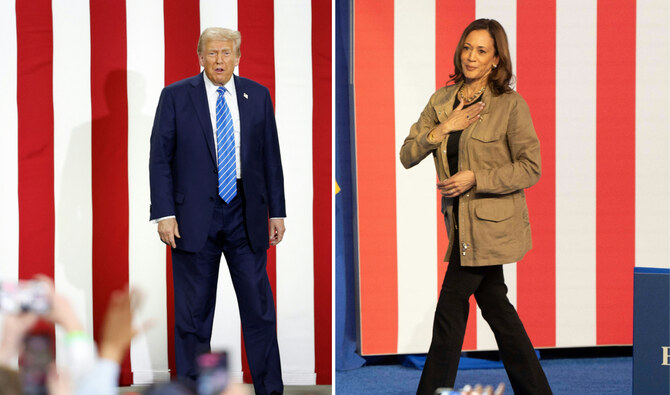

NEW YORK: Kamala Harris has taken a slim lead over Donald Trump in the US presidential race, a new poll showed Tuesday, as the Democrat slammed her rival for “weakness” during a media blitz four weeks before the election.
Vice President Harris and Republican former president Trump — who was doing a three-hit airwaves blitz of his own Tuesday — are deadlocked as they scramble to get out the vote and reach the sliver of Americans who remain undecided.
The national poll conducted by Siena College and The New York Times found Harris ahead by 49 percent to 46 percent, with registered voters crediting her more than Trump with representing change and caring about people like themselves, but giving the edge to Trump on who is the stronger leader.
The rivals were tied at 47 percent in a mid-September Times/Siena poll shortly after the two clashed in their presidential debate.
The overall result is largely in line with an aggregate of national polling collated by RealClearPolitics.com, which has Harris ahead by two percentage points.
In the seven battleground states seen as likely to determine the election outcome, the race is even tighter.
With Trump critics warning the election is nothing less than a referendum on American democracy, Harris conceded the knife-edge race is keeping her up at night.
“I literally lose sleep — and have been — over what is at stake in this election,” she told radio icon Howard Stern in a 70-minute live interview Tuesday.
“This is an election that is about strength versus weakness, and weakness as projected by someone who puts himself in front of the American people and does not have the strength to stand in defense of their needs, their dreams, their desires.”
Harris, the new poll showed, has begun making inroads with the rival party, with nine percent of Republicans saying they planned to support her, up from five percent last month.
She touched on the issue during a Tuesday appearance on popular ABC television show “The View,” where she talked about campaigning recently with Republican former congresswoman Liz Cheney.
There are more than 200 former officials from past Republican presidents George W. Bush and George H.W. Bush, as well as officials tied to Republican heavyweights John McCain and Mitt Romney, who have endorsed her, Harris said.
“We really are building a coalition around some very fundamental issues, including that we love our country and that we have to put country before party,” she said.
The Democrat, who turns 60 next week, also accused Trump of “full-time perpetuating lies and misinformation,” and said voters have grown “exhausted” with the strategy.
Trump meanwhile maintained his aggressive posture, attacking Harris as a “very low intelligence person” and claiming she has been “missing in action” over the federal response to Hurricane Helene — even though Harris traveled to the disaster zone last week.
And the 78-year-old Republican insisted on conservative influencer Ben Shapiro’s podcast that he has the stamina to finish strong on the campaign trail.
“I’ve worked about 28 days in a row, I have about 29 days left” before the election, he said, “and I’m not taking any days off.”
In addition to the poll, Harris got another potential boost Tuesday after a pro-Palestinian group threatening to draw votes from her in swing state Michigan came out strongly against Trump.
The Uncommitted movement stopped short of explicitly endorsing Harris, but warned in a video that “it can get worse” under Trump.


