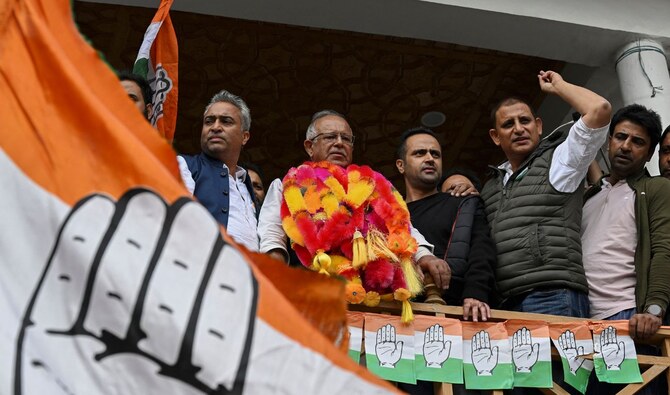
SRINAGAR: Kashmir’s biggest political party on Tuesday won most seats in the local election for a largely powerless local government in Indian-controlled Kashmir, official data showed, in a vote seen as a referendum against the 2019 move by Indian Prime Minister Narendra Modi’s government that stripped the disputed region of its special status.
National Conference, or NC, won 41 seats and was leading in one constituency, mainly from the Kashmir Valley, the heartland of the anti-India rebellion, the data showed. Modi’s Bharatiya Janata Party secured 29 seats, all from the Hindu-dominated areas of Jammu.
India’s main opposition Congress party, which fought the election in alliance with the NC, succeeded in six constituencies.
“People have supported us more than our expectations. Now our efforts will be to prove that we are worth these votes,” Omar Abdullah, the NC leader and the region’s former chief minister, told reporters in the main city of Srinagar.
His father and president of the party, Farooq Abdullah, said that the mandate was to run the region without “police raj (rule)” and try freeing people from jails. “Media will be free,” he said.
Hundreds of the NC workers gathered outside counting centers and at the homes of the winning candidates to celebrate the party’s victory.
It was the first such vote in a decade and the first since Modi’s Hindu nationalist government scrapped the Muslim-majority region’s long-held semi-autonomy in 2019.
The unprecedented move downgraded and divided the former state into two centrally governed union territories, Ladakh and Jammu-Kashmir. Both are ruled directly by New Delhi through its appointed administrators along with unelected bureaucrats and security setup. The move — which largely resonated in India and among Modi supporters — was mostly opposed in Kashmir as an assault on its identity and autonomy amid fears that it would pave the way for demographic changes in the region.
The region has since been on edge with civil liberties curbed and media gagged.
India and Pakistan each administer a part of Kashmir, but both claim the territory in its entirety. The nuclear-armed rivals have fought two of their three wars over the territory since they gained independence from British colonial rule in 1947.
Authorities tallied votes as thousands of additional police and paramilitary soldiers patrolled roads and guarded 28 counting centers. Nearly 8.9 million people were eligible to vote in the election, which began on Sept. 18 and concluded on Oct. 1. The overall turnout was 64 percent across the three phases, according to official data.
In the region’s legislature, five seats are appointed and 90 elected, so a party or coalition would need at least 48 of the 95 total seats to form a government. The alliance of the National Conference and the Congress have 48 seats combined.
Authorities have said the election will bring democracy to the region after decades of strife, but many locals viewed the vote as an opportunity not only to elect their own representatives but also to register their protest against the 2019 changes.
Except for the BJP, most parties who contested the election campaigned on promises to reverse the 2019 changes and address key issues like rising unemployment and inflation. The Congress party favored restoring the region’s statehood. The BJP has also stated that it will restore statehood, but has not told when it would do.
The BJP has vowed to block any move aimed at undoing most of the 2019 changes but promised to help in the region’s economic development.
Meanwhile, Modi’s BJP appears to be heading for a victory in the northern state of Haryana, bordering New Delhi, which it has ruled for 10 years, leading in 50 constituencies and the Congress in 35 out of 90.
The BJP has so far won 18 seats and is leading in 32 constituencies while the Congress has won 15 seats and is leading in 20, according to the Election Commission of India.
A victory would give the BJP a record third five-year term in the state.
The voting trend in Haryana state is a surprise since most exit polls had predicted an easy victory for the Congress party.
The vote will allow Kashmir to have its own truncated government and a regional legislature, called an assembly, rather than being directly under New Delhi’s rule.
However, there will be a limited transition of power from New Delhi to the assembly as Kashmir will remain a “union territory” — directly controlled by the federal government — with India’s Parliament as its main legislator. Kashmir’s statehood must be restored for the new government to have powers similar to other states of India.
The region’s last assembly election was held in 2014, after which the BJP for the first time ruled in a coalition with the local Peoples Democratic Party. But the government collapsed in 2018, after the BJP withdrew from the coalition.
Polls in the past have been marked with violence, boycotts and vote-rigging, even though India called them a victory over separatism.
Militants in the Indian-controlled portion of Kashmir have been fighting New Delhi’s rule since 1989. Many Muslim Kashmiris support the rebels’ goal of uniting the territory, either under Pakistani rule or as an independent country.
India insists the Kashmir militancy is Pakistan-sponsored terrorism. Pakistan denies the charge, and many Kashmiris consider it a legitimate freedom struggle. Tens of thousands of civilians, rebels and government forces have been killed in the conflict.


![]()

Biggest Kashmir party opposed to India’s stripping of region’s autonomy wins most seats in election
Short Url
https://arab.news/gj6rp
Biggest Kashmir party opposed to India’s stripping of region’s autonomy wins most seats in election
- National Conference won 41 seats and was leading in one constituency, mainly from the Kashmir Valley, the heartland of anti-India rebellion
- Indian Prime Minister Narendra Modi’s Bharatiya Janata Party secured 29 seats, all from the Hindu-dominated areas of Jammu, the data showed
Latest updates


© 2026 SAUDI RESEARCH & PUBLISHING COMPANY, All Rights Reserved And subject to Terms of Use Agreement.