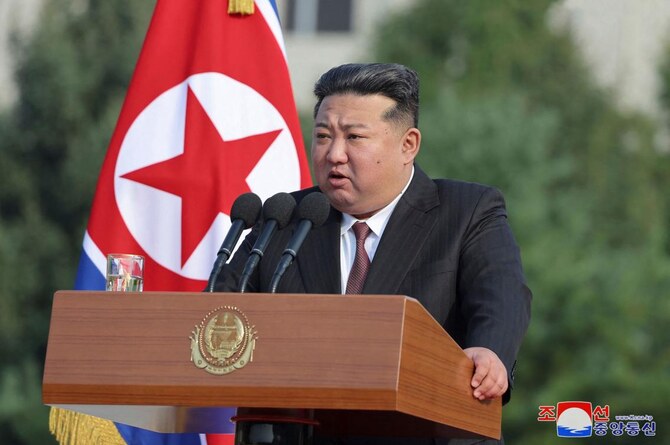
SEOUL: North Korean leader Kim Jong Un said his country will speed up steps toward becoming a military superpower with nuclear weapons and would not rule out using them if it came under enemy attack, state news agency KCNA said on Tuesday.
Kim mentioned South Korean President Yoon Suk Yeol by name for the second time in a week in denouncing Seoul for colluding with Washington to destabilize the region to gloss over the fact it does not even have proper strategic weapons.
“Yoon Suk Yeol made some tasteless and vulgar comment about the end of the Republic in his speech, and it shows he is totally consumed by his blind faith in his master’s strength,” KCNA quoted Kim as saying, referring to the South’s alliance with the US
“To be honest, we have absolutely no intention of attacking South Korea,” he said in the speech at the Kim Jong Un National Defense University, a training ground for elite military specialists.
“Every time I stated our position on the use of military force, I clearly and consistently used the qualification ‘if.’ If the enemies try to use force against our country, the Republic’s military will use all offensive power without hesitation. This does not preclude the use of nuclear weapons.”
“Our footsteps toward becoming a military superpower and a nuclear power will accelerate,” he added.
North Korea has for decades pursued a nuclear weapons program and is believed to have enough fissile materials to build dozens of the weapons. It has conducted six underground nuclear detonation tests.
Last week, South Korea marked an annual armed forces day with a large military parade showcasing a ballistic missile capable of carrying a massive warhead and featuring a flypast of a US strategic bomber.
In his address that day, Yoon warned the North against using nuclear weapons. “That day will see the end of the North Korean regime.”
North Korea may be building a new submarine, the South Korean defense ministry said citing intelligence indications in a report to a member of parliament. In January, Kim reportedly ordered a nuclear submarine to be built.
The construction was at an early stage and it was not clear if the vessel was a nuclear-powered submarine, said the report.
North Korea is also working on a submarine drone that could be developed to carry nuclear weapons, possibly with the help of Russia, it said.
KCNA said Kim made his “military superpower” remarks on Monday, the same day the North has said its Supreme People’s Assembly would meet to discuss amending the country’s constitution. The news agency has made no mention of the assembly’s deliberations since Monday.
The session is being closely watched because of the likelihood it would approve a constitutional amendment to reflect Kim’s statement that unification is no longer possible and the South was a separate country and “a principal enemy.”
Such a move would formalize Kim’s break with decades-old goal espoused by both countries of national unification and attempts to improve ties, including a 2018 summit where their leaders declared there will be no more war and a new era of peace has opened.
In a separate report, KCNA said Kim sent a birthday message to Russian President Vladimir Putin, calling him his “closest Comrade and saying “strategic and cooperative relations” between the two countries will be raised to a new level.
South Korea’s Defense Minister Kim Yong-hyun said “there was a high possibility” North Korea could deploy troops to help Russia in the war with Ukraine.
Kim also told a parliament hearing news reports of North Korean military officers having been killed in a Ukrainian strike in Russian-occupied territory were likely true.
Kim Jong Un and Putin in June adopted on a comprehensive strategic partnership that includes mutual defense pact.
The two countries have denied accusations by US and South Korean officials the North was supplying arms to Russia.


North Korea’s Kim Jong Un wants to speed up becoming a nuclear superpower
https://arab.news/9cqmv
North Korea’s Kim Jong Un wants to speed up becoming a nuclear superpower

- North Korea has for decades pursued a nuclear weapons program and is believed to have enough fissile materials to build dozens of the weapons


Filmmakers defend Berlin festival chief in Gaza row
- Actors and filmmakers rushed to defend the head of the Berlin film festival Thursday following a media report that her job was on the line over a director’s anti-Israel speech at the event
BERLIN: Actors and filmmakers rushed to defend the head of the Berlin film festival Thursday following a media report that her job was on the line over a director’s anti-Israel speech at the event.
Syrian-Palestinian filmmaker Abdallah Al-Khatib kicked off a controversy during Saturday’s closing ceremony by accusing Germany of being complicit in genocide in Gaza through its support for Israel.
German tabloid Bild had reported that Tricia Tuttle was due to be dismissed at an emergency meeting on Thursday, citing sources close to state-owned KBB, the company that runs the festival.
Culture minister Wolfram Weimer’s office confirmed the meeting had taken place but made no mention of Tuttle being sacked, stating that discussions had been “constructive and open” and would “continue in the coming days.”
A group of cinema luminaries including Tilda Swinton, Todd Haynes, Sean Baker and Tom Tykwer signed an open letter defending the Berlinale as a forum for free expression.
“As filmmakers in Germany and beyond, we are following the debates surrounding the Berlinale and the discussion about the dismissal of Tricia Tuttle with great concern,” they wrote. “We defend the Berlinale for what it is: a place of exchange.”
Angry rows over the Israel-Palestinian conflict have repeatedly rocked the Berlinale, held every February as Europe’s first major film festival of the year.
Environment Minister Carsten Schneider walked out of Saturday’s closing ceremony, labelling Khatib’s remarks “unacceptable.”
Germany, as it has sought to atone for the horrors of the Holocaust, has been a steadfast supporter of Israel, and criticism of Israel’s conduct in Gaza has been more muted than in many other countries.
Conservative lawmaker Ellen Demuth was among those who condemned the “antisemitic incident” at the awards ceremony and urged “a fresh start at the top of the film festival.”
The Berlinale Team in an Instagram post meanwhile defended Tuttle, praising her “clarity, integrity and artistic vision.”
The writers’ association PEN Berlin said Khatib’s comments were protected by freedom of expression and that if Tuttle were to be sacked over them, it would cause “immense damage” to the festival.
“Such wanton destruction of the German cultural scene, such self-inflicted insularity, must not be allowed to happen,” it said.
The backdrop of the Middle East conflict led to a tense 76th edition of the festival from the start.
More than 80 film professionals criticized the Berlinale’s “silence” on the Gaza war in an open letter, accusing the festival of censoring artists “who reject the genocide” they believe Israel has committed in Gaza.
Award-winning Indian writer Arundhati Roy withdrew from the festival after the jury president, German director Wim Wenders, said cinema should “stay out of politics” when asked about Gaza.