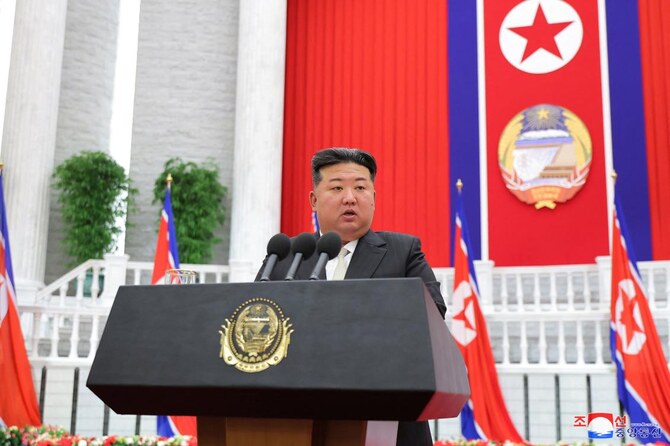
SEOUL: North Korean leader Kim Jong Un said the country is now implementing a nuclear force construction policy to increase the number of nuclear weapons “exponentially,” state media KCNA reported on Tuesday.
In a speech on North Korea’s founding anniversary on Monday, Kim said the country must more thoroughly prepare its “nuclear capability and its readiness to use it properly at any given time in ensuring the security rights of the state,” said KCNA.
A strong military presence is needed to face “the various threats posed by the United States and its followers,” he added.
Kim also said North Korea is facing a “grave threat” from what it sees as a US-led nuclear-based military bloc in the region.
South Korea’s deputy defense minister for policy, Cho Chang-rae, and his US and Japanese counterparts on Tuesday condemned Pyongyang’s recent diversification of nuclear delivery systems, tests and launches of multiple ballistic missiles.
Meeting in Seoul, the three reaffirmed a commitment to strengthen trilateral cooperation to ensure peace in the region, including by deterring North Korea’s nuclear and missile threats, according to a joint statement released by the US State Department.
They also agreed to hold a second trilateral military exercise known as Freedom Edge in the near term.
South Korea will also hold a defense ministerial meeting with the member states of the United Nations Command (UNC) on Tuesday.
The UNC is led by the commander of the US military stationed in South Korea.
Last month, Germany became the latest to join the UNC in South Korea that helps police the heavily fortified border with North Korea and has committed to defend the South in the event of a war.
North Korea has criticized the UNC as an “illegal war organization” and Germany’s entry into the US-led UN border monitoring force as raising tensions.


![]()

North Korea’s Kim Jong Un vows to exponentially boost nuclear arsenal
Short Url
https://arab.news/j3zhp
North Korea’s Kim Jong Un vows to exponentially boost nuclear arsenal
- Kim Jong Un says North Korea is facing a ‘grave threat’ from what it sees as a US-led nuclear-based military bloc in the region


Latest updates


© 2026 SAUDI RESEARCH & PUBLISHING COMPANY, All Rights Reserved And subject to Terms of Use Agreement.