

India PM Modi’s BJP trails in vote count in two provincial elections, TV says

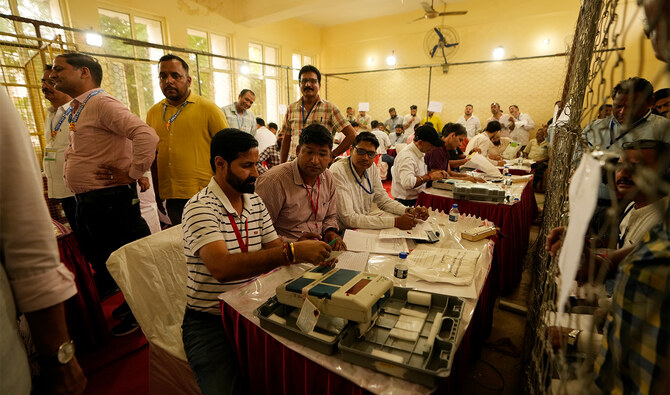
Election officers count votes for the recent election at a counting center in Jammu, India, on October 8, 2024. (AP)
Short Url
Updated 08 October 2024
Follow

India PM Modi’s BJP trails in vote count in two provincial elections, TV says

  • Defeats could be a fresh setback for BJP after it failed to win clear majority in general election earlier this year
  • Losing Haryana and Jammu and Kashmir would be dampeners for BJP ahead of elections in Maharashtra, Jharkhand

NEW DELHI: Indian Prime Minister Narendra Modi’s Bharatiya Janata Party (BJP) trailed in two provincial elections as votes were counted on Tuesday, TV channels said, a fresh setback after it failed to win a clear majority in the general election this year.

Elections in the northern state of Haryana and the troubled Himalayan territory of Jammu and Kashmir were held in phases that ended on Saturday, the first test of popularity since Modi returned as prime minister for a record third, straight term in June, albeit with the help of regional parties.

Losing Haryana and not winning power in Jammu and Kashmir is not expected to impact the Modi government’s ability to make federal policies but will be seen as dampeners for BJP ahead of elections in the more politically crucial states of Maharashtra and Jharkhand.

Exit polls had predicted a win for the main opposition Congress party in Haryana and gave an edge to Congress and its regional ally National Conference (NC) in Jammu and Kashmir.

The counting showed BJP was leading in 22 seats in Haryana, where it has held power for a decade, while Congress was ahead in 57 seats, TV channel CNN-News18 reported.

In Jammu and Kashmir, it said BJP was leading in 29 seats while the Congress-NC alliance was ahead in 44 seats in the first provincial poll there in a decade, and the first since the state was split into two federally administered territories in 2019.

Both legislatures have 90 seats each.

The industrial hub of Maharashtra is presently ruled by a BJP coalition, and an opposition alliance is in power in mineral-rich Jharkhand.

Elections in both states, although yet to be announced, are expected to be held in November.

Victory for Congress in Haryana and Jammu and Kashmir will come as a major boost for its leader, Rahul Gandhi, the scion of a dynasty that gave India three prime ministers but who was blamed for the party’s slump since Modi swept to power in 2014.

Gandhi was also the face of the two-dozen party opposition alliance that denied Modi an outright majority in the parliamentary election and is currently the leader of the opposition in the lower house of parliament.


Sri Lanka takes custody of an Iranian vessel off its coast after US sank an Iranian warship

Updated 1 sec ago
Follow

Sri Lanka takes custody of an Iranian vessel off its coast after US sank an Iranian warship

  • Sri Lankan President Anura Kumara Dissanayake said the country took control of the vessel after it reported an engine failure and that the decision followed talks with Iranian officials and the ship’s
COLOMBO: Sri Lanka began transferring more than 200 sailors from an Iranian vessel to shore Friday after the ship sought assistance while anchored outside the country’s waters, as tensions mounted in the Indian Ocean following the sinking of an Iranian warship by a US submarine.
Sri Lankan navy spokesperson Cmdr. Buddhika Sampath said 204 sailors of the IRIS Bushehr were brought to the Welisara Naval Base near the capital, Colombo. They underwent border control procedures and medical tests, but none were found to have health issues.
About 15 others have been left aboard the ship with Sri Lankan naval personnel for assistance because they had reported a fault with the ship.
The Iranian sailors are interpreting operational instructions, manuals and logs for their Sri Lankan counterparts because the ship will be in Sri Lankan custody until further notice, Sampath said.
The ship will be taken to the port of Trincomalee in eastern Sri Lanka, Sampath said.
Iranian ship was taking part in naval exercises
The Sri Lankan government took custody of the Bushehr after the US sank an Iranian warship, the IRIS Dena, off Sri Lanka’s coast Wednesday. The strike marked one of the rare instances since World War II in which a submarine sank a surface warship, and highlighted the expanding scope of the US-Israeli military campaign against Iran.
The Dena had participated in naval exercises hosted by India before heading into international waters on its way home. At least 74 countries had joined the events, according to India’s Defense Ministry, including the US Navy, which conducted reconnaissance aircraft and maritime patrol drills.
The Indian navy received a distress signal from the Dena but by the time it launched a search and rescue operation, the Sri Lankan navy had already begun its own rescue efforts, the ministry said.
The Sri Lankan navy rescued 32 sailors and recovered 87 bodies.
Iran’s Foreign Minister Abbas Araghchi said the Dena had been carrying “almost 130” crew. The normal crew size for a warship of that class is 140.
Araghchi called the sinking an “atrocity at sea” and said the US would “bitterly regret” the attack.
Sri Lanka says it acted under international law
Sri Lankan President Anura Kumara Dissanayake said late Thursday that authorities decided to take control of the IRIS Bushehr after discussions with Iranian officials and the ship’s captain, after one of its engines failed.
“We have to understand that this is not an ordinary situation. It’s a request by a ship belonging to one party to enter into our port. We have to consider that according to the international treaties and conventions,” he told journalists Thursday night.
Separately on Friday, he wrote on X: “No civilian should die in wars. Our approach is that every single life is as precious as our own.”
The IRIS Bushehr had been described in previous Iranian media reports as a navy logistics ship equipped with a helicopter pad.
Dissanayake said Sri Lanka was guided by neutrality while seeking to uphold humanitarian principles.
“We have followed a very clear stance. We will not be biased to any state nor we will be submissive to any state,” he said.
Sri Lanka’s neutrality is tested
The broadening Middle East conflict is putting strategically located Sri Lanka in a delicate position as it tries to balance humanitarian obligations, international maritime law and its longstanding policy of non-alignment.
H.M.G.S. Palihakkara, Sri Lanka’s retired former foreign secretary who also served as its permanent representative to the United Nations, said the country had acted responsibly and impartially.
“There has been a distress call from the ship. So naturally Sri Lanka, as a party to the Law of Sea and The Hague Convention, had no option but to do what it did by mounting a humanitarian operation to provide assistance to save lives and provide medical care to the affected,” he said.
Palihakkara said parties to the conflict would understand that Sri Lanka was not taking sides.
“You could not have ignored the distress call. Even the attacking powers cannot leave shipwrecked sailors dying. That is the law,” Palihakkara said.
Katsuya Yamamoto, director of the Strategy and Deterrence Program at the Sasakawa Peace Foundation in Tokyo, said Sri Lanka, which is not at war with either the US or Iran, is considered a neutral state. As such, the Bushehr can enter a Sri Lankan port if granted permission by the government, he said.
Yamamoto said that once the vessel is docked, it falls under Iranian jurisdiction, leaving Sri Lankan authorities without legal grounds to inspect it unless Colombo decides to side with the US
Australians aboard submarine
Australia’s government confirmed on Friday that three Australians were aboard the submarine that sank the IRIS Dena. The Australians were there as part of the trilateral US, Australian and British training program under the AUKUS security pact.
The Australian government has maintained it was not warned that the USand Israel planned to attack Iran. Australia has not commented on the legality of the attack, but supports the objective of preventing Iran from gaining nuclear weapons.
Neil James, executive director of the Australian Defense Association policy think tank, said it is “reasonably rare” for Australians embedded with another nation’s military to go to war against a country such as Iran that Australia wasn’t at war with.
He said an Australian would not have fired the torpedo that sank the Iranian ship
“The Australians wouldn’t have a job where they had to push the button on the torpedo because the captain of the boat gives the order and someone else, perhaps the weapons officer, presses the button but they’re not going to be Australian,” James said.
