



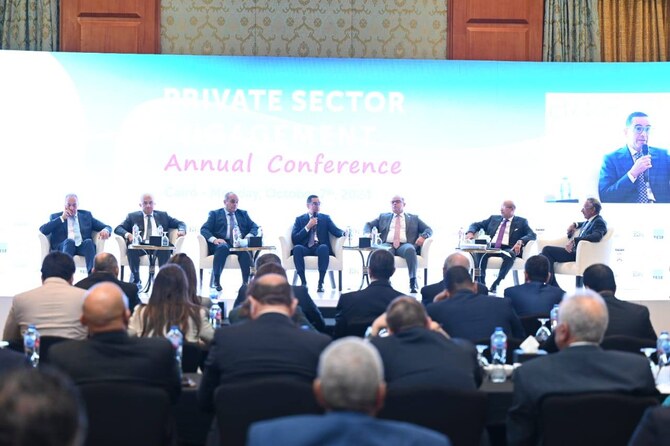

RIYADH: Egypt is rolling out a series of infrastructure projects to boost private sector engagement, according to the minister of investment and foreign trade.
During a conference organized by the Center for International Private Enterprise, Minister Hassan Al-Khatib outlined the government’s commitment to empowering the private sector as a catalyst for economic growth.
Egypt’s private sector engagement is crucial for development cooperation, enhancing livelihoods, and advancing the 2030 agenda.
The government is currently offering nine infrastructure projects through its partnership unit, with Al-Khatib saying: “The government is committed to attracting more investments and enhancing the role of the private sector as a key engine of economic growth and innovation.”
Al-Khatib added that public-private partnerships will be crucial in driving sustainable growth, creating jobs, and improving the investment climate through regulatory reforms. The government has prioritized investments in sectors such as industry, health care, agriculture, tourism, and energy.
The minister also said that renewable energy, particularly in hydrogen production and energy storage, is a key focus area in line with Egypt’s energy goals.
“The government is encouraging investments in solar energy technology, semiconductor production, data centers, and outsourcing services,” the Egyptian Cabinet said in an official statement.
Diversifying export markets is another strategic priority for Egypt, and Al-Khatib said the government aims to expand export markets across Africa, Europe, Asia, and North America, targeting $145 billion in annual exports.
“Efforts are underway to strengthen global trade relations and bolster the African Continental Free Trade Area agreement, alongside partnerships with the European Union and other global partners,” the minister said.
The government is also working to reduce trade barriers, simplify customs procedures, and improve logistics infrastructure to connect Egypt with international markets.
On the green hydrogen front, Egypt is positioning itself as a global leader in the production and export of green hydrogen.
Al-Khatib discussed Egypt’s national low-carbon hydrogen strategy, which is a core part of its renewable energy transition to leverage the country’s rich solar and wind resources, making Egypt a hub for hydrogen exports to European and Asian markets.
On the legislative front is Law No. 2 of 2024, which came into effect in January and established a comprehensive legal framework for green hydrogen projects, offering financial incentives and streamlined processes for investors.
“The law grants the ‘golden license,’ a single license covering all stages of project execution and operation,” the minister said.
Al-Khatib also touched on recent reforms to Egypt’s investment law, which introduced new incentives to attract local and foreign investments.
The reforms include the launch of digital platforms by the General Authority for Investment to streamline company registration, licensing, and name reservation processes, as well as reducing paperwork requirements.
Efforts to simplify land allocation and fast-track licensing for industrial projects were also highlighted, including expanding free zones for industries like petroleum refining, fertilizer manufacturing, and gas liquefaction.
“The government is working to attract more industrial projects under this free zone model and has simplified the establishment criteria for these zones,” the Cabinet statement said.
In support of entrepreneurship and startups, Al-Khatib referenced a decision by the prime minister to establish a permanent unit within the Cabinet. This unit, led by the CEO of GAFI, is tasked with developing policies and regulations to foster the growth of startups in Egypt.
“It will also serve as a liaison between the government and entrepreneurs to address challenges and gather input for policy-making,” the minister said.


