

Maldives President Muizzu to meet India’s Modi to repair strained diplomatic ties

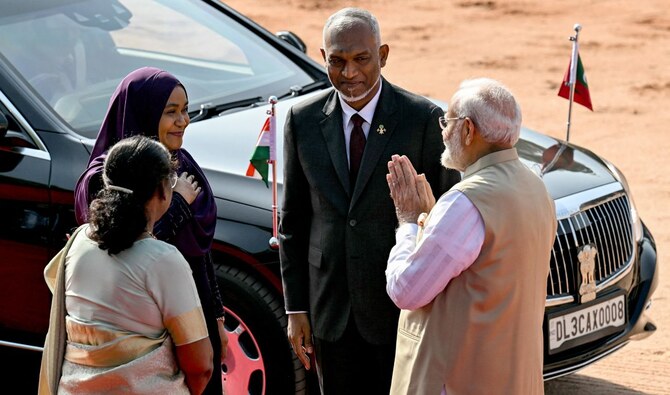
India's President Droupadi Murmu (L) with Prime Minister Narendra Modi (R) welcomes her Maldives counterpart Mohamed Muizzu (2R) and his wife Sajidha Mohamed during Muizzu's ceremonial reception at the presidential palace Rashtrapati Bhavan in New Delhi on October 7, 2024. (AFP)
Short Url
Updated 07 October 2024
Follow

Maldives President Muizzu to meet India’s Modi to repair strained diplomatic ties

  • Tensions between India and Maldives have grown since pro-China Muizzu came to power last year
  • Muizzu had promised to expel Indian soldiers deployed in Maldives to help in humanitarian assistance

NEW DELHI: Maldives President Mohamed Muizzu is expected to talk Monday with Indian Prime Minister Narendra Modi in New Delhi as he aims to repair ties between the countries that have been strained since he came to power last year.

Muizzu and Modi are expected to discuss “bilateral, regional, and international issues of mutual interest,” according to India’s foreign ministry. Muizzu will also hold meetings with senior Indian officials during his five-day India visit.

Tensions between India and Maldives have grown since pro-China Muizzu came to power last year after defeating India-friendly incumbent Ibrahim Mohamed Solih.

Leading up to the 2023 elections, Muizzu had promised to expel Indian soldiers deployed in Maldives to help in humanitarian assistance. In May, New Delhi replaced dozens of these soldiers with civilian experts.

Ties were also strained in January when some Maldivian leaders lashed out at Modi for promoting India’s Lakshadweep archipelago for Indian travelers. Lakshadweep is off the southwestern coast of the Indian mainland.

Maldivian leaders saw the move as a way to lure Indian tourists away from their country and encourage them to visit Lakshadweep instead. It sparked angry protests from Indian celebrities who called for a tourism boycott to Maldives. Tourism is the mainstay of the Maldives’ economy.

The dispute deepened when Muizzu visited China ahead of India in January, a move which was seen as a snub to New Delhi. On his return, Muizzu spelled out plans to rid his tiny nation of dependence on India for health facilities, medicines, and import of staples.

A thaw ensued after Muizzu attended Modi’s June swearing-in ceremony in New Delhi for a third five-year term. Since then, Muizzu has toned down his anti-Indian rhetoric, and official-level contacts have intensified with New Delhi.

India’s foreign minister, Subrahmanyam Jaishankar, on Sunday said he was confident Muizzu’s talks with Modi would give “a new impetus” to the “friendly ties” between the countries.

Regional powers India and China compete for influence in the archipelago nation, which is strategically located in the Indian Ocean.

For decades, India has been a critical provider of development assistance to the Maldives, including infrastructure projects, medical care, and health facilities. Meanwhile, Maldives is part of China’s “Belt and Road” initiative to build ports and highways and expand trade, as well as China’s influence across Asia, Africa, and Europe.

Muizzu’s visit to New Delhi is essential for Modi, who is facing a challenging time in neighborhood diplomacy with Marxist politician Anura Kumara Dissanayake taking over as Sri Lanka’s president and India-friendly Bangladesh Prime Minister Sheikh Hasina fleeing to India in August after being forced to resign by students-led protests. Nepal also now has pro-China K.P. Sharma Oli as its prime minister.

Experts say India needs to maintain close ties with Sri Lanka, Bangladesh, Bhutan, Nepal, and the Maldives, which are its traditional spheres of influence.


Kremlin says Putin is mediating in Iran to normalize situation

Updated 16 January 2026
Follow

Kremlin says Putin is mediating in Iran to normalize situation

  • Putin had then been briefed by Pezeshkian in a separate call on what the Kremlin called Tehran’s “sustained efforts” to normalize the situation inside Iran

MOSCOW: President Vladimir Putin is mediating in the Iran situation to quickly de-escalate tensions, the Kremlin said on Friday, after the Russian leader spoke with Israeli Prime Minister Benjamin Netanyahu and Iranian President Masoud Pezeshkian.
Moscow has condemned US threats of new military strikes after Iran acted against protests that broke out late last month.
Putin in ‌his call with Netanyahu expressed Russia’s willingness to “continue its mediation efforts and to promote constructive dialogue with the participation of all interested states,” the Kremlin said, adding he had set out his ideas for boosting stability in the Middle East.
No further details were given on Putin’s mediation attempt.
Putin had then been briefed by Pezeshkian in a separate call on what the Kremlin called Tehran’s “sustained efforts” to normalize the situation inside Iran.
“It was noted that Russia and Iran unanimously and consistently support de-escalating 
the tensions — both surrounding  Iran and in the region as a whole — as soon as possible 
and resolving any emerging issues through exclusively political and diplomatic ‌means,” the Kremlin said.
Putin and Pezeshkian had confirmed their commitment to their countries’ strategic partnership and to implementing joint economic projects, the Kremlin added.
Separately, the Shanghai Cooperation Organization, which includes Russia, China, India, and Iran, among others, said it opposed external interference in Iran and blamed Western sanctions for creating conditions for unrest.
“Unilateral sanctions have had a significant negative impact on the economic stability of the state, led to a deterioration in people’s living conditions, and objectively limited the ability of the Government of the Islamic Republic ​of Iran to implement measures to ensure the country’s socio-economic development,” the SCO said in a statement.
Protests erupted on Dec. 28 over soaring inflation in Iran, whose economy has been crippled by sanctions.
Asked what support Russia could provide to Iran, Kremlin spokesman Dmitry Peskov said: “Russia is already providing assistance not only to Iran but also to the entire region, and to the cause of regional stability and peace. This is partly thanks to the president’s efforts to help de-escalate tensions.”
The US Treasury on Thursday announced new sanctions targeting Iranian officials, including Ali Larijani, secretary of Iran’s Supreme Council for National Security.