Israel obstructing search for Hezbollah’s Safieddine, Hezbollah official says

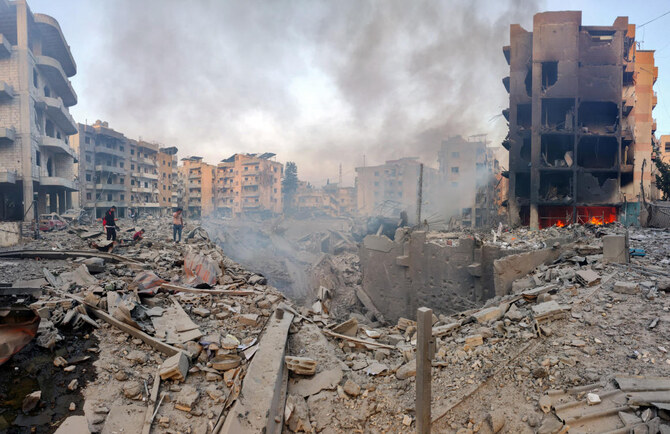
People inspect the damage, in the aftermath of Israeli strikes in Choueifat, amid the ongoing hostilities between Hezbollah and Israeli forces, Lebanon, October 6, 2024. (Reuters)
Short Url
Updated 06 October 2024
Follow

Israel obstructing search for Hezbollah’s Safieddine, Hezbollah official says

  • Safieddine is seen as a likely successor to former leader Sayyed Hassan Nasrallah who was killed in an Israeli strike on Beirut’s southern suburbs

BEIRUT: Israel is not allowing a search for senior Hezbollah leader Hashem Safieddine to progress after it bombed Beirut’s southern suburbs on Thursday, a Hezbollah official said, noting the group would only announce his fate when the search concluded.
Safieddine is seen as a likely successor to former leader Sayyed Hassan Nasrallah who was killed in an Israeli strike on Beirut’s southern suburbs, known as Dahiye, on Sept. 27.
His fate remains unclear.
Israel should “let rescue teams do their work” senior Hezbollah political official Mahmoud Qmati told Iraqi state television.
He said that Hezbollah was now being jointly led until it could pick a new leader, which would take time.
“What’s important is that joint command is in place,” he said.
“The method of choosing a replacement for the secretary-general takes time and requires appropriate circumstances, and for that reason we suffice today with temporary joint command,” he said.
Qmati said Nasrallah’s body remained in Lebanon and that he would be laid to rest in Beirut’s southern suburbs, where Hezbollah holds heavy influence, when conditions allowed.
Israel has killed much of Hezbollah’s military command and senior leadership in nearly a year of fighting that began when Hezbollah opened a front in solidarity with Palestinians the day after Hamas’ Oct. 7 attack on Israel.
The conflict has rapidly expanded in the past couple of weeks, with Israel snubbing a US-backed push for a ceasefire, killing Nasrallah and launching a wide air campaign that has pummeled Lebanese towns and villages and left 1.2 million people displaced, according to Lebanese government figures.


US condemns RSF drone attack on World Food Programme convoy in Sudan’s North Kordofan

Updated 42 min 27 sec ago
Follow

US condemns RSF drone attack on World Food Programme convoy in Sudan’s North Kordofan

  • Denise Brown, the UN Humanitarian Coordinator for Sudan, also expresses concern over the drone attack

WASHINGTON: The US has condemned a drone attack by Rapid Support Forces on an aid convoy in Sudan’s North Kordofan state that killed one person and injured three others.

“The United States condemns the recent drone attack on a World Food Program convoy in North Kordofan transporting food to famine-stricken people which killed one and wounded many others,” US Senior Adviser for Arab and African Affairs Massad Boulos wrote on X.

“Destroying food intended for people in need and killing humanitarian workers is sickening,” the US envoy wrote.

“The Trump Administration has zero tolerance for this destruction of life and of U.S.-funded assistance; we demand accountability and extend our condolences to all those affected by these inexcusable events and terrible war,” he added.

The Sudan Doctors Network said the convoy was struck by RSF drones in the Allah Karim area as it headed toward displaced people in El-Obeid, the state capital, Anadolu Agency reported.

The network described the attack as a “clear violation of international humanitarian law,” warning that it undermines efforts to deliver life-saving aid to civilians amid worsening humanitarian conditions across the country.

There was no immediate comment from the rebel group.


Denise Brown, the UN Humanitarian Coordinator for Sudan, in a statement also expressed concern over the drone attack which hit the aid trucks in North Kordofan.

“I am deeply concerned by a drone attack earlier today on trucks contracted by the World Food Programme (WFP) in North Kordofan, the aftermath of which I came across a few hours later, as I left the state capital, El Obeid.”

“The trucks were en route from Kosti to deliver life-saving food assistance to displaced families near El Obeid when they were struck, tragically killing at least one individual and injuring many more. The trucks caught fire, destroying food commodities intended for life-saving humanitarian response.”

Brown added that “Humanitarian personnel, assets and supplies must be protected at all times. Attacks on aid operations undermine efforts to reach people facing hunger and displacement.”

“Safe and unimpeded humanitarian access remains critical to ensure assistance reaches the most vulnerable people across Sudan.”

Since April 2023, the conflict between Sudan’s army and the paramilitary forces has killed tens of thousands, displaced 11 million and which the UN has described as one of the world’s worst humanitarian crises.

An alert issued by the Integrated Food Security Phase Classification (IPC), confirmed famine conditions in El-Fasher and Kadugli, the capital of South Kordofan, about 800 kilometers to the east.

The IPC said that 20 more areas in Sudan’s Darfur and neighboring Kordofan were at risk of famine.

Of Sudan’s 18 states, the RSF controls all five states in the western Darfur region, except for parts of North Darfur that remain under army control. The army holds most areas of the remaining 13 states across the south, north, east and center of the country, including the capital, Khartoum.

The conflict between the army and the RSF, which erupted in April 2023, has killed thousands of people and displaced millions.