

EVIQ, Ceer partner to enhance Saudi EV infrastructure

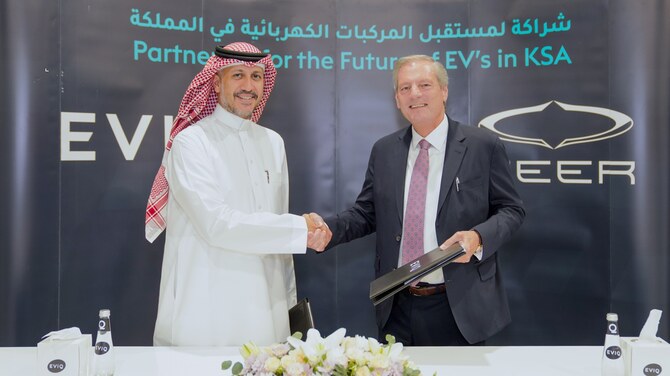
EVIQ, a joint venture between the Public Investment Fund and the Saudi Electricity Co., aims to bolster the electric vehicle ecosystem by collaborating with manufacturing brands and local partners to implement installation and maintenance operations. Photo/Supplied
Short Url
Updated 06 October 2024
Follow

EVIQ, Ceer partner to enhance Saudi EV infrastructure

  • Initiative will establish a comprehensive charging network to support widespread electric vehicle adoption
  • Kingdom aims to convert 30% of vehicles in Riyadh to electric by 2030

JEDDAH: Saudi Arabia’s Electric Vehicle Infrastructure Co., EVIQ, has formed a strategic partnership with the Kingdom’s first EV brand, Ceer, to expand the nation’s charging infrastructure and promote sustainability. 

EVIQ, a joint venture between the Public Investment Fund and the Saudi Electricity Co., aims to bolster the electric vehicle ecosystem by collaborating with manufacturing brands and local partners to implement installation and maintenance operations.  

This initiative will establish a comprehensive charging network to support widespread electric vehicle adoption. 

EVIQ CEO Mohammad Baker Gazzaz highlighted the agreement’s significance in supporting the electric vehicle sector in Saudi Arabia.   

“This partnership will help encourage the wider adoption of electric vehicles, making them a seamless and convenient choice for drivers in the Kingdom. We look forward to fruitful cooperation with Ceer to achieve a more environmentally friendly and sustainable future for the Kingdom.” 

Saudi Arabia aims to convert 30 percent of vehicles in Riyadh to electric by 2030, part of a larger strategy to cut emissions in the capital by 50 percent and achieve carbon neutrality by 2060.  

The Kingdom is also targeting the production of approximately 300,000 vehicles by 2030, seeking a 50 percent share of car sales in the Gulf Cooperation Council countries by 2025. 

Ceer CEO James DeLuca emphasized that the partnership extends beyond building an electric vehicle industry. “We are also committed to providing an exceptional experience for electric vehicle owners in the Kingdom. We are pleased to partner with EVIQ to ensure a comfortable and seamless driving experience for electric vehicles in the Kingdom,” he said.   

The partnership signifies a major step toward realizing the Kingdom’s vision of developing an automotive industry and promoting sustainable transportation.  

By aligning Ceer’s commitment to advanced Saudi electric vehicles with EVIQ’s goals of building an effective network, this collaboration paves the way for a smooth transition to electric mobility. 

Last year, EVIQ announced plans to install over 5,000 fast chargers across 10,000 locations throughout the Kingdom.  

This strategic initiative not only enhances Saudi Arabia's electric vehicle infrastructure but also aligns with broader economic and environmental objectives, paving the way for a sustainable future and diversified economy. 

Ceer is investing significantly in research and development to produce competitive electric vehicles, with government support through incentives and regulations designed to foster industry growth. 


Supplier hub to anchor Saudi car industry, says TASARU CEO

Updated 09 February 2026
Follow

Supplier hub to anchor Saudi car industry, says TASARU CEO

RIYADH: Saudi Arabia’s Public Investment Fund is stepping up efforts to localize automotive manufacturing, with its portfolio company TASARU announcing partnerships with five Tier-1 global suppliers to localize advanced component manufacturing in the Kingdom. 

The agreements were announced at the fourth PIF Private Sector Forum in Riyadh. TASARU also revealed plans to establish a new Supplier Hub in the King Salman Automotive Cluster in King Abdullah Economic City, designed to support next-generation vehicle development and strengthen the national automotive ecosystem in alignment with Vision 2030. 

TASARU also revealed plans to establish a new Supplier Hub in the King Salman Automotive Cluster in King Abdullah Economic City. Supplied

Speaking to Arab News on the sidelines of the forum, Michael Mueller, CEO of TASARU, said: “You cannot build cars without having the right partners from the supplier side, and with that, together with the OEMs, we selected the partners that we just announced today to localize them.” 

He added that the presence of large international suppliers is expected to attract smaller Tier-2 and Tier-3 manufacturers, helping the ecosystem scale. 

The five partners include Shin Young for metal stamping and body structures, JVIS for exterior plastics, and BENTELER for chassis and hot-formed steel components. Guangxi Fangxin will supply interior systems, while Lear Corp. completes the group, with all expected to establish manufacturing operations in the Kingdom. 

Founded more than three years ago, TASARU was established to introduce new technologies into Saudi Arabia’s mobility sector. The company has prioritized localizing smaller OEM and supplier businesses while bringing next-generation solutions into the Kingdom. 

Mueller said visible progress on factory construction by Ceer, Lucid and Hyundai is shifting perceptions about the sector’s viability. 

“A lot of people on the sideline watched whether automotive is really happening,” he said. “Now they recognize that the factories … are under construction, so that’s the first signal that it’s not just the bubble. It’s not just PowerPoint. It’s getting real now on the ground.” 

The CEO shares that KAEC is positioned as a hub for Saudi Arabia’s automotive industry, making it a strategic location for the TASARU Supplier Hub. The facility is designed to support OEMs and next-generation vehicles, including Ceer and Lucid Motors, through a shared, just-in-time manufacturing model with integrated logistics and regulatory support. 

TASARU will provide infrastructure and operational support, while partners bring technical expertise and gradually develop training centers to build a local workforce, Mueller said. 

He positioned Saudi Arabia as an attractive base for global suppliers because of its access to minerals and rare earth resources, energy availability and coordination across PIF portfolio companies and government entities.  

“They have access to minerals. They have access to rare earth. They can benefit from what is already existing. They have stable energy solutions. I think this footprint might benefit from the whole ecosystem as it is, not just automotive,” he said. 

Companies without a Saudi footprint risk missing a “huge opportunity,” Mueller added. 

He said advancing the industry will require clearer regulatory frameworks, including defined trigger points and licensing pathways that allow companies to execute their mandates. 

“Of course, you need to have more or less the regulatory framework to allow autonomous cars, sooner or later, on the streets. But it's happening, and this is a huge chance also for Saudi Arabia,” Muller said. 

He added: “If you are advanced in bringing such regulations onto a fast track, then you have a huge opportunity to be one of the first countries that establish this.”  

With rising traffic levels in Riyadh, Mueller said emerging mobility technologies could help solve first- and last-mile transportation challenges. 

“If the Metro is already full, that is good because people are using it. Now, you have to connect the dots. You have to finally make sure that people get from home to the metros and or to the bus station. So this first last-mile transportation is something where new technologies might help to bridge that,” he said. 

The CEO said the project is expected to take roughly one and a half to two years for suppliers to go live. More broadly, the initiative reflects Saudi Arabia’s transition from investment attraction to full-scale industrial localization, strengthening local content, private-sector participation, and long-term industrial resilience in line with Vision 2030.