

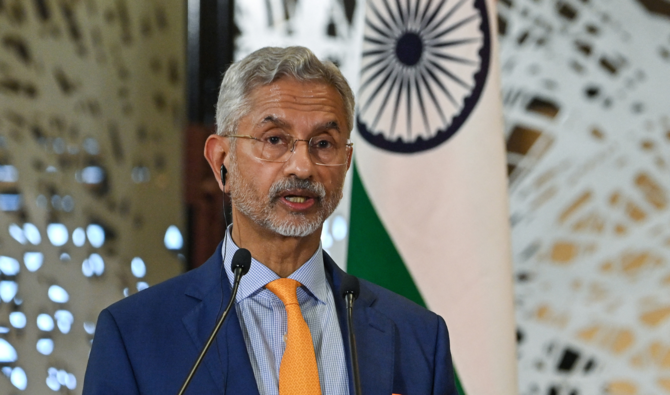
Indian minister Jaishankar rules out bilateral talks with Pakistan during SCO summit

India's Foreign Minister Subrahmanyam Jaishankar speaks during a press conference after the Quad Ministerial Meeting with his counterparts from the US, Japan and Australia at the Iikura Guest House in Tokyo on July 29, 2024. (AFP/File)
Short Url
Updated 05 October 2024
Follow

Indian minister Jaishankar rules out bilateral talks with Pakistan during SCO summit

  • Pakistan had originally invited Narendra Modi along with other international leaders to the summit
  • Jaishankar says the Indian PM typically attends such high-level meetings, but it sometimes changes

ISLAMABAD: India’s External Affairs Minister Subrahmanyam Jaishankar said on Saturday he would not hold bilateral talks with Pakistan during his upcoming visit to Islamabad this month to attend the Shanghai Cooperation Organization (SCO) Summit.
His statement came only a day after the authorities in New Delhi announced his visit to Pakistan amid frosty relations between the two states to participate in the multilateral forum.
Pakistan had originally extended the invitation to Indian Prime Minister Narendra Modi along with other international leaders to attend the summit that will be held in Islamabad on October 15 and 16.
Jaishankar’s visit to Pakistan will be the first by a high-ranking Indian minister in nearly a decade. The last one was Sushma Swaraj, who traveled to Islamabad in December 2015 to attend a conference on Afghanistan.
“It (visit) will be for a multilateral event,” India Today quoted him as saying. “I’m not going there to discuss India-Pakistan relations. I’m going there to be a good member of the SCO.”
The Indian minister said Modi typically attended such high-level meetings involving heads of state, adding that the norm sometimes changes.
Relations between India and Pakistan hit a major low in 2019 when New Delhi revoked Article 370, which granted special autonomy to Muslim-majority state of Kashmir.
The South Asian neighbors have fought three wars, including two over control of the disputed Kashmir region in the Himalayas. New Delhi accuses Islamabad of aiding and abetting Islamist militants fighting Indian rule in the region, a charge Pakistan denies.
Last year in May, Pakistan’s former foreign minister Bilawal Bhutto-Zardari visited India to attend an SCO meeting in Goa.
While Bhutto-Zardari did not meet any Indian leaders, he and Jaishankar used the forum to trade blame for their strained relations.

With input from Reuters.


Pakistan receives $1.2 billion from IMF under EFF, RSF loan programs— central bank

Updated 9 sec ago
Follow

Pakistan receives $1.2 billion from IMF under EFF, RSF loan programs— central bank

  • IMF Executive Board approved Pakistan’s second review under EFF, first review under RSF loan programs this week 
  • Disbursements from IMF have been crucial for cash-strapped Pakistan as it tries to recover from economic crisis 

ISLAMABAD: Pakistan’s central bank announced on Thursday that it has received $1.2 billion under the International Monetary Fund’s (IMF) External Fund Facility and Resilience and Sustainability Facility (RSF) loan programs. 

The IMF approved a $7 billion bailout package for Pakistan under its EFF program in September 2024 while in May 2025, it approved a separate $1.4 billion loan to Pakistan under its climate resilience fund. The RSF will support Pakistan’s efforts in building economic resilience to climate vulnerabilities and natural disasters. 

The global lender approved Pakistan’s second review under its $7 billion EFF program and first review under the RSF loan on Tuesday. As per the State Bank of Pakistan (SBP), the central bank received a combined sum of $1.2 billion under the EFF and RSF on Dec. 10. 

“The amount would be reflected in SBP’s foreign exchange reserves for the week ending on Dec. 12, 2025,” the SBP said in a statement. 

IMF bailouts have been crucial for cash-strapped Pakistan, which has been struggling with a prolonged economic crisis that has exhausted its financial reserves and weakened its currency. Pakistan came to the brink of a sovereign default in 2023 before a last-gasp IMF bailout package helped it avert the crisis. 

Pakistan has had to take tough decisions to comply with the IMF’s loan requirements, which include scrapping subsidies from food and fuel items to trigger inflation. Since then, Pakistan has attempted to regain stability by sharply reducing inflation and recording a current account surplus. 

The disbursement, however, comes at an important time for the South Asian country as it mitigates losses from a deadly monsoon season that killed over 1,000 people since late June and caused at least $2.9 billion in damages to agriculture and infrastructure.