

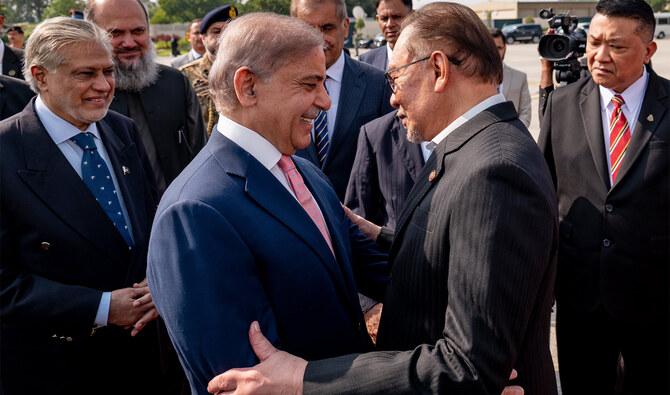

ISLAMABAD: Malaysian Prime Minister Anwar Ibrahim said on Friday Pakistan had the “potential” to be a gateway for Malaysian companies wanting to venture out into the Central and West Asian markets.
Ibrahim left Pakistan on Friday after concluding a three-day visit accompanied by a delegation of ministers and senior officials who held wide-ranging talks with Pakistani counterparts on trade, connectivity, energy, agriculture, the halal food industry, tourism, and cultural and educational exchanges. The visit came as Islamabad is pushing for foreign investment from allies and beyond in a bid to shore up its $350 billion economy while navigating tough reforms mandated by the International Monetary Fund (IMF).
During a joint press stakeout on Thursday, Ibrahim and Pakistani PM Shehbaz Sharif Prime Minister Shehbaz Sharif announced setting up a Malaysian trade office in Karachi. It was also agreed that Pakistan would export halal meat worth $200 million and 100,000 tones of basmati rice to Malaysia per year.
“I believe Pakistan has the potential to be a gateway for Malaysian companies that want to expand the market in Central Asia and West Asia,” Ibrahim said in a farewell message posted on X.
He said his state visit had “opened the widest possible space” for Malaysia and Pakistan to discuss and explore cooperation in various fields, including economic zones, trade and market issues, transport, halal industry, tourism, education, skilled labor and others.
Trade between Malaysia and Pakistan currently stands at $1.4 billion, including in palm oil, apparel, textiles, chemical and chemical-based products, and electrics and electronic products. Among South Asian countries, Pakistan is Malaysia’s third-largest trading partner.
“As part of the efforts to boost bilateral trade, both leaders agreed that Pakistan would export Halal meat worth $200 million per annum and 100,000 metric tones of Basmati Rice to Malaysia,” state news agency APP reported after Sharif and Ibrahim addressed a joint press stakeout on Thursday evening.
In his remarks to reporters, Sharif said the two leaders had discussed the export of Pakistani basmati rice as well as of halal meat from Pakistan to Malaysia worth $200 million per annum.
“He said the Malaysian PM had also assured to address the discrepancies in the import of Pakistan’s rice into his country,” APP reported, saying the two leaders also discussed cooperation in defense, tourism, agriculture, green energy, skilled labor and youth empowerment.
In his remarks, Ibrahim said both sides had agreed on a number of issues and follow-up discussions would be held in an upcoming joint commission meeting in Kuala Lumpur later this month “to ensure swift implementation of the decisions.”
“He assured that a Malaysian trade office would be opened in Karachi soon to strengthen economic collaboration between the two countries,” APP said. “He said Malaysia was seeking more skilled labor in various sectors including IT, artificial intelligence, and semiconductors and Pakistan could also be a source for such skilled labor.”
“Our focus is on professionals required to satisfy new demands, massive investments, probably the largest in the ASEAN region in terms of information technology, digital and artificial intelligence,” Ibrahim told reporters.
The two prime ministers also witnessed the exchange of signed Memorandums of Understanding (MoUs) and a Letter of Cooperation. This included an MoU between the Trade Development Authority of Pakistan (TDAP) and the Malaysia External Trade Development Cooperation (MATRADE) on trade cooperation, and an MoU for cooperation in halal trade between the Pakistan-Malaysia Business Council (PMBC) in Pakistan and the Malaysia-Pakistan Business Council (MPBC) in Malaysia.
A Letter of Cooperation between the Pakistan Telecommunication Authority (PTA) and Malaysian Communications and Multimedia Commission (MCMC) was also signed. Pakistan’s aviation ministry and Malaysian airline AirAsia also signed an agreement for four weekly flights.


