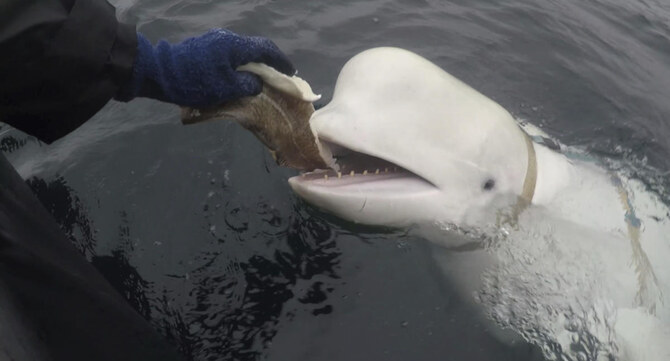
‘Russian spy’ whale likely died of infection: Norway police

Animal rights’ organizations NOAH and One Whale claimed the whale had been shot dead and filed a police report. (AP)
Short Url
Updated 04 October 2024
Follow

‘Russian spy’ whale likely died of infection: Norway police

  • Animal rights’ organizations NOAH and One Whale claimed the whale had been shot dead and filed a police report

OSLO: A beluga whale found dead in Norway in August, suspected by some of being a Russian spy, probably died of an infection and not gunshot wounds, Norwegian police said Friday.
Nicknamed “Hvaldimir” in a pun on the Norwegian word for whale (“hval“) and its purported ties to Moscow, the white beluga first appeared off the coast in Norway’s far-northern Finnmark region in 2019 and quickly became a celebrity in the country.
He was found dead on August 31 in a bay on Norway’s southwestern coast.
Animal rights’ organizations NOAH and One Whale claimed the whale had been shot dead and filed a police report.
The Norwegian Veterinary Institute conducted an autopsy and found a 35-centimeter (14-inch) stick lodged in his mouth.
“The report concluded that the probable cause of death was a bacterial infection, possibly a result of wounds in his mouth caused by a stick that got stuck,” police official Amund Preede Revheim said in a statement on Friday.
“The stick may also have made it difficult for Hvaldimir to eat, thereby increasing the risk of infection,” he added.
Police said they had found no trace of bullets and had decided not to open an investigation.
“There is nothing in the examinations that suggests Hvaldimir was killed illegally,” Preede Revheim said.
When Hvaldimir was found in 2019, Norwegian marine biologists removed a man-made harness with a mount suited for an action camera and the words “Equipment St. Petersburg” printed in English on the plastic clasps.
The whale appeared to be accustomed to humans.
Norwegian officials said the whale might have escaped an enclosure and been trained by the Russian navy.
Moscow has never made any official response to claims the whale could be a “Russian spy.”


Filipinos master disaster readiness, one roll of the dice at a time

Updated 7 sec ago
Follow

Filipinos master disaster readiness, one roll of the dice at a time

  • In a library in the Philippines, a dice rattles on the surface of a board before coming to a stop, putting one of its players straight into the path of a powerful typhoon
MANILA: In a library in the Philippines, a dice rattles on the surface of a board before coming to a stop, putting one of its players straight into the path of a powerful typhoon.
The teenagers huddled around the table leap into action, shouting instructions and acting out the correct strategies for just one of the potential catastrophes laid out in the board game called Master of Disaster.
With fewer than half of Filipinos estimated to have undertaken disaster drills or to own a first-aid kit, the game aims to boost lagging preparedness in a country ranked the most disaster-prone on earth for four years running.
“(It) features disasters we’ve been experiencing in real life for the past few months and years,” 17-year-old Ansherina Agasen told AFP, noting that flooding routinely upends life in her hometown of Valenzuela, north of Manila.
Sitting in the arc of intense seismic activity called the “Pacific Ring of Fire,” the Philippines endures daily earthquakes and is hit by an average of 20 typhoons each year.
In November, back-to-back typhoons drove flooding that killed nearly 300 people in the archipelago nation, while a 6.9-magnitude quake in late September toppled buildings and killed 79 people around the city of Cebu.
“We realized that a lot of loss of lives and destruction of property could have been avoided if people knew about basic concepts related to disaster preparedness,” Francis Macatulad, one of the game’s developers, told AFP of its inception.
The Asia Society for Social Improvement and Sustainable Transformation (ASSIST), where Macatulad heads business development, first dreamt up the game in 2013, after Super Typhoon Haiyan ravaged the central Philippines and left thousands dead.
Launched six years later, Master of Disaster has been updated this year to address more events exacerbated by human-driven climate change, such as landslides, drought and heatwaves.
More than 10,000 editions of the game, aimed at players as young as nine years old, have been distributed across the archipelago nation.
“The youth are very essential in creating this disaster resiliency mindset,” Macatulad said.

- ‘Keeps on getting worse’ -

While the Philippines has introduced disaster readiness training into its K-12 curriculum, Master of Disaster is providing a jolt of innovation, Bianca Canlas of the Department of Science and Technology (DOST) told AFP.
“It’s important that it’s tactile, something that can be touched and can be seen by the eyes of the youth so they can have engagement with each other,” she said of the game.
Players roll a dice to move their pawns across the board, with each landing spot corresponding to cards containing questions or instructions to act out disaster-specific responses.
When a player is unable to fulfil a task, another can “save” them and receive a “hero token” — tallied at the end to determine a winner.
At least 27,500 deaths and economic losses of $35 billion have been attributed to extreme weather events in the past two decades, according to the 2026 Climate Risk Index.
“It just keeps on getting worse,” Canlas said, noting the lives lost in recent months.
The government is now determining if it will throw its weight behind the distribution of the game, with the sessions in Valenzuela City serving as a pilot to assess whether players find it engaging and informative.
While conceding the evidence was so far anecdotal, ASSIST’s Macatulad said he believed the game was bringing a “significant” improvement in its players’ disaster preparedness knowledge.
“Disaster is not picky. It affects from north to south. So we would like to expand this further,” Macatulad said, adding that poor communities “most vulnerable to the effects of climate change” were the priority.
“Disasters can happen to anyone,” Agasen, the teen, told AFP as the game broke up.
“As a young person, I can share the knowledge I’ve gained... with my classmates at school, with people at home, and those I’ll meet in the future.”