

Pakistan confers highest civilian award on Malaysian PM

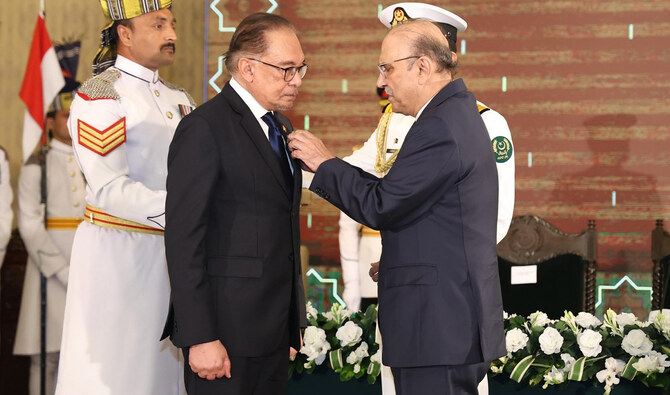
President Asif Ali Zardari (right) confers Pakistan’s highest civilian award on Malaysian Prime Minister Dato’ Seri Anwar Ibrahim in Islamabad, Pakistan on October 3, 2024. (PID)
Short Url
Updated 04 October 2024
Follow

Pakistan confers highest civilian award on Malaysian PM

  • Malaysian PM Dato’ Seri Anwar Ibrahim arrived in Islamabad on Wednesday on a three-day visit along with a delegation of ministers and senior officials
  • PM Shehbaz Sharif and his Malaysian counterpart agreed to set up a trade office in Karachi, increase halal meat and basmati rice exports to Malaysia

ISLAMABAD: President Asif Ali Zardari on Thursday conferred Pakistan’s highest civilian award on Malaysian Prime Minister Dato’ Seri Anwar Ibrahim in recognition of his support for Islamic causes and for being a great friend of Pakistan, Pakistani state media reported.

Ibrahim arrived in Islamabad on Wednesday on a three-day visit along with a delegation of ministers and senior officials to hold wide-ranging talks on trade, connectivity, energy, agriculture, the halal food industry, tourism, and cultural and educational exchanges.

The Malaysian prime minister has been a prominent advocate of humanitarian causes and Islamic values, and his leadership is marked by a profound commitment to promoting social justice and addressing global issues affecting the Islamic world, according to a report by the Radio Pakistan broadcaster.

He has also been a voice for self-determination movements and has particularly stood against oppression across the world. The award, which honors those who render “services of highest distinction” to the national interest of Pakistan, was conferred upon him at a special investiture ceremony in Islamabad.

“The Malaysian Prime Minister continues to work tirelessly to counter Islamophobia, striving to create interfaith harmony by fostering understanding and respect between different cultures and religions,” the report read.

The investiture ceremony was attended by Prime Minister Shehbaz Sharif, federal ministers, services chiefs, diplomats, and senior government officials, followed by a state dinner in honor of PM Ibrahim and his delegation.

Separately, the Malaysian prime minister met Pakistan Army Chief General Asim Munir and discussed with him bilateral strategic interests, regional security and defense cooperation.

“He emphasized on the need for increasing bilateral ties, particularly military relations, among the two brotherly countries and extended an invitation to the COAS (chief of army staff) to visit Malaysia in the same context,” the Pakistani military’s media wing, the Inter-Services Public Relations (ISPR), said in a statement.

Ibrahim’s visit comes as Islamabad pushes for foreign investment from allies and beyond in a bid to shore up its $350 billion economy, while navigating tough reforms mandated by the International Monetary Fund (IMF) as part of a $7 billion bailout.

Earlier on Thursday, PM Sharif and his Malaysian counterpart agreed to set up a trade office in Karachi, while Islamabad will increase its halal meat and basmati rice exports to the Southeast Asian country, Sharif’s office said.

“As part of the efforts to boost bilateral trade, both leaders agreed that Pakistan would export Halal meat worth $200 million per annum and 100,000 metric tons of Basmati Rice to Malaysia,” Pakistani state news agency APP reported after Sharif and Ibrahim addressed a joint press stakeout.

Trade between Malaysia and Pakistan currently stands at $1.4 billion, including in palm oil, apparel, textiles, chemical and chemical-based products, and electrics and electronic products. Among South Asian countries, Pakistan is Malaysia’s third-largest trading partner.

Pakistan fines beverage maker Rs150 million for imitating PepsiCo. product packaging

Updated 8 sec ago
Follow

Pakistan fines beverage maker Rs150 million for imitating PepsiCo. product packaging

  • The case dates back to 2018, when PepsiCo. filed a complaint that Mezan Beverages’ ‘Storm’ energy drink was designed to imitate its ‘Sting’
  • Such rulings are a rarity in Pakistan, where prolonged litigation, frequent stay orders and jurisdictional challenges often delay enforcement

KARACHI: The Competition Commission of Pakistan (CCP) has imposed a penalty of Rs150 million ($535,283) on Mezan Beverages (Private) Limited for “deceptive marketing” in a case brought against it by PepsiCo, the CCP said on Friday.

The case dates back to 2018, when the American multinational food and beverage corporation filed a complaint alleging that Mezan Beverages’ ‘Storm’ energy drink was designed to imitate its ‘Sting’ and benefit from PepsiCo’s goodwill.

Instead of responding on merits, Mezan Beverages repeatedly challenged the CCP’s jurisdiction and initiated prolonged litigation, delaying the inquiry for several years by obtaining stay orders from the Lahore High Court in 2018 and 2021, according to the CCP.

In June 2024, the court dismissed Mezan Beverages’ petition, upheld the CCP’s authority, and ruled that early challenges to show-cause notices were not maintainable. The court observed that the Pakistani beverage maker had used litigation to delay regulatory proceedings.

“The company (Mezan Beverages) was found to have imitated the packaging and trade dress of PepsiCo’s Sting energy drink, thereby engaging in deceptive marketing practices in violation of Section 10 of the Competition Act, 2010,” the CCP said in a statement.

“Such conduct amounted to parasitic copying and constituted deceptive marketing prohibited under Pakistan’s competition law.”

Such rulings remain uncommon in Pakistan, where prolonged litigation, frequent stay orders and jurisdictional challenges often delay or dilute enforcement of competition and consumer protection laws. Regulatory actions are frequently stalled for years in courts, allowing companies accused of unfair practices to continue operating while cases remain unresolved.

In its verdict, the CCP said Mezan Beverages’ energy drink adopted a red-dominant color scheme, identical to Sting; bold, slanted white lettering with aggressive visual motifs; near-identical bottle shape and presentation; and branding elements likely to mislead an ordinary consumer with imperfect recollection.

It emphasized that deception is assessed based on the overall commercial impression, not minute differences examined side by side.

“Even though Mezan Beverages held a registered trademark for ‘Storm’... copycat branding and misleading packaging will not be tolerated, regardless of the size or local status of the company,” the commission added.