Libya to resume oil production after central bank dispute ends

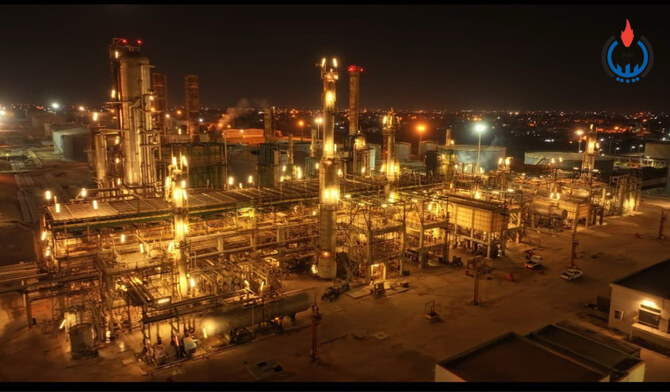
Libya's National Oil Corporation on Thursday announced the resumption of oil production at its Sharara and El-Feel oil fields, which were both closed in August over a Central Bank leadership row. (X: @NOC_Libya)
Short Url
Updated 04 October 2024
Follow

Libya to resume oil production after central bank dispute ends

  • Libya produces more than 1.2 million barrels of oil per day, and Sharara is the country’s largest field, producing up to 300,000 barrels per day
  • Authorities in Benghazi closed the oilfields on Aug. 26 after the Tripoli-based Presidential Council replace the veteran central bank chief

CAIRO: Libya’s state-run oil company said Thursday it was restarting full oil production, almost two months after shutting down operations in two of its major fields amid a political crisis.
The National Oil Corporation said in a statement that it would resume production at the Sharara and El-Feel oil fields, and export shipments from Es Sider, the country’s largest port. In August, the company declared “force majeure,” a legal maneuver that lets a company get out of its contracts because of extraordinary circumstances.
As part of the review of the force majeure situation, NOC confirmed in its statement that it “can resume the operations of crude oil production and exporting operations to its customers.”
The National Oil Corporation previously blamed the shutdown on the Fezzan Movement, a local protest group. It came as the country’s rival authorities were locked in a dispute over the governance of its Central Bank, which distributes the country’s oil revenues.
In August, the UN warned that the country was poised to face even greater instability due to the dispute. But that was resolved in recent days, when the country’s parliament appointed a new governor to the bank.
Libya produces more than 1.2 million barrels of oil per day, and Sharara is the country’s largest field, producing up to 300,000 barrels per day.  It was exporting most of it. In September, exports averaged 460,000 bpd according to oil analytics firm Kpler.

The oil-rich country has been in political turmoil since a NATO-backed uprising toppled and killed longtime dictator Muammar Qaddafi in 2011. Since then, Libya has been split between rival administrations in the east and the west, each backed by militias and foreign governments.

The latest dispute
NOC declared force majeure on Aug. 7 at Sharara oilfield — one of Libya’s largest production areas with a capacity of about 300,000 barrels per day — and on Elfeel oilfield on Sept.2.
Sharara is located in southwestern Libya and operated by a joint venture of NOC with Spain’s Repsol, France’s TotalEnergies, Austria’s OMV, and Norway’s Equinor.
Elfeel has a capacity of 70,000 barrels per day and is operated by Mellitah Oil and Gas, a joint venture between NOC and Italy’s Eni.
Two engineers at the field told Reuters the oilfield resumed production but not with full capacity due to maintenance work.
Earlier, three engineers said there were some “technical problems” at Elfeel.
The government in Benghazi in the east said oil production and exports would resume normal operations, after the rival authorities agreed last month to appoint Issa as new central bank governor.
Authorities in the second-largest city had closed oilfields and halted most of crude exports on Aug. 26 in protest against a move by the Presidential Council, which sits in Tripoli in the west, to replace veteran central bank chief Sadiq Al-Kabir.
The head of the Presidential Council, Mohamed Al-Menfi, met with Issa on Wednesday and stressed “the need for the central bank governor to commit to the technical role of the bank, stay away from politics, and not surpass the legal jurisdictions of the board of directors.”
The United Nations Support Mission in Libya UNSMIL welcomed in a statement NOC announcing the lifting of force majeure on oil production.
The mission emphasized that “it is essential that revenues from this vital resource be channeled through the appropriate institutional framework, and ultimately to the Central Bank of Libya.”


Israel PM holds coalition meeting after objecting to Gaza panel

Updated 6 sec ago
Follow

Israel PM holds coalition meeting after objecting to Gaza panel

  • Israeli Prime Minister Benjamin Netanyahu convened a meeting of his ruling coalition partners on Sunday after objecting to the composition of a Gaza advisory panel
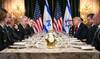
JERUSALEM: Israeli Prime Minister Benjamin Netanyahu convened a meeting of his ruling coalition partners on Sunday after objecting to the composition of a Gaza advisory panel formed by the White House, according to an official and media reports.
The White House announced this week the setting up of a “Gaza Executive Board,” which would operate under a broader “Board of Peace” to be chaired by US President Donald Trump as part of his 20-point plan to end the war in Gaza.
The executive board, described as having an advisory role, includes Turkish Foreign Minister Hakan Fidan and Qatari diplomat Ali Al-Thawadi, alongside other regional and international officials.
Late on Saturday, Netanyahu’s office objected to the composition of the executive board.
“The announcement regarding the composition of the Gaza Executive Board, which is subordinate to the Board of Peace, was not coordinated with Israel and runs contrary to its policy,” the office of Netanyahu said.
“The Prime Minister has instructed the Foreign Affairs Minister to contact the US Secretary of State on this matter.”
It did not explain the reason for its objection, but Israel has previously objected strongly to any Turkish role in post-war Gaza, with relations between the two countries deteriorating sharply since the war began in October 2023.
In addition to naming Turkiye’s foreign minister to the executive board, Trump has also invited Turkish President Recep Tayyip Erdogan to join the overarching Board of Peace.
Media reports said that leaders of the country’s ruling coalition were scheduled to meet on Sunday to examine the composition of the executive board.
“There is a meeting scheduled of the coalition at 10:00 am (0800 GMT),” the spokesman of Netanyahu’s Likud Party told AFP, declining to provide further details.
Alongside Likud, the coalition includes the Religious Zionist Party led by far-right Finance Minister Bezalel Smotrich and Otzma Yehudit (Jewish Power) led by far-right National Security Minister Itamar Ben Gvir.
The White House said Trump’s plan would include three bodies: the Board of Peace, chaired by Trump; a Palestinian committee of technocrats tasked with governing Gaza; and the Gaza Executive Board, which would play an advisory role.
The Palestinian technocratic committee held its first meeting in Cairo on Saturday.
The diplomatic developments came as the United States said this week that the Gaza truce plan had entered a second phase, shifting from implementing a ceasefire to the disarmament of Hamas, whose October 7, 2023 attack on Israel triggered the Israeli offensive in Gaza.