More than 800 mpox deaths recorded across Africa

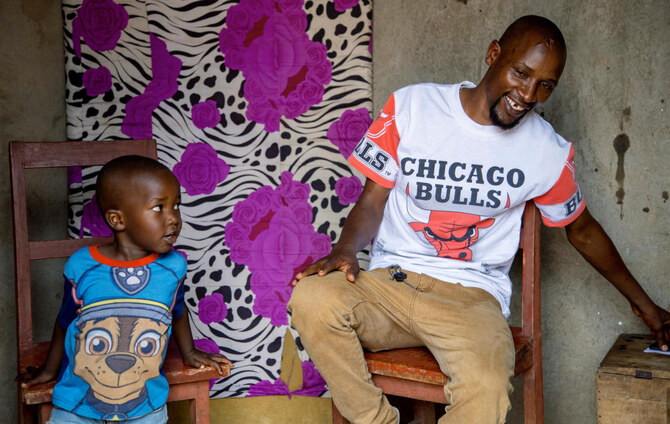
Manigaba Eric, 35, plays with his son after a Reuters interview on the stigma they faced after returning home from the Mpox Center treatment in Tenga at Rubirizi zone, in Mutimbuzi Commune, Bujumbura, Burundi on Oct. 1, 2024. (Reuters)
Short Url
Updated 03 October 2024
Follow

More than 800 mpox deaths recorded across Africa

  • “The epidemic is not under control,” Jean Kaseya, the head of Africa CDC said
  • The Democratic Republic of Congo would begin vaccinating in two days

NAIROBI: More than 800 people across Africa have died from mpox, the African Union’s disease control center said Thursday, warning the epidemic “was not under control.”
Some 34,297 cases have been recorded across the continent since January, the AU’s Centers for Disease Control and Prevention (Africa CDC) said, adding that the figure included 38 cases in Ghana.
This brings to 16 the number of African countries where mpox has been officially detected this year, according to the health agency.
“The epidemic is not under control,” Jean Kaseya, the head of Africa CDC told a press briefing, saying the number of deaths since the start of the year was 866.
He also warned that the testing rate remained “too low,” noting that some 2,500 new cases had been detected in the past week.
The Democratic Republic of Congo (DRC) — the epicenter of the outbreak — would begin vaccinating in two days, Kaseya added. Vaccinations had been due to begin October 2.
Mpox, previously known as monkeypox, is caused by a virus transmitted to humans by infected animals but can also be passed from human to human through close physical contact.
It causes fever, muscular aches and large boil-like skin lesions, and can be deadly.


Sanchez hails Spain’s immigration approach as a model for EU

Updated 4 sec ago
Follow

Sanchez hails Spain’s immigration approach as a model for EU

  • Prime minister rejects critics who argue Spain’s stance fuels illegal migration to the country

MADRID: Prime Minister Pedro Sanchez has hailed Spain’s openness to immigration as a model for Europe, saying it has benefited the economy and bolstered state coffers.

While other European nations have tightened their borders against newcomers under pressure from right-wing parties, Spain has championed legal immigration.

The country has opened up paths for migrants to live and work in the country legally, even as it has pushed to police its borders and block irregular migration.

Migration accounts for 80 percent of Spain’s economic growth over the past six years, and accounts for 10 percent of the country’s social security revenues, Sanchez said.

“Spain will continue to defend a migration model that works, one that works for Spain and could also help awaken an aging Europe,” the Socialist premier told a gathering of Spanish ambassadors in Madrid.

“Our model works. There is no so-called ‘pull effect,’” Sanchez added, rejecting critics who argue Spain’s pro-immigration stance fuels illegal migration to the country.

Irregular migrant arrivals to Spain fell by 42.6 percent in 2025 from the previous year to 36,775, largely due to a sharp drop in arrivals along the Atlantic route to the Canary Islands, according to Interior Ministry figures.

Spain has reached cooperation agreements with several African nations that are key sources of irregular migration to bolster the fight against smuggling networks.

Spain, the EU’s fourth-largest economy, has outperformed its peers since 2021, supported by tourism, low energy costs, domestic consumption, and foreign investment.

The government forecasts the economy will expand by 2.9 percent in 2025, more than twice the euro zone average.