

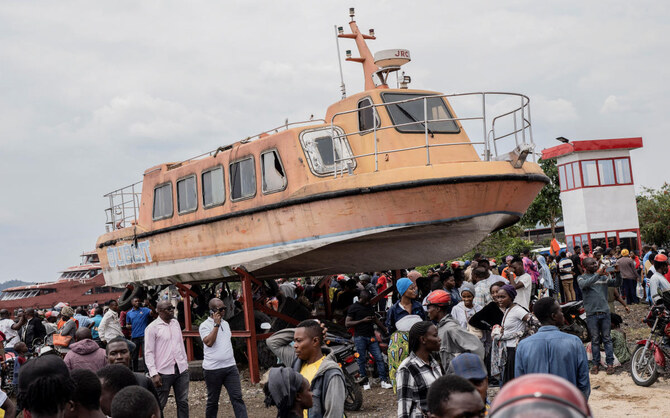
At least 78 people died when a boat with 278 passengers capsized in eastern Congo, official says

Residents gather to witness the search and rescue mission after a boat ferrying passengers and goods from the Minova villages sank in Lake Kivu near the Port of Kituku in Goma, North Kivu province of the Democratic Republic of Congo Oct. 3, 2024. (Reuters)
Short Url
Updated 04 October 2024
Follow

At least 78 people died when a boat with 278 passengers capsized in eastern Congo, official says

  • According to Jean-Jacques Purusi, governor of the South Kivu province, the death toll was provisional and the number of fatalities could rise
  • The boat, overloaded with passengers, sank while trying to dock just meters (yards) away from the port of Kituku, according to witnesses

GOMA, Congo: At least 78 people died when an overcrowded boat with 278 passengers capsized on Lake Kivu in eastern Congo on Thursday, a local governor said.
According to Jean-Jacques Purusi, governor of the South Kivu province, the death toll was provisional and the number of fatalities could rise. He spoke to The Associated Press over the phone hours after the tragedy.
The boat, overloaded with passengers, sank while trying to dock just meters (yards) away from the port of Kituku, according to witnesses. It was going from Minova in South Kivu province to Goma, in North Kivu province.
Earlier in the day, witnesses said they saw rescue services recover at least 50 bodies from the water. The boat, overloaded with passengers, sank while trying to dock just meters (yards) away from the port of Kituku, they added. It was going from Minova in South Kivu province to Goma, in North Kivu province.
The witnesses said 10 people survived and were taken to the local hospital. Local officials later reported that as many as 50 were rescued. The search and rescue efforts were continuing.

It was the latest deadly boat accident in the central African country, where overcrowding on vessels is often to blame. Maritime regulations also are often not followed.
Congolese officials have often warned against overloading and vowed to punish those violating safety measures for water transportation. But in remote areas where most passengers come from, many are unable to afford public transport for the few available roads.
In June, an overloaded boat sank near the capital of Kinshasa and 80 passengers lost their lives. In January, 22 people died on Lake Maî-Ndombe and in April 2023, six were killed and 64 went missing on Lake Kivu.
Witnesses of the Thursday tragedy said the boat was visibly overcrowded.
“I was at the port of Kituku when I saw the boat arriving from Minova, full of passengers,” Francine Munyi told the AP. “It started to lose its balance and sank into the lake. Some people threw themselves into the water.”
“Many died, and few were saved,” she added. “I couldn’t help them because I don’t know how to swim.”
The victims’ families and Goma residents gathered at the port of Kituku, accusing authorities of negligence in the face of growing insecurity in the region.
Since the fighting between the armed forces and the M23 rebels made the road between the cities of Goma and Minova impassable, forcing the closure of the passage to trucks transporting food, many traders have resorted to maritime transport on Lake Kivu. It’s an alternative considered safer than road traffic, which is threatened by insecurity.
But according to Elia Asumani, a shipping agent who works on this line, the situation has become dangerous:
“We are afraid,” he told the AP. “This shipwreck was predictable.”
Bienfait Sematumba, 27, said he lost four family members.
“They are all dead. I am alone now,” he said, sobbing. “If the authorities had ended the war, this shipwreck would never have happened.”
The survivors, about 10 of them, were taken to Kyeshero hospital for treatment. One of them, Neema Chimanga, said she was still in shock.
“We saw the boat start to fill with water halfway,” she recounted to the AP. “The door of the boat opened, and we tried to close it. But the water was already coming in, and the boat tilted.”
“I threw myself into the water and started swimming,” she said. “I don’t know how I got out of the water.”


UK police seek information from ex-protection officers of king’s brother Andrew

Updated 5 sec ago
Follow

UK police seek information from ex-protection officers of king’s brother Andrew

  • Any changes to the line of succession would require consultation and agreement with other countries where King Charles is head of state
  • London’s Metropolitan Police said on Friday it was now identifying and contacting former and serving officers

SANDRINGHAM, England: British police said on Friday they were contacting former protection officers who worked for King Charles’ younger brother Andrew Mountbatten-Windsor, urging anyone with allegations of sex offenses relating to Jeffrey Epstein to come forward.
Mountbatten-Windsor was arrested on Thursday, his 66th birthday, on suspicion of misconduct in a public office.
A British official said Britain’s government would consider new legislation to remove the former prince from the line of royal succession once the police investigation into his ties with Epstein is over.
Any changes to the line of succession — Mountbatten-Windsor is eighth in line to the throne — would require consultation and agreement with other countries where King Charles is head of state, the official — who asked not to be identified — said.
OFFICERS URGED TO SHARE INFORMATION
Thursday’s arrest related to allegations Mountbatten-Windsor sent confidential government documents to the disgraced financier when he was a trade envoy.
As part of a completely separate inquiry, London’s Metropolitan Police said on Friday it was now identifying and contacting former and serving officers who may have worked closely with the royal.
“They have been asked to consider carefully whether anything they saw or heard during that period of service may be relevant to our ongoing reviews and to share any information that could assist us,” the police statement said.
“We continue to urge ⁠anyone with new ⁠or relevant information to come forward. All allegations will be taken seriously and, as with any matter, any information received will be assessed and investigated where appropriate.”
Mountbatten-Windsor has always denied any wrongdoing in relation to Epstein, a convicted sex offender whose death in a New York jail in 2019 was ruled a suicide, and said he regretted their friendship.
In 2022, the royal settled a civil lawsuit brought in the United States by the late Virginia Giuffre who accused him of sexually abusing her when she was a teenager at properties owned by Epstein or his associates.
British media reports have stated that Giuffre received around 12 million pounds ($16.2 million) from Mountbatten-Windsor. He has denied ever meeting her.
London police had previously looked into allegations of trafficking for sexual exploitation relating to Epstein and decided in 2016 not to launch any criminal investigation. That decision has since been reviewed three ⁠times, and as it stands there is no current formal investigation.
Friday’s statement said in light of the recent mass release of documents by the US government relating to Epstein, police were also looking into whether London airports were used by him to facilitate human trafficking and sexual exploitation.
“We are assessing this information and are actively seeking further detail from law enforcement partners, including those in the United States,” the statement said.
That echoed statements from three other police forces that are looking into private flight links to Epstein at other airports in Britain.

HELD FOR MORE THAN 10 HOURS
The latest development comes after Mountbatten-Windsor was released under investigation, having been held by detectives from Thames Valley police for more than 10 hours on suspicion of misconduct in a public office relating to his time as a trade envoy from 2001-2011.
He has not been charged with any offense, but looked haunted in a Reuters photograph after his release, eyes red and slumped in the back of a Range Rover.
The photograph of a man who was once a dashing naval officer and reputed favorite son of the late Queen Elizabeth was carried on the front page of newspapers in Britain and around the world, accompanied by headlines such as “Downfall.”
News of the arrest also made headlines around the world, including Australia, where Charles is ⁠head of state, Europe and the United ⁠States.
The recent release of Epstein files showed Mountbatten-Windsor had remained friends with Epstein long after the financier was convicted of soliciting prostitution from a minor in 2008.
Those files suggested he had forwarded to Epstein British government reports about investment opportunities in Afghanistan and assessments of Vietnam, Singapore and other places he had visited as the government’s Special Representative for Trade and Investment.
The arrest of the senior royal is unprecedented in modern times.
King Charles, who stripped his brother of his title of prince and forced him out of his Windsor home last year, said on Thursday he had learned about the arrest with “deepest concern.”
“Let me state clearly: the law must take its course,” the king said.
Julian Payne, Charles’ former communications chief who is now at Edelman, said by putting the statement in the king’s words, it was designed to show that he was taking the lead on the matter, and he thought the public would be supportive.
“After all, how many other leaders around the world are judged through the actions of their relatives?” he told Reuters.

POLICE SEARCHES AT WINDSOR CONTINUE
As part of its investigation, Thames Valley Police have searched Wood Farm on the king’s Sandringham estate in Norfolk, eastern England, where Mountbatten-Windsor now lives, and officers were still searching his former mansion in Windsor on Friday.
While being arrested means that police have reasonable suspicion that a crime has been committed and that the royal is suspected of involvement in an offense, it does not imply guilt.
A conviction for misconduct in public office carries a maximum sentence of life imprisonment, and cases must be dealt with in a Crown Court, which handle the most serious criminal offenses.