

At least 78 people died when a boat with 278 passengers capsized in eastern Congo, official says

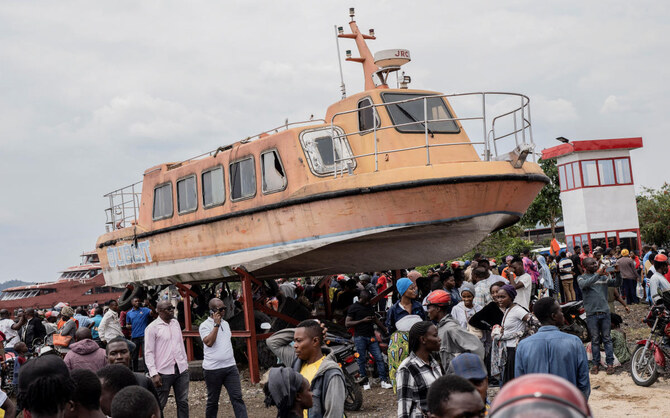
Residents gather to witness the search and rescue mission after a boat ferrying passengers and goods from the Minova villages sank in Lake Kivu near the Port of Kituku in Goma, North Kivu province of the Democratic Republic of Congo Oct. 3, 2024. (Reuters)
Short Url
Updated 04 October 2024
Follow

At least 78 people died when a boat with 278 passengers capsized in eastern Congo, official says

  • According to Jean-Jacques Purusi, governor of the South Kivu province, the death toll was provisional and the number of fatalities could rise
  • The boat, overloaded with passengers, sank while trying to dock just meters (yards) away from the port of Kituku, according to witnesses

GOMA, Congo: At least 78 people died when an overcrowded boat with 278 passengers capsized on Lake Kivu in eastern Congo on Thursday, a local governor said.
According to Jean-Jacques Purusi, governor of the South Kivu province, the death toll was provisional and the number of fatalities could rise. He spoke to The Associated Press over the phone hours after the tragedy.
The boat, overloaded with passengers, sank while trying to dock just meters (yards) away from the port of Kituku, according to witnesses. It was going from Minova in South Kivu province to Goma, in North Kivu province.
Earlier in the day, witnesses said they saw rescue services recover at least 50 bodies from the water. The boat, overloaded with passengers, sank while trying to dock just meters (yards) away from the port of Kituku, they added. It was going from Minova in South Kivu province to Goma, in North Kivu province.
The witnesses said 10 people survived and were taken to the local hospital. Local officials later reported that as many as 50 were rescued. The search and rescue efforts were continuing.

It was the latest deadly boat accident in the central African country, where overcrowding on vessels is often to blame. Maritime regulations also are often not followed.
Congolese officials have often warned against overloading and vowed to punish those violating safety measures for water transportation. But in remote areas where most passengers come from, many are unable to afford public transport for the few available roads.
In June, an overloaded boat sank near the capital of Kinshasa and 80 passengers lost their lives. In January, 22 people died on Lake Maî-Ndombe and in April 2023, six were killed and 64 went missing on Lake Kivu.
Witnesses of the Thursday tragedy said the boat was visibly overcrowded.
“I was at the port of Kituku when I saw the boat arriving from Minova, full of passengers,” Francine Munyi told the AP. “It started to lose its balance and sank into the lake. Some people threw themselves into the water.”
“Many died, and few were saved,” she added. “I couldn’t help them because I don’t know how to swim.”
The victims’ families and Goma residents gathered at the port of Kituku, accusing authorities of negligence in the face of growing insecurity in the region.
Since the fighting between the armed forces and the M23 rebels made the road between the cities of Goma and Minova impassable, forcing the closure of the passage to trucks transporting food, many traders have resorted to maritime transport on Lake Kivu. It’s an alternative considered safer than road traffic, which is threatened by insecurity.
But according to Elia Asumani, a shipping agent who works on this line, the situation has become dangerous:
“We are afraid,” he told the AP. “This shipwreck was predictable.”
Bienfait Sematumba, 27, said he lost four family members.
“They are all dead. I am alone now,” he said, sobbing. “If the authorities had ended the war, this shipwreck would never have happened.”
The survivors, about 10 of them, were taken to Kyeshero hospital for treatment. One of them, Neema Chimanga, said she was still in shock.
“We saw the boat start to fill with water halfway,” she recounted to the AP. “The door of the boat opened, and we tried to close it. But the water was already coming in, and the boat tilted.”
“I threw myself into the water and started swimming,” she said. “I don’t know how I got out of the water.”


UN refugee agency chief: ‘Very difficult moment in history’

UNHCR High Commissioner Barham Salih during an interview in Rome on Monday. (AP)
Updated 4 sec ago
Follow

UN refugee agency chief: ‘Very difficult moment in history’

  • According to his agency also known as UNHCR, there are 117.3 million forcibly displaced people around the world from 194 countries

ROME: The first refugee to lead the UN refugee agency has said that the world faces “a very difficult moment in history” and is appealing to a common humanity amid dramatic change.
Repression of immigrants is growing, and the funding to protect them is plummeting. 
Without ever mentioning the Trump administration or its policies directly, Barham Salih said his office will have to be inventive to confront the crisis, which includes losing well over $1 billion in US support.

FASTFACT

There are 117.3 million forcibly displaced people around the world from 194 countries.

“Of course it’s a fight, undeniably so, but I think also I’m hopeful and confident that there is enough humanity out there to really enable us to do that,” said Salih, a former president of Iraq.
He was also adamant on the need to safeguard the 1951 refugee convention as the Trump administration campaigns for other governments to join it in upending a decades-old system and redefining asylum rules.
Salih, who took up his role as high commissioner for refugees on Jan. 1, described it as an international legal responsibility and a moral responsibility.
According to his agency also known as UNHCR, there are 117.3 million forcibly displaced people around the world from 194 countries. Salih’s challenge is supporting some 30 million refugees with significantly less funds.
In 2024 and 2025, funding from the US dropped from $2.1 billion to $800 million, and yet the country remains UNHCR’s largest donor.
“Resources made available to helping refugees are being constrained and limited in very, very significant way,” Salih said.
The Trump administration is also reviewing the US asylum system, suspending the refugee program in 2025 and setting a limit for entries to 7,500, mostly white South Africans — a historic low for refugee admittance since the program’s inception in 1980.
The Trump administration also has tightened immigration enforcement as part of its promise to increase deportations, while facing criticism for deportations to third countries and an uproar over two fatal shootings by federal officers and other deaths.
“We have to accept the need for adapting with a new environment in the world,” Salih said. 
His agency is seeking to be more cost-effective, “to really deliver assistance to the people who need it, rather than be part of a system that sustains dependency on humanitarian assistance,” he added. Salih has already met Pope Leo XIV at the Vatican. He said he was grateful for the support of the pontiff — the first pope from the US.
“The voice of the church and faith-based organizations in this endeavor is absolutely vital,” Salih said. “His moral support, his voice of the need for supporting refugees and what we do as UNHCR at this moment is very, very important.”