

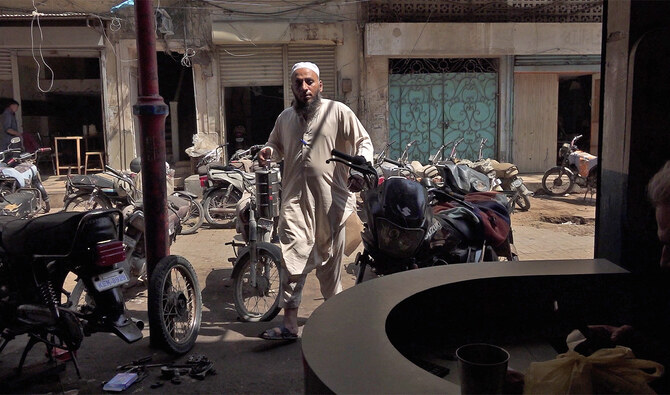

KARACHI: Muhammad Hussain waited for the traffic light to turn green and then sped ahead into a busy artery in Pakistan’s southern port city of Karachi, with large bags slung from his motorcycle’s handlebars filled with steel lunch boxes called tiffins.
Hussain is among hundreds of tiffin wallahs who daily navigate the crowded port city by motorbike, and sometimes by public transport, to deliver thousands of hot lunches to Karachi’s vast working population.
Tiffins are mostly round, with up to four stainless steel compartments stacked atop one another and sealed together with a tight fitting lid and side clip. The separate compartments are perfect for accommodating multi-dish South Asian lunches, simple but often made of many moving parts: a spicy vegetable or meat curry, lentils, rice, yogurt, pickles, flatbread and sometimes even a sweet.
The delivery of home-cooked tiffin lunches has its origins as a service for British colonial officers in India but turned into a booming business in the late 1800s to cater to a growing number of migrants moving from different parts of the country to Bombay — a crucial center of British imperial rule and bringing with them their distinctive cuisines and tastes. An Indian entrepreneur, Mahadeo Havaji Bacche, launched the tiffin distribution business in Bombay in 1890 to meet the culinary needs of this rapidly growing working population whose members had to leave early in the morning for work and would often go hungry for lunch.
Today, even with the advent of fast food joints and delivery services like FoodPanda, the middle-classes of Karachi, much like Bombay, remain skeptical of “outside” food and prefer their lunches homecooked.
“This started in India, the tiffin service is operating there,” Muhammad Ibrahim Abu, 60, a retired tiffin wallah who was in the business for three decades, told Arab News earlier this month.
“Since we migrated from there [to Pakistan], we thought why not start this work in Pakistan? So, we started it in Pakistan and praise be to god, it has been running successfully.”
Indeed, the tiffin wallahs have loyal customers all over Karachi, with many students and office goers preferring the taste of home-prepared meals to takeouts.
“We get home-cooked meals while sitting in the office, and secondly it carries the same homemade taste,” local trader Muhammad Irfan, 42, told Arab News as he unclasped a just-delivered tiffin and poured egg curry into a white plate from one of its containers. A group of four of his colleagues gathered around the food and began the shared meal.
Muhammad Hussain can serve up to 150 customers like Irfan in one day, he told Arab News as he started his deliveries one cool October morning this week.
“Our kitchen, catering work starts after 8:30am or 8:45am and by approximately 11am, we begin filling the tiffins and from 11:00am to around 12:30pm, we head out for deliveries,” the tiffin wallah explained.
By around 330pm, his deliveries are done and he is ready to pick up empty tiffins.
“By the time we have everything settled, it’s evening.”
Hussain charges Rs520 ($1.87) for a regular tiffin, which serves three to four people while a larger tiffin that serves up to six people costs Rs780 ($2.81). The prices are at least three times less than what it would cost to have a simple meal at a street side dhaba.
But what’s on the menu?
“We cook two dishes every day,” Hussain said. “We prepare one meat dish and one vegetable dish.”
A range of items is on offer: chicken korma, chicken roast, chicken karahi, achari chicken, a curry of egg and onions, chickpeas cooked in masalas, lentils, moong dal, mixed vegetables, and fried okra.
“On Tuesdays, we have special lentils and rice and we also serve a separate chicken dish,” Hussain said. “And on Fridays, sometimes we have chicken biryani [rice], sometimes beef biryani, and at times chicken pulao [rice].”
His customers love the offerings.
Muhammad Bashir, 30, an office worker, said there was a “significant difference” between the tiffin meals and those he sometimes ordered from restaurants near his office.
“This is home-cooked food, which is clean and tidy,” Bashir told Arab News. “Secondly, it has fewer spices, and the homemade flavors are great.”
Irfan, who was sharing his tiffin with four colleagues, said it evoked a “powerful feeling” of nostalgia.
“I’ve been seeing this since my childhood because in the school we attended, tiffins used to come for the teachers,” he said.
But time has not been kind to the tiffin business, said Abu, the retired tiffin wallah who closed shop two years ago as surging inflation and a dwindling clientele dampened the business.
“I started with just five or six tiffins and gradually it grew to over a hundred,” Abu told Arab News.
Asif Haroon, 50, who took over the business from his mother 30 years ago, said he was carrying on “just for the sake of the past.”
“One can say that someone working in the tiffin business is merely passing the time,” Haroon said. “It’s not the same as it was before.”
Hussain, who was on his way to start picking up empty tiffins as the afternoon sun went down, agreed.
“Many people have left this work and moved on to other fields,” he said as he revved the engine of his motorcycle. “Only some of us have managed to keep this tradition of the past alive.”


