Malaysian PM arrives in Pakistan to strengthen bilateral trade and investment ties

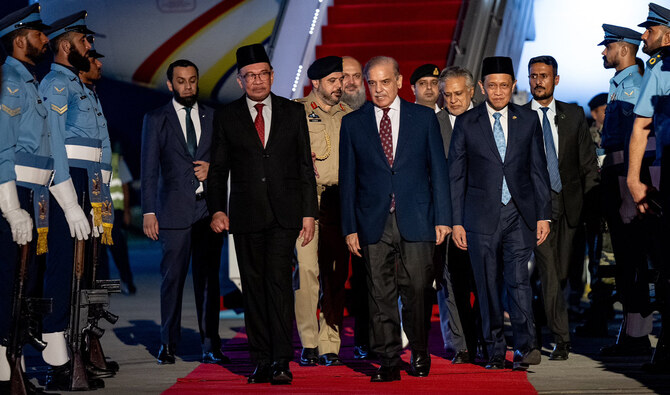
PM Shehbaz Sharif (center right) welcomes his Malaysian counterpart Dato' Seri Anwar Ibrahim (center left) as he arrives in Islamabad, Pakistan, on October 2, 2024. (@anwaribrahim/X)
Short Url
Updated 03 October 2024
Follow

Malaysian PM arrives in Pakistan to strengthen bilateral trade and investment ties

  • Malaysian PM arrives in Pakistan’s capital Islamabad on three-day visit with high-level delegation
  • Anwar Ibrahim will also participate in Pakistan-Malaysia Business to foster trade, investment ties

ISLAMABAD: Malaysian Prime Minister Dato’ Seri Anwar Ibrahim arrived in Islamabad on a three-day visit to the country on Wednesday, PM Shehbaz Sharif’s office said, with his visit aimed at strengthening bilateral cooperation between the two countries in trade, investment and other sectors. 

Pakistan and Malaysia enjoy a strong bilateral relationship, rooted in shared Islamic values and historical ties. Since 1957, they’ve fostered economic cooperation, defense collaborations, and cultural exchange. 

The Pakistan-Malaysia Free Trade Agreement of 2008 boosted trade and investment, while regular high-level visits have solidified their partnership, underpinned by mutual respect and trust. Ibrahim is being accompanied by a high-level delegation comprising Malaysian ministers, deputy ministers and senior officials.

Sharif welcomed his Malaysian counterpart and the high-level delegation upon their arrival in the capital, with senior Pakistani government officials by his side. 

“Pakistan-Malaysia bilateral cooperation will be discussed during the visit and important progress related to the partnership between the two countries will be made,” the Prime Minister’s Office (PMO) said. 

“The prime minister of Malaysia will also participate in the Pakistan-Malaysia Business Forum for cooperation in trade and investment between the two countries,” it added. 

Sharif’s office said Ibrahim will also meet Pakistani President Asif Ali Zardari during his visit. 

Pakistan’s foreign office said earlier this week that the two sides will discuss a wide-ranging agenda to further strengthen Pakistan-Malaysia ties. These diverse fields include trade, connectivity, energy, agriculture, halal industry, tourism, cultural exchanges and people-to-people contacts.

Bilateral trade between Pakistan and Malaysia was recorded at $1.5 billion in 2023-24. The major exports of Pakistan to Malaysia include rice, condensate oil, onions, potatoes, home textiles, corn, seafood, and meat, palm oil and its products, petroleum, LNG, computers and laptops, nonwoven wadding, and fiberboard, according to the High Commission of Pakistan in Malaysia.

Tourism between both countries has gained momentum over the past few years and Malaysia currently ranks among the top tourist source countries to Pakistan, the foreign office said. 

Around 160,000 Pakistani nationals are residing in Malaysia and over 3,800 students from Pakistan are also enrolled in Malaysian higher education institutes, making the country the third largest source of international students in Malaysia.

Pakistan is also one of the major workforce source countries for Malaysia in various key sectors including plantation, construction, manufacturing, agriculture and services, the foreign office said. 


Pakistan urges concessional finance for developing nations to boost clean energy security

Updated 11 January 2026
Follow

Pakistan urges concessional finance for developing nations to boost clean energy security

  • Pakistan has emerged as one of world’s fastest growing solar markets, with 12GWs of off-grid and 6GWs of net-metered capacity in 2025
  • PM’s aide says Islamabad remains committed to Paris Agreement, looks for continued support in building a resilient and low-carbon future

ISLAMABAD: Pakistan has urged international partners to scale up concessional financing for developing countries, the country’s Press Information Department (PID) said on Sunday, citing an aide to Prime Minister Shehbaz Sharif.

The call was made by Sharif’s coordinator on climate change, Romina Khurshid Alam, while delivering Pakistan’s national statement at the 16th International Renewable Energy Agency (IRENA) Assembly in Abu Dhabi.

Pakistan has emerged as one of the world’s fastest growing solar markets, with 12 gigawatts (GWs) of off-grid and over 6GWs of net-metered solar capacity by the end of 2025. Last fiscal year, renewables accounted for a historic 53 percent of total electricity generation, according to Alam.

The prime minister’s aide stressed that affordable funding for developing nations is critical to accelerating their transition to clean energy and strengthening energy security amid rising climate and economic challenges.

“Alam reaffirmed Pakistan’s target of achieving 60 percent renewables in the power mix by 2030,” the PID said in a statement.

“In her call to action, she urged IRENA and Member States to increase concessional finance for developing nations, treat technologies such as energy storage and green hydrogen as global public goods, and strengthen regional cooperation for shared energy security.”

IRENA is a global intergovernmental agency for energy transformation that serves as the principal platform for international cooperation, supports countries in their energy transition, and provides state of the art data and analyzes on technology, innovation, policy, finance and investment. Its membership comprises 170 countries and the European Union (EU).

The 16th session of the IRENA Assembly is taking place on Jan. 10-12 in Abu Dhabi and focuses on the theme of “Powering Humanity: Renewable Energy for Shared Prosperity.” The session has gathered global leaders and energy decision-makers to discuss strategies and underline necessary actions for the acceleration of renewable energy across countries, regions, and the world, driving economic inclusion, equity, and human well-being.

Alam shared that Pakistan is taking action against energy poverty through initiatives like the Punjab Solar Panel Scheme 2026, which provides free or subsidized systems to low-income households.

She highlighted how distributed solar kits have restored power and livelihoods in flood-affected communities and offer a replicable model for climate-resilient recovery.

“Pakistan remains fully committed to the Paris Agreement and looks to IRENA for continued technical and financial support in building a resilient, inclusive, and low-carbon future,” Alam said.

Adopted in 2015 to combat climate change, the Paris Agreement binds nations to hold “the increase in the global average temperature to well below 2°C above pre-industrial levels” and pursue efforts “to limit the temperature increase to 1.5°C above pre-industrial levels.”