

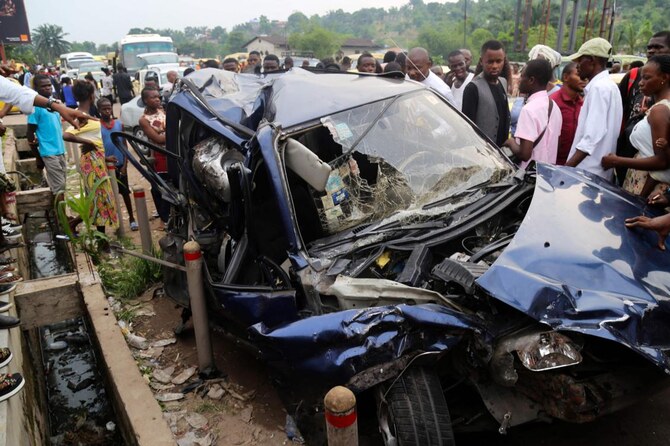

ADDIS ABABA: Africa has the fewest roads and cars of any region, and yet the largest ratio of vehicle deaths, caused by the usual suspects — unsafe habits, speeding and drinking — but also poor infrastructure, scant rescuers and old cars.
As everywhere, speed, alcohol and not wearing a seat belt or helmet are among the main causes of death and injury, say experts.
But in Africa, where there are 620 traffic deaths every day, these problems are compounded by bad roads, outdated vehicles, minimal prosecutions and a shortage of emergency services.
A recent World Health Organization report found that Africa surpassed the rest of the world, including Southeast Asia — which recorded the most road deaths — with a record ratio of 19.5 people killed per 100,000 inhabitants in 2021.
Home to only around four percent of the world’s automobiles, Africa accounted for 19 percent of road deaths last year.
“What is worrying is the upward trend in Africa,” said Jean Todt, a former head of the International Automobile Federation and now the United Nations(UN) special envoy for road safety.
The continent is the only region where road deaths increased between 2010 and 2021 — up 17 percent to 226,100. The spike was seen in more than half of Africa’s countries (28 out of 54).
The biggest victims are pedestrians, accounting for a third of fatalities due to a lack of adequate pavements, compared to 21 percent worldwide.
“We need to have better designed streets with sidewalks, adequate signage and pedestrian lanes, particularly around schools,” Todt said.
He also bemoaned the shortage of public transport for the rapidly urbanizing continent.
Urban planning is also at fault.
“Many African countries continue to design their infrastructure for motor vehicles and not for individuals, and without safety being the main concern,” said Haileyesus Adamtei, a transport expert at the World Bank.
Cars Quality
One major culprit is the quality of the cars plying Africa’s roads, with many more than 15 years old, according to the UN Road Safety Fund.
A transport ministry spokesperson in Senegal told AFP that faulty brakes and worn tires were common — and often deadly.
“The dilapidated state of vehicles is a major factor in the lack of safety,” the spokesperson said.
The West African country introduced a raft of new rules after a head-on crash between two night buses in January 2023 killed 40 people.
“But most have never been implemented,” the ministry spokesperson admitted.
Some rules, such as a ban on loading luggage on the roof of buses, which could unbalance the vehicle, were fiercely opposed by operators.
It does not help that drivers can often get a license with only perfunctory lessons and testing — often avoided altogether with a bribe.
Corruption also means that permissive law enforcement often sweeps many road safety violations under the carpet.
The UN has called for a “decade of action” to halve the number of road deaths by 2030.
Todt insists the aim is achievable and should top government agendas.
“Beyond the human tragedy, road crashes are also a major cause of slowdown in the development of a country, costing on average four to five percent of GDP, sometimes much more in Africa,” he said.


