

New polio cases surface as WHO says trachoma no longer ‘public health problem’ in Pakistan

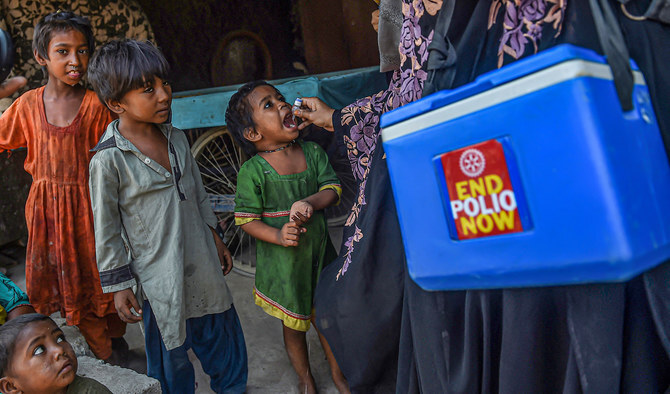
A health worker administers polio vaccine drops to a child during a vaccination campaign in Karachi, Pakistan, on October 24, 2022. (AFP/File)
Short Url
Updated 02 October 2024
Follow

New polio cases surface as WHO says trachoma no longer ‘public health problem’ in Pakistan

  • Fresh cases in Karachi and Sujawal in southern Sindh province bring 2024 nationwide polio tally to 26
  • Pakistan, along with neighboring Afghanistan, remains the last polio-endemic country in the world

KARACHI: Pakistan’s fight against the poliovirus suffered another setback as two new cases were reported in the southern Sindh province on Tuesday, the same day the World Health Organization (WHO) declared the trachoma blinding disease was no longer a “public health problem” in the South Asian country.

The latest polio cases, one in the Karachi East district and the other in the port city’s Sujawal district, brought the nationwide 2024 tally to 26, with 15 cases reported from Balochistan province, seven from Sindh, two from Khyber Pakhtunkhwa, and one each from Punjab and the federal capital, Islamabad.

“No child anywhere is safe until all children in Pakistan are repeatedly vaccinated for polio, building a wall of protection so the virus cannot break through,” the Prime Minister’s Focal Person for Polio Eradication, Ayesha Raza Farooq, said. 

The Pakistan polio program has said it is implementing a strategic roadmap to control virus spread and interrupt transmission by mid-2025.

Meanwhile, Prime Minister Shehbaz Sharif welcomed the elimination from the country of trachoma, a disease of the eye caused by infection with the chlamydia trachomatis bacterium, which can result in irreversible blindness if left untreated. Pakistan is the 19th country globally to eliminate the infectious disease, according to the WHO.

“It is hoped that this disease will never return to Pakistan,” Sharif said in televized comments on Tuesday evening, stressing the “urgent need” for Pakistan to eradicate polio and hepatitis as it had trachoma. 

“For this, we will always have to keep in place whatever preventive measures are there, and keep a very effective supervision and check and balance.”

Pakistan, along with neighboring Afghanistan, remains the last polio-endemic country in the world. Starting from late 2018, Pakistan saw a resurgence of cases and increased spread of polio, highlighting the fragility of gains achieved in the preceding three years.


79 foreign firms, including Middle Eastern investors, enter Pakistan in three years — SECP

Updated 6 sec ago
Follow

79 foreign firms, including Middle Eastern investors, enter Pakistan in three years — SECP

  • Foreign firms invested about $145 million across energy, logistics, IT and agriculture
  • Pakistani regulator says 19 companies exited market over the same three-year period

KARACHI: Middle Eastern energy and logistics companies including Saudi Aramco, Wafi Energy and DP World expanded their footprint in Pakistan, as 79 new foreign firms commenced operations in the country over the past three years, according to an official statement released on Tuesday.

The figures come as Pakistan seeks to rebuild investor confidence and attract foreign capital to shore up its economy after years of financial turbulence that saw foreign currency reserves shrink, the rupee weaken sharply and inflation surge. Islamabad has been pursuing structural reforms and courting overseas partners to stabilize growth and ease external financing pressures.

“79 new foreign companies commenced operations in Pakistan over the past three years, while foreign firms invested Rs 40.7 billion [$145 million] in key sectors during the same period,” the Securities and Exchange of Pakistan (SECP) said in a statement.

“A total of 61 foreign companies also carried out shareholding transactions involving local entities,” it added. “Of the 61 shareholding transactions, 29 involved transfers to other foreign companies, four to foreign individual investors, 20 to local individual investors, and eight to local corporate entities.”

According to the regulator, several transactions were linked to global corporate restructuring among multinational companies. Saudi Arabia’s Wafi Energy acquired Shell Pakistan’s operations, while Dubai-based PTA Global Holdings secured a majority stake in Lotte Chemical Pakistan.

Saudi Aramco purchased a 40 percent equity stake in Gas & Oil Pakistan Limited, and Switzerland’s Gunvor Group alongside Total Parco Limited acquired equal stakes in TotalEnergies Pakistan.

In logistics, UAE-based DP World entered into a joint venture with Pakistan’s National Logistics Corporation, while investments in the technology and telecommunications sectors included acquisitions and stake purchases involving regional and international firms.

The statement said 1,157 foreign companies are currently registered and operational in Pakistan, with 19 exits recorded over the past three years.