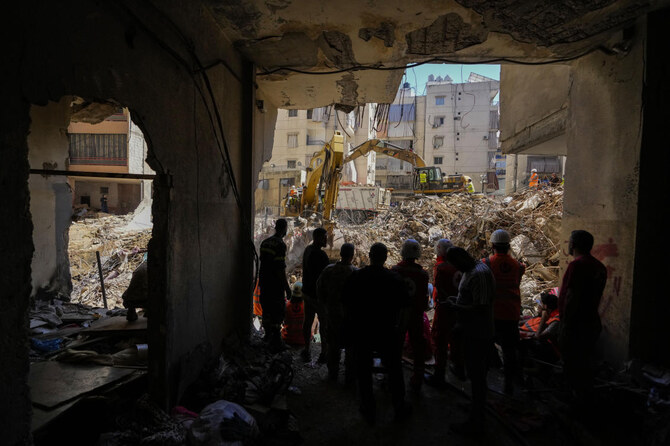
BEIRUT: Intense Israeli attacks may have forced up to a million people to flee parts of Lebanon in possibly the worst displacement crisis in the tiny country’s history, Prime Minister Najib Mikati said Sunday.
Mikati told reports that “the estimated number is very high and may reach one million” — which would amount to roughly a sixth of Lebanon’s population.
“It is the largest displacement movement that may have happened... in Lebanon,” he said.
On Friday, Israel killed Hezbollah’s powerful leader Hassan Nasrallah in a move many fear risks destabilising Lebanon and the wider region.
Since Monday, intense Israeli attacks across Lebanon’s east, south and on southern Beirut have killed hundreds of people and forced many to flee their homes.
Earlier this week, UN refugee chief Filippo Grandi said “well over 200,000 people are displaced inside Lebanon” and more than 50,000 had fled to neighboring Syria.
The intensive strikes come as Israel shifted the focus of its operation from Gaza to Lebanon, after nearly a year of cross-border fire with Hezbollah over the Gaza war, with the group saying it is acting in support of ally Hamas.

Lebanon may be seeing ‘largest displacement’ ever: PM
Short Url
https://arab.news/vc9rc
Lebanon may be seeing ‘largest displacement’ ever: PM
- Lebanon PM says up to 1 million may be displaced by Israel attacks
US military transfers first 150 Daesh detainees from Syria to Iraq
- Transfer follows Syrian government forces taking control of Al-Hol camp from SDF
- US Central Command says up to 7,000 detainees could be transferred to Iraqi-controlled facilities
AL-HOL, Syria: The US military said Wednesday it has started transferring detainees from the Daesh group being held in northeastern Syria to secure facilities in Iraq.
The move came after Syrian government forces took control of a sprawling camp, housing thousands of mostly women and children, from the US-backed Syrian Democratic Forces, or SDF, which withdrew as part of a ceasefire. Troops on Monday seized a prison in the northeastern town of Shaddadeh, where some Daesh detainees escaped and many were recaptured, state media reported.
The Kurdish-led SDF still controls more than a dozen detention facilities holding around 9,000 Daesh members.
US Central Command said the first transfer involved 150 Daesh members, who were taken from Syria’s northeastern province of Hassakah to “secure locations” in Iraq. The statement said that up to 7,000 detainees could be transferred to Iraqi-controlled facilities.
“Facilitating the orderly and secure transfer of Daesh detainees is critical to preventing a breakout that would pose a direct threat to the United States and regional security,” said Adm. Brad Cooper, CENTCOM commander. He said the transfer was in coordination with regional partners, including Iraq.
US troops and their partner forces detained more than 300 Daesh operatives in Syria and killed over 20 last year, the US military said. An ambush last month by Daesh militants killed two US soldiers and one American civilian interpreter in Syria.
An Iraqi intelligence general told The Associated Press that an agreement was reached with the US to transfer 7,000 detainees from Syria to Iraq. He said that Iraqi authorities received the first batch of 144 detainees Wednesday night, after which they will be transferred in stages by aircraft to Iraqi prisons.
The general, who spoke on condition of anonymity because he was not authorized to speak to the media, said the Daesh members who will be transferred to Iraq are of different nationalities. He said they include around 240 Tunisians, in addition to others from countries including Tajikistan and Kazakhstan and some Syrians.
“They will be interrogated and then put on trial. All of them are commanders in Daesh and are considered highly dangerous,” the general said. He added that in previous years, 3,194 Iraqi detainees and 47 French citizens have been transferred to Iraq.
Regional threat despite battle setbacks
The Daesh group was defeated in Iraq in 2017, and in Syria two years later, but the group’s sleeper cells still carry out deadly attacks in both countries. The SDF played a major role in defeating Daesh.
Tom Barrack, the US envoy to Syria, said in a statement on Tuesday that the SDF’s role as the primary anti-Daesh force “has largely expired, as Damascus is now both willing and positioned to take over security responsibilities.”
He added that the “recent developments show the US actively facilitating this transition, rather than prolonging a separate SDF role.”
Syria’s Foreign Ministry welcomed the transfer of detainees, calling it “an important step to strengthen security and stability.”
Earlier on Wednesday, a convoy of armored vehicles with government forces moved into the Al-Hol camp following two weeks of clashes with the SDF, which appeared closer to merging into the Syrian military, in accordance with government demands.
At its peak in 2019, some 73,000 people were living at Al-Hol. Their number has since declined with some countries repatriating their citizens.
The camp is still home to some 24,000, most of them women and children. They include about 14,500 Syrians and nearly 3,000 Iraqis. Some 6,500 others, many of them loyal Daesh supporters who came from around the world to join the extremist group, are separately held in a highly secured section of the camp.
The Syrian government and the SDF announced a new four-day truce on late Tuesday after a previous ceasefire broke down.
The move came after Syrian government forces took control of a sprawling camp, housing thousands of mostly women and children, from the US-backed Syrian Democratic Forces, or SDF, which withdrew as part of a ceasefire. Troops on Monday seized a prison in the northeastern town of Shaddadeh, where some Daesh detainees escaped and many were recaptured, state media reported.
The Kurdish-led SDF still controls more than a dozen detention facilities holding around 9,000 Daesh members.
US Central Command said the first transfer involved 150 Daesh members, who were taken from Syria’s northeastern province of Hassakah to “secure locations” in Iraq. The statement said that up to 7,000 detainees could be transferred to Iraqi-controlled facilities.
“Facilitating the orderly and secure transfer of Daesh detainees is critical to preventing a breakout that would pose a direct threat to the United States and regional security,” said Adm. Brad Cooper, CENTCOM commander. He said the transfer was in coordination with regional partners, including Iraq.
US troops and their partner forces detained more than 300 Daesh operatives in Syria and killed over 20 last year, the US military said. An ambush last month by Daesh militants killed two US soldiers and one American civilian interpreter in Syria.
An Iraqi intelligence general told The Associated Press that an agreement was reached with the US to transfer 7,000 detainees from Syria to Iraq. He said that Iraqi authorities received the first batch of 144 detainees Wednesday night, after which they will be transferred in stages by aircraft to Iraqi prisons.
The general, who spoke on condition of anonymity because he was not authorized to speak to the media, said the Daesh members who will be transferred to Iraq are of different nationalities. He said they include around 240 Tunisians, in addition to others from countries including Tajikistan and Kazakhstan and some Syrians.
“They will be interrogated and then put on trial. All of them are commanders in Daesh and are considered highly dangerous,” the general said. He added that in previous years, 3,194 Iraqi detainees and 47 French citizens have been transferred to Iraq.
Regional threat despite battle setbacks
The Daesh group was defeated in Iraq in 2017, and in Syria two years later, but the group’s sleeper cells still carry out deadly attacks in both countries. The SDF played a major role in defeating Daesh.
Tom Barrack, the US envoy to Syria, said in a statement on Tuesday that the SDF’s role as the primary anti-Daesh force “has largely expired, as Damascus is now both willing and positioned to take over security responsibilities.”
He added that the “recent developments show the US actively facilitating this transition, rather than prolonging a separate SDF role.”
Syria’s Foreign Ministry welcomed the transfer of detainees, calling it “an important step to strengthen security and stability.”
Earlier on Wednesday, a convoy of armored vehicles with government forces moved into the Al-Hol camp following two weeks of clashes with the SDF, which appeared closer to merging into the Syrian military, in accordance with government demands.
At its peak in 2019, some 73,000 people were living at Al-Hol. Their number has since declined with some countries repatriating their citizens.
The camp is still home to some 24,000, most of them women and children. They include about 14,500 Syrians and nearly 3,000 Iraqis. Some 6,500 others, many of them loyal Daesh supporters who came from around the world to join the extremist group, are separately held in a highly secured section of the camp.
The Syrian government and the SDF announced a new four-day truce on late Tuesday after a previous ceasefire broke down.
© 2026 SAUDI RESEARCH & PUBLISHING COMPANY, All Rights Reserved And subject to Terms of Use Agreement.


