

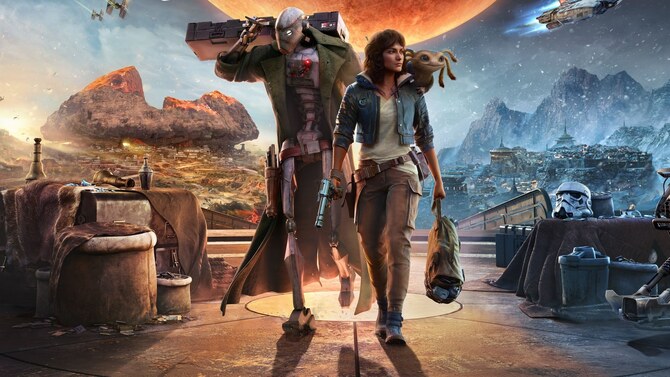

LONDON: Ubisoft’s Star Wars Outlaws presents an ambitious entry in the Star Wars gaming universe as the first-ever open-world instalment, set between the events of The Empire Strikes Back and Return of the Jedi.
This game delivers an immersive crime-driven narrative that fans have long awaited, blending the familiar allure of Star Wars with gameplay mechanics reminiscent of Far Cry and Grand Theft Auto. But does it live up to the galaxy-sized expectations? Let us dive in.
The game transports players to a vibrant, morally grey underworld that feels like a perfect fit for its “original scoundrel story.” Set during the dark times of the Galactic Empire’s reign, players control Kay Vess, a resourceful outlaw who navigates the dangerous landscape of crime syndicates, shifting alliances, and backstabbing enemies.
The central narrative takes place on planets like Canto, with Kay caught between the Empire and the criminal underworld. Star Wars lore weaves seamlessly into the experience, as conversations with non-player characters and your adorable companion, Nix, help flesh out the galaxy and its struggles.
The world-building is a strong point here. Kay’s story encourages players to explore the Star Wars galaxy from a new perspective, absent of the high politics and philosophy of the Jedi. Conversations and side quests emphasize trust and reputation, providing players the freedom to “play the underworld to their advantage” and manipulate situations.
Side quests, however, tend to fall into the familiar territory of fetch tasks, limiting their creativity, but they do provide extra opportunities to engage with the game’s rich environments.
If you have ever wondered what Grand Theft Auto in space would feel like, Star Wars Outlaws gets pretty close. There is a wanted system that escalates based on your actions, adding tension to missions as you are pursued by law enforcement or bounty hunters.
The addition of slow-motion shooting mechanics adds flair, letting players make quick decisions in high-intensity moments. Combat feels satisfying, though not revolutionary, and can occasionally feel repetitive, especially when coupled with enemy artificial intelligence that does not always present a significant challenge.
Where the game shines are in its traversal mechanics. Kay’s grappling hook, stealth missions, and use of vents (which admittedly feel overused at times) allow her to sneak through the environment, offering a variety of ways to approach objectives.
There is an undeniable rush from slowing down time in mid-air during combat, but the over-reliance on certain movement tactics, like jumping and climbing, can make the gameplay feel a bit predictable.
Vehicles such as Kay’s Trailblazer spaceship and her customizable speeder bike help flesh out the Star Wars experience. While upgrades to the bike provide some sense of progression, it is the exploration aspect — flying to different planets, speeding through landscapes — that evokes the most excitement.
The inclusion of side activities, like changing music on a jukebox, learning a card game, or playing an arcade game, adds to the immersion and keeps things light when you want a break from the main story.
One glaring issue lies with the game’s technical performance. Glitches, like floating stormtroopers and awkward animations, break immersion at times. While Ubisoft is known for polishing its games post-launch, these bugs can pull players out of an otherwise engaging world.
Another point of contention is the enemy AI, which can feel lackluster. Too often, enemies fail to present a strategic challenge, relying more on brute force than intelligent tactics. This can make some combat scenarios feel repetitive.
Star Wars Outlaws is an impressive open-world experiment in the Star Wars universe. The narrative is compelling, the world immersive, and the core mechanics — while not perfect — offer enough to keep players engaged.
However, a lack of variety in missions, occasional bugs, and underwhelming enemy AI keep it from being a true standout. With a bit more refinement, this could be the definitive Star Wars game for fans of open-world exploration.
For now, it is a solid adventure with potential for more.


