Katmandu, Nepal: Nepal has shut schools for three days after landslides and floods triggered by two days of heavy rain across the Himalayan nation killed 151 people, with 56 missing, officials said on Sunday.
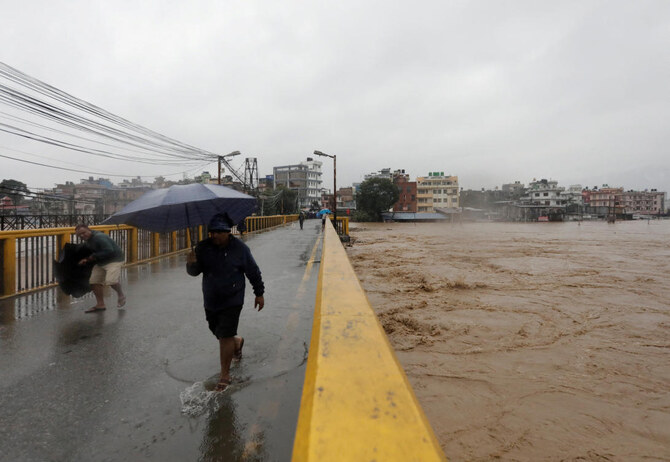
The floods brought traffic and normal activity to a standstill in the Katmandu valley, where 37 deaths were recorded in a region home to 4 million people and the capital.
Authorities said students and their parents faced difficulties as university and school buildings damaged by the rains needed repair.
“We have urged the concerned authorities to close schools in the affected areas for three days,” Lakshmi Bhattarai, a spokesperson for the education ministry, told Reuters.
Some parts of the capital reported rain of up to 322.2 mm (12.7 inches), pushing the level of its main Bagmati river up 2.2 m (7 ft) past the danger mark, experts said.
But there were some signs of respite on Sunday morning, with the rains easing in many places, said Govinda Jha, a weather forecaster in the capital.
“There may be some isolated showers, but heavy rains are unlikely,” he said.
Television images showed police rescuers in knee-high rubber boots using picks and shovels to clear away mud and retrieve 16 bodies of passengers from two buses swept away by a massive landslide at a site on the key route into Katmandu.
Weather officials in the capital blamed the rainstorms on a low-pressure system in the Bay of Bengal extending over parts of neighboring India close to Nepal.
Haphazard development amplifies climate change risks in Nepal, say climate scientists at the International Center for Integrated Mountain Development (ICIMOD).
“I’ve never before seen flooding on this scale in Katmandu,” said Arun Bhakta Shrestha, an environmental risk official at the center.
In a statement, it urged the government and city planners to “urgently” step up investment in, and plans for, infrastructure, such as underground stormwater and sewage systems, both of the “grey,” or engineered kind, and “green,” or nature-based type.
The impact of the rains was aggravated by poor drainage due to unplanned settlement and urbanization efforts, construction on floodplains, lack of areas for water retention, and encroachment on the Bagmati river, it added.
The level in the Koshi river in Nepal’s southeast has started to fall, however, said Ram Chandra Tiwari, the region’s top bureaucrat.
The river, which brings deadly floods to India’s eastern state of Bihar nearly every year, had been running above the danger mark at a level nearly three times normal, he said.


Nepal closes schools as deaths from heavy rains hit 151
https://arab.news/6ajc4
Nepal closes schools as deaths from heavy rains hit 151

- Rescue, recovery and clean-up efforts underway
- The floods brought traffic and normal activity to a standstill


Philippines seeks to regain Chinese visitors as arrivals lag behind regional rivals
- 262,000 Chinese tourists visited Philippines in 2025, compared to 1.7m in 2019
- Vietnam is top destination for Chinese travelers, with about 4.8m visitors this year
MANILLA: The Philippines is trailing behind other countries in Southeast Asia in winning back Chinese tourists, with arrivals well below a quarter of pre-pandemic levels so far this year, latest data showed.
Known for its white sandy beaches, famous diving spots and diverse culture, the Philippines was welcoming an increasing number of Chinese tourists in the period before the pandemic, with the number peaking at over 1.7 million in 2019, when it was the second-largest source market after South Korea.
But the post-pandemic rebound has been slow, with China ranking sixth among international arrivals and the number of Chinese visitors reaching only 262,000 as of Dec. 20, according to data from the Philippine Department of Tourism.
“China remains one of the country’s largest and most important source markets,” the tourism department said earlier this week.
Chinese arrivals this year are equivalent to only around 15 percent of the numbers in 2019 and there is stiff competition with regional rivals like Vietnam, Thailand, Malaysia, Singapore and Indonesia each welcoming at least 1 million tourists from China in 2025.
Vietnam has become Chinese travelers’ top travel destination in Southeast Asia with around 4.8 million visitors so far this year, followed by Thailand, which has recorded about 4.36 million.
China is Singapore’s top source market, with nearly 3 million visitors as of November.
To attract more visitors from China, the Philippines reintroduced electronic visas for Chinese travelers in November, after suspending the system for two years.
“The eVisa resumption is a critical step forward and a clear signal that the Philippines is open, ready, and eager to welcome our Chinese friends,” said Ireneo Reyes, the tourism attache to China.
“While the timing meant that its full benefits could not be felt within the peak booking periods of 2025, we expect a more visible impact beginning the first quarter of 2026.”
The Philippine tourism department said that “recovery has also been constrained by reduced flight capacity, with China-Philippines routes operating at only about 45 percent of pre-pandemic levels,” adding that officials were working closely with relevant stakeholders to “rebuild connectivity and confidence.”
Tourism is an important sector in the Philippine economy, according to a report by the ASEAN+3 Macroeconomic Research Office, accounting for about 13.2 percent of the country’s gross domestic product last year and making up around 13.8 percent of its labor force.


