

Pakistani diplomat at UN accuses India of sponsoring militants, mistreating minorities

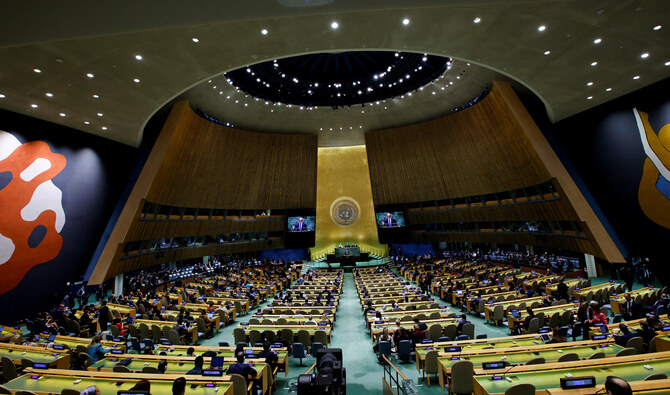
Pakistan Prime Minister Shehbaz Sharif addresses the 79th United Nations General Assembly at UN headquarters in New York, US on September 27, 2024. (REUTERS)
Short Url
Updated 28 September 2024
Follow

Pakistani diplomat at UN accuses India of sponsoring militants, mistreating minorities

  • Pakistan says India’s ‘terrorist franchise has gone global,’ targeting political dissidents in North America
  • Pakistani diplomat issued the statement after India accused his country of hosting Al Qaeda founder

ISLAMABAD: A Pakistani diplomat at the United Nations responded to India’s assertions against his country on Saturday, accusing New Delhi of sponsoring armed factions targeting Pakistani civilians and mistreating religious minorities.
The riposte came after an Indian diplomat exercised the Right of Reply following Prime Minister Shehbaz Sharif’s United Nations General Assembly speech, which was critical of New Delhi.
The Indian diplomat said Pakistan was “run by the military, with a global reputation for terrorism,” yet it had “the audacity to attack the world’s largest democracy.”
She also maintained that Islamabad had pursued a policy of “cross-border terrorism” against her country and had “hosted Osama bin Laden” for a long time.
“India continues to sponsor [terrorist] activities not only against Pakistan but also in other countries,” Muhammad Faheem, Third Secretary at the Pakistan Mission, told the world body.
“For decades, India has been the primary perpetrator, supporter and financer of terrorism,” he continued. “India’s sponsorship of terrorist organizations, such as Tehreek-e-Taliban Pakistan and the Balochistan Liberation Army, has led to the loss of thousands of innocent Pakistani lives.”
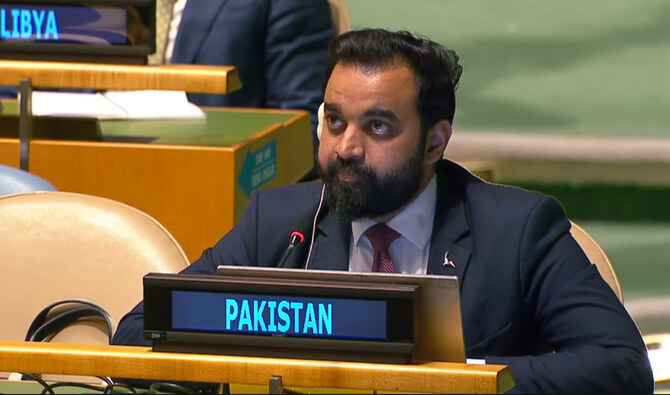


Muhammad Faheem, Third Secretary Pakistan UN Mission, speaks during a UNGA meeting at the United Nations Headquarters in New York on September 28, 2024. (Photo courtesy: Screengrab/UN)

Faheem said his country had shared evidence of Indian activities with the international community.
“Now, the Indian terrorist franchise has gone global, with assassinations and attempted murders of political dissidents on North American soil,” he added.
Pakistan has long accused India of sponsoring the anti-Pakistan militant factions which New Delhi has dismissed in the past.
India also faced diplomatic pressure due to its suspected involvement in the murder of a Sikh dissident in North America, Hardeep Singh Nijjar, who was based in Canada and was a prominent leader of the separatist Khalistan movement.
Nijjar was killed last year in June, and Canada publicly accused India of being involved in his assassination, sparking a diplomatic row between the two countries.
The United States also urged India to cooperate with Canada’s investigation into the murder.
The situation further complicated for New Delhi after an attempted assassination was of another Sikh dissident was reported, this time in the US.
The Pakistani diplomat also highlighted Indian “occupation” of Kashmir and said it had unleashed a “reign of terror” against its minorities.
Prime Minister Sharif had also criticized India for running a “settler-colonial project” in the disputed Himalayan territory by seizing Kashmiri lands and properties and trying to change the demographics of the Muslim-majority region.
So far, India has not responded to the Pakistani diplomat’s statement.


Pakistan army hits Afghan Taliban drone storage facility, ammunition depot in Jalalabad

Updated 02 March 2026
Follow

Pakistan army hits Afghan Taliban drone storage facility, ammunition depot in Jalalabad

  • Around 435 Afghan Taliban fighters killed, over 630 injured in Pakistani military offensive, minister says
  • Several countries, global bodies have urged both sides to exercise restraint since the conflict began last week

ISLAMABAD: Pakistan’s army struck a drone storage facility and ammunition depot of Afghan Taliban in Jalalabad, a Pakistani security official said on Monday, following Pakistani strikes on more than 50 locations in Afghanistan amid ongoing hostilities between the neighbors.

Pakistan launched Operation ‘Ghazb lil Haq’ against Afghanistan on the night of Feb. 26 following an attack by Afghanistan on Pakistani military installations along their shared border.

The worst fighting between the two neighbors in years erupted after Pakistani airstrikes targeted what Islamabad called militant hideouts inside Afghanistan on Feb. 21-22, accusing Kabul of harboring Tehreek-e-Taliban Pakistan (TTP) militants behind the attacks on its soil. Afghanistan denies the charge.

A Pakistani security official, who requested anonymity, said the army was continuing “strong retaliatory action” against the Afghan Taliban and blew up multiple border posts, forcing them to abandon their positions.

“Pakistan forces are effectively targeting the bases and military installations of the Fitna Al-Khawarij and the Afghan Taliban,” he said.

“During the effective counter-operation of the Pakistani forces, the ammunition depot and drone storage site of Fitna Al-Khawarij (TTP) and the Afghan Taliban in Jalalabad was destroyed.”

Separately, Pakistan’s Information Minister Attaullah Tarar said more than 400 Afghan Taliban fighters had been killed and over 630 wounded in the Pakistani military offensive so far.

Pakistan destroyed around 188 check posts and captured 31, according to a post on X by Tarar. Over 180 tanks, armored vehicles and artillery guns were also destroyed in Pakistani air raids at 51 locations across Afghanistan.

On Sunday, Pakistani state media shared a video of what it said were Pakistani soldiers crossing into Afghanistan in the northwest to capture an Afghan post. Pakistan has seized a 32-square-kilometer area of Afghanistan, another Pakistani security official said.

Afghan officials earlier said that dozens of Pakistani soldiers had been killed and several Pakistan posts had been captured by their forces. None of the casualty figures or battlefield claims from either side could be independently verified.

Since the conflict began last week, diplomatic efforts have intensified, with several countries and international bodies calling on both sides to exercise restraint.

The United Nations, along with China and Russia, has called for calm, while US President Donald Trump said Pakistan has the right to defend itself against cross-border militancy.